Comparison map
Amines, Biomolecules, and Polymers: relationships and examples
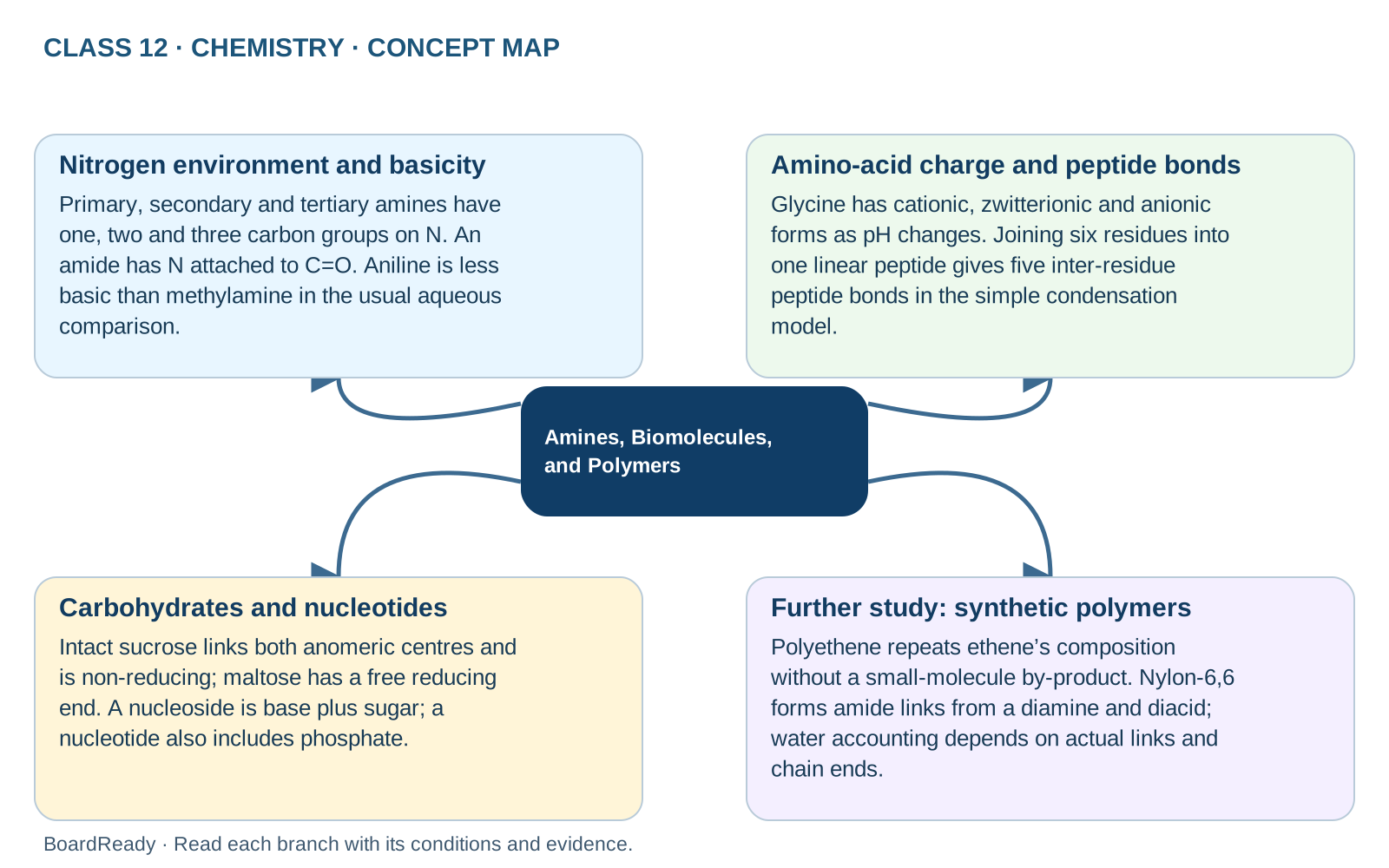
Classify the nitrogen environment, identify biomolecular linkages and count polymer units without mixing categories. Nitrogen environment and basicity: Primary, secondary and tertiary amines have one, two and three carbon groups on N. An amide has N attached to C=O. Aniline is less basic than methylamine in the usual aqueous comparison. Amino-acid charge and peptide bonds: Glycine has cationic, zwitterionic and anionic forms as pH changes. Joining six residues into one linear peptide gives five inter-residue peptide bonds in the simple condensation model. Carbohydrates and nucleotides: Intact sucrose links both anomeric centres and is non-reducing; maltose has a free reducing end. A nucleoside is base plus sugar; a nucleotide also includes phosphate. Further study: synthetic polymers: Polyethene repeats ethene’s composition without a small-molecule by-product. Nylon-6,6 forms amide links from a diamine and diacid; water accounting depends on actual links and chain ends.Exam cue: Count groups directly bonded to N before classifying an amine. For biomolecules identify charge state, units and linkages; distinguish denaturation from peptide hydrolysis. For synthetic polymers, separate a bracketed repeating unit from a complete chain with end groups.
- 1Amines, Biomolecules, and Polymers -> Nitrogen environment and basicity: Primary, secondary and tertiary amines have one, two and three carbon groups on N. An amide has N attached to C=O. Aniline is less basic than methylamine in the usual aqueous comparison.
- 2Amines, Biomolecules, and Polymers -> Amino-acid charge and peptide bonds: Glycine has cationic, zwitterionic and anionic forms as pH changes. Joining six residues into one linear peptide gives five inter-residue peptide bonds in the simple condensation model.
- 3Amines, Biomolecules, and Polymers -> Carbohydrates and nucleotides: Intact sucrose links both anomeric centres and is non-reducing; maltose has a free reducing end. A nucleoside is base plus sugar; a nucleotide also includes phosphate.
- 4Amines, Biomolecules, and Polymers -> Further study: synthetic polymers: Polyethene repeats ethene’s composition without a small-molecule by-product. Nylon-6,6 forms amide links from a diamine and diacid; water accounting depends on actual links and chain ends.