Comparison map
Aldehydes, Ketones, and Carboxylic Acids: relationships and examples
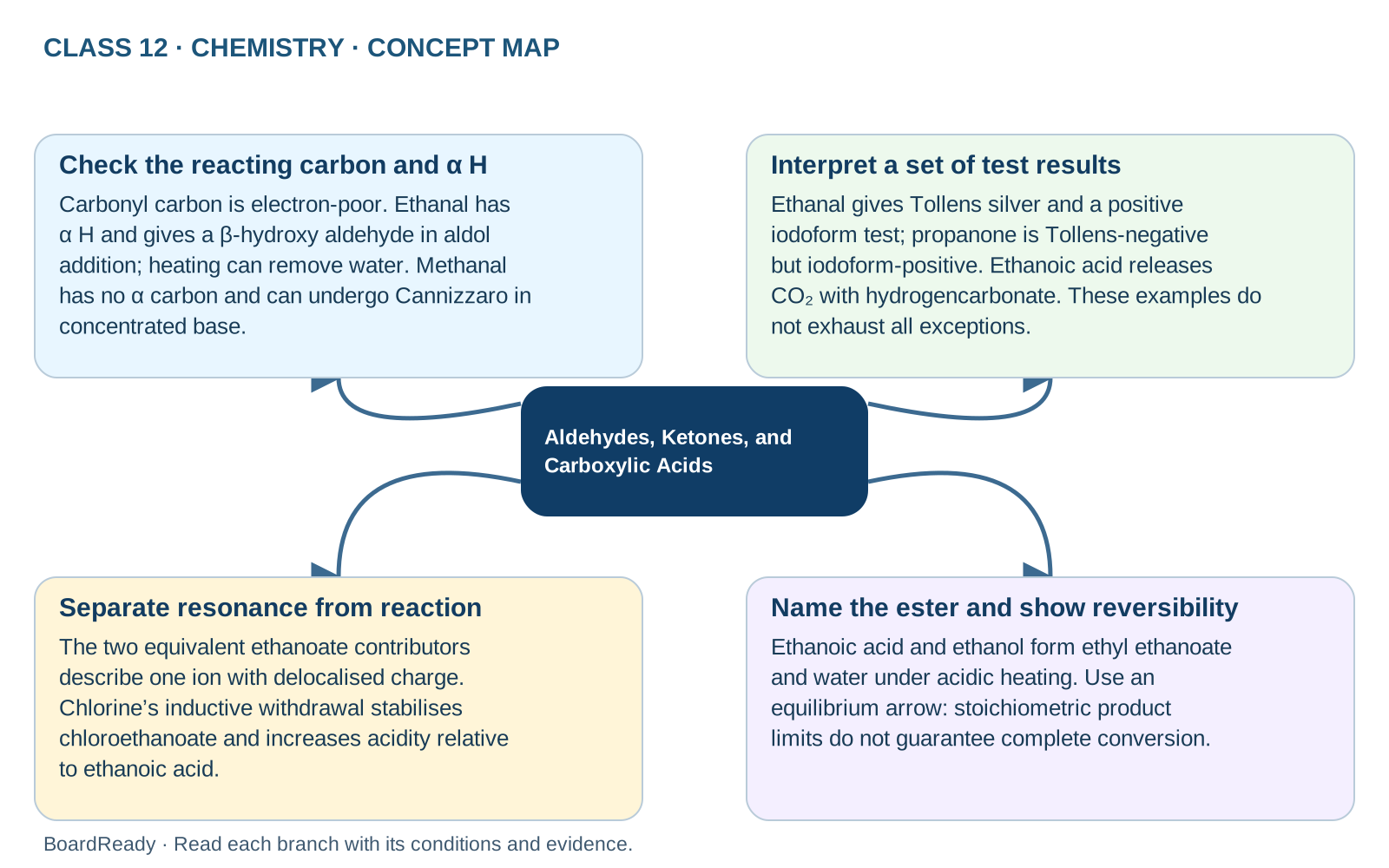
Use carbonyl connectivity, α-hydrogen availability and conditions to connect reactions with their evidence. Check the reacting carbon and α H: Carbonyl carbon is electron-poor. Ethanal has α H and gives a β-hydroxy aldehyde in aldol addition; heating can remove water. Methanal has no α carbon and can undergo Cannizzaro in concentrated base. Interpret a set of test results: Ethanal gives Tollens silver and a positive iodoform test; propanone is Tollens-negative but iodoform-positive. Ethanoic acid releases CO₂ with hydrogencarbonate. These examples do not exhaust all exceptions. Separate resonance from reaction: The two equivalent ethanoate contributors describe one ion with delocalised charge. Chlorine’s inductive withdrawal stabilises chloroethanoate and increases acidity relative to ethanoic acid. Name the ester and show reversibility: Ethanoic acid and ethanol form ethyl ethanoate and water under acidic heating. Use an equilibrium arrow: stoichiometric product limits do not guarantee complete conversion.Exam cue: Identify functional group, α H and reagent conditions before choosing a named reaction. Keep test evidence conditional, distinguish carboxylate in alkaline solution from free acid after work-up, and use resonance arrows only between contributors of the same ion.
- 1Aldehydes, Ketones, and Carboxylic Acids -> Check the reacting carbon and α H: Carbonyl carbon is electron-poor. Ethanal has α H and gives a β-hydroxy aldehyde in aldol addition; heating can remove water. Methanal has no α carbon and can undergo Cannizzaro in concentrated base.
- 2Aldehydes, Ketones, and Carboxylic Acids -> Interpret a set of test results: Ethanal gives Tollens silver and a positive iodoform test; propanone is Tollens-negative but iodoform-positive. Ethanoic acid releases CO₂ with hydrogencarbonate. These examples do not exhaust all exceptions.
- 3Aldehydes, Ketones, and Carboxylic Acids -> Separate resonance from reaction: The two equivalent ethanoate contributors describe one ion with delocalised charge. Chlorine’s inductive withdrawal stabilises chloroethanoate and increases acidity relative to ethanoic acid.
- 4Aldehydes, Ketones, and Carboxylic Acids -> Name the ester and show reversibility: Ethanoic acid and ethanol form ethyl ethanoate and water under acidic heating. Use an equilibrium arrow: stoichiometric product limits do not guarantee complete conversion.