Comparison map
Alcohols, Phenols, and Ethers: relationships and examples
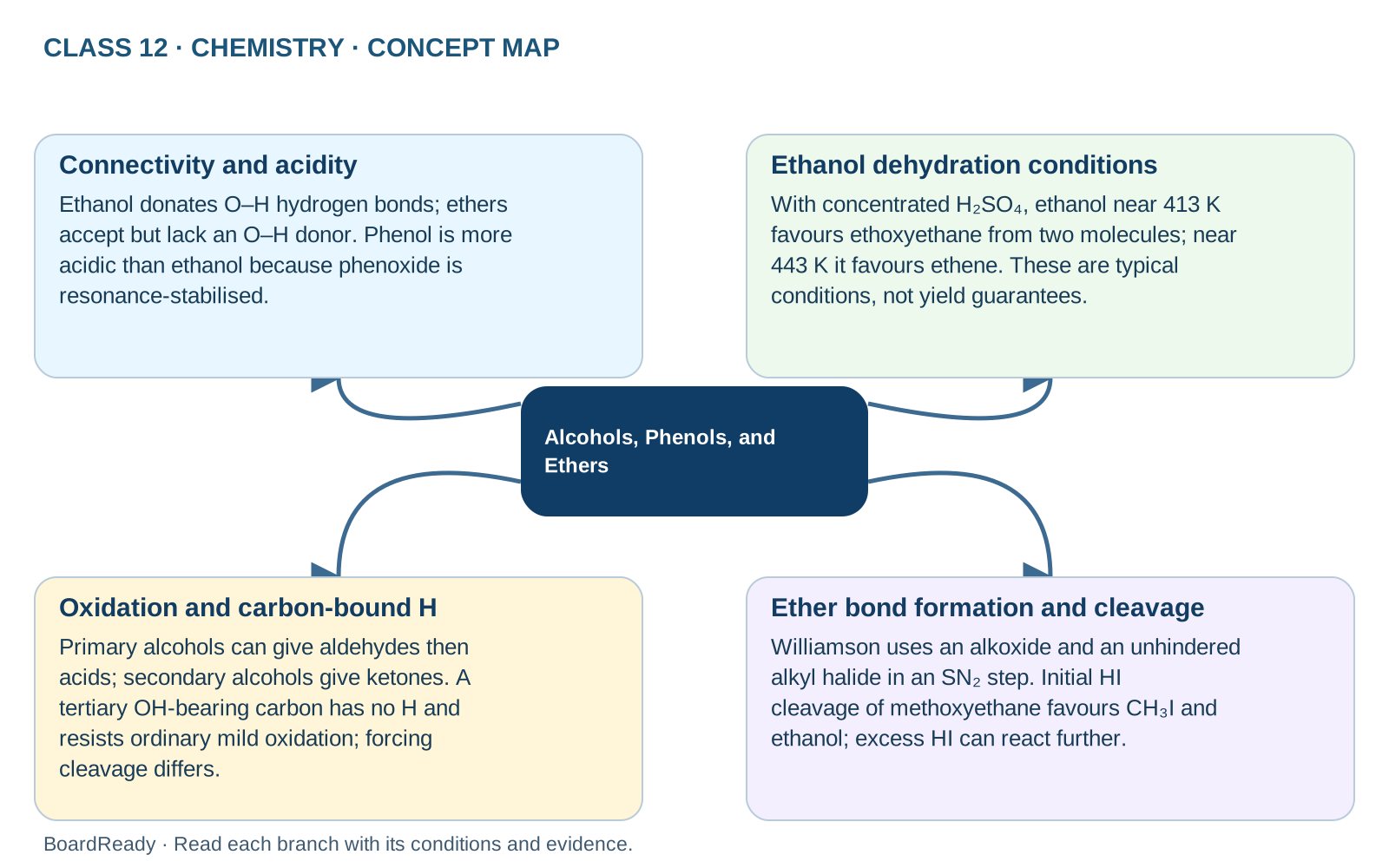
Connect oxygen-group location with hydrogen bonding, acidity, oxidation and condition-dependent reactions. Connectivity and acidity: Ethanol donates O–H hydrogen bonds; ethers accept but lack an O–H donor. Phenol is more acidic than ethanol because phenoxide is resonance-stabilised. Ethanol dehydration conditions: With concentrated H₂SO₄, ethanol near 413 K favours ethoxyethane from two molecules; near 443 K it favours ethene. These are typical conditions, not yield guarantees. Oxidation and carbon-bound H: Primary alcohols can give aldehydes then acids; secondary alcohols give ketones. A tertiary OH-bearing carbon has no H and resists ordinary mild oxidation; forcing cleavage differs. Ether bond formation and cleavage: Williamson uses an alkoxide and an unhindered alkyl halide in an SN₂ step. Initial HI cleavage of methoxyethane favours CH₃I and ethanol; excess HI can react further.Exam cue: Specify functional-group connectivity, reagents and conditions. Keep O–H hydrogen bonding separate from H on the carbon bearing OH; the first helps explain physical properties and the second helps explain ordinary alcohol oxidation.
- 1Alcohols, Phenols, and Ethers -> Connectivity and acidity: Ethanol donates O–H hydrogen bonds; ethers accept but lack an O–H donor. Phenol is more acidic than ethanol because phenoxide is resonance-stabilised.
- 2Alcohols, Phenols, and Ethers -> Ethanol dehydration conditions: With concentrated H₂SO₄, ethanol near 413 K favours ethoxyethane from two molecules; near 443 K it favours ethene. These are typical conditions, not yield guarantees.
- 3Alcohols, Phenols, and Ethers -> Oxidation and carbon-bound H: Primary alcohols can give aldehydes then acids; secondary alcohols give ketones. A tertiary OH-bearing carbon has no H and resists ordinary mild oxidation; forcing cleavage differs.
- 4Alcohols, Phenols, and Ethers -> Ether bond formation and cleavage: Williamson uses an alkoxide and an unhindered alkyl halide in an SN₂ step. Initial HI cleavage of methoxyethane favours CH₃I and ethanol; excess HI can react further.