Comparison map
Strategies for Enhancement in Food Production: relationships and examples
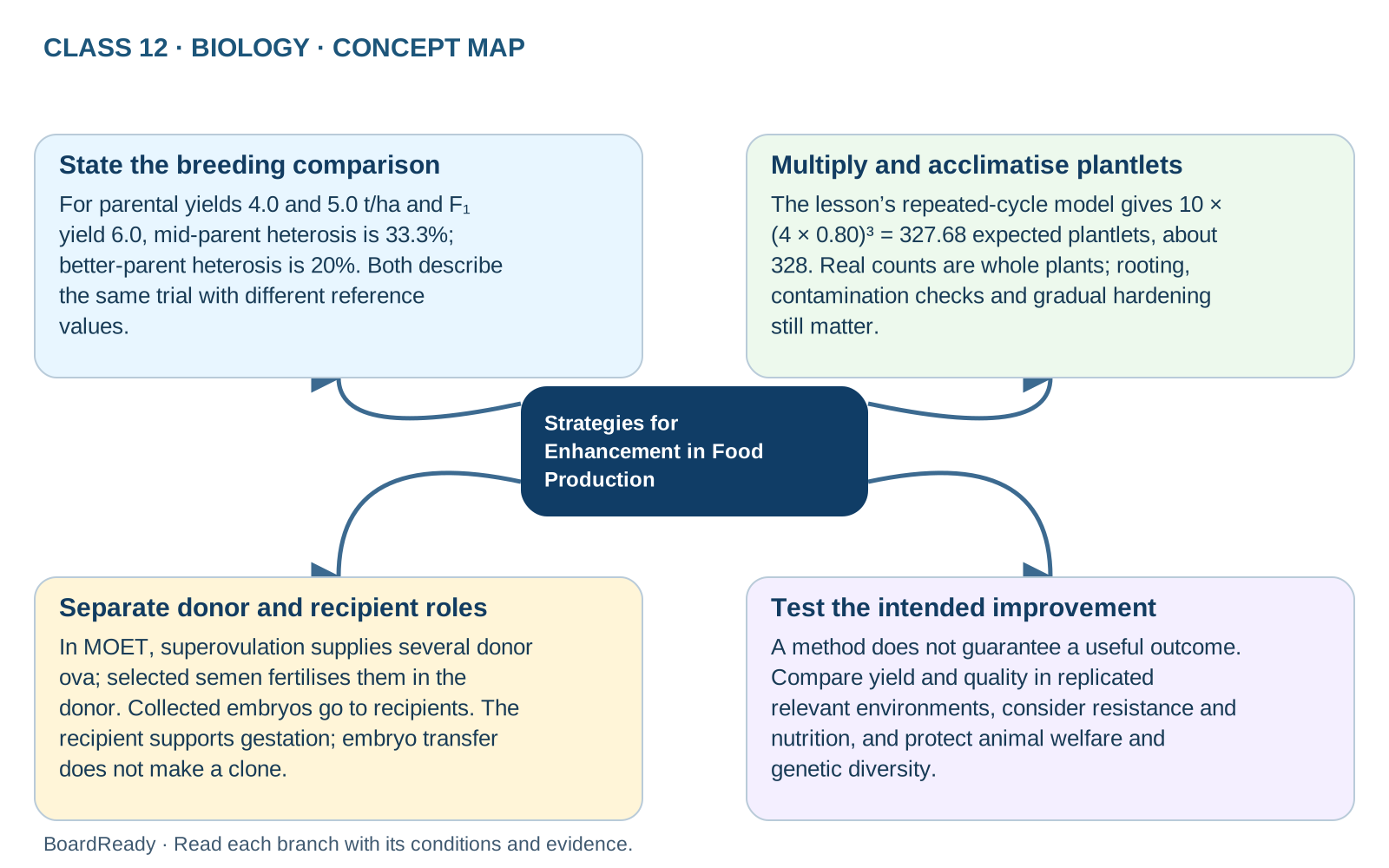
Match an improvement method to its biological mechanism, measured outcome and limits. Keep creating variation, multiplying material and evaluating performance distinct. State the breeding comparison: For parental yields 4.0 and 5.0 t/ha and F₁ yield 6.0, mid-parent heterosis is 33.3%; better-parent heterosis is 20%. Both describe the same trial with different reference values. Multiply and acclimatise plantlets: The lesson’s repeated-cycle model gives 10 × (4 × 0.80)³ = 327.68 expected plantlets, about 328. Real counts are whole plants; rooting, contamination checks and gradual hardening still matter. Separate donor and recipient roles: In MOET, superovulation supplies several donor ova; selected semen fertilises them in the donor. Collected embryos go to recipients. The recipient supports gestation; embryo transfer does not make a clone. Test the intended improvement: A method does not guarantee a useful outcome. Compare yield and quality in replicated relevant environments, consider resistance and nutrition, and protect animal welfare and genetic diversity.Exam cue: Name the target trait and method, identify what is inherited or multiplied, and state how improvement is measured. A numerical expectation is not guaranteed output, and a favourable result in one trial is not a universal recommendation.
- 1Strategies for Enhancement in Food Production -> State the breeding comparison: For parental yields 4.0 and 5.0 t/ha and F₁ yield 6.0, mid-parent heterosis is 33.3%; better-parent heterosis is 20%. Both describe the same trial with different reference values.
- 2Strategies for Enhancement in Food Production -> Multiply and acclimatise plantlets: The lesson’s repeated-cycle model gives 10 × (4 × 0.80)³ = 327.68 expected plantlets, about 328. Real counts are whole plants; rooting, contamination checks and gradual hardening still matter.
- 3Strategies for Enhancement in Food Production -> Separate donor and recipient roles: In MOET, superovulation supplies several donor ova; selected semen fertilises them in the donor. Collected embryos go to recipients. The recipient supports gestation; embryo transfer does not make a clone.
- 4Strategies for Enhancement in Food Production -> Test the intended improvement: A method does not guarantee a useful outcome. Compare yield and quality in replicated relevant environments, consider resistance and nutrition, and protect animal welfare and genetic diversity.