Comparison map
Microbes and Food Production: relationships and examples
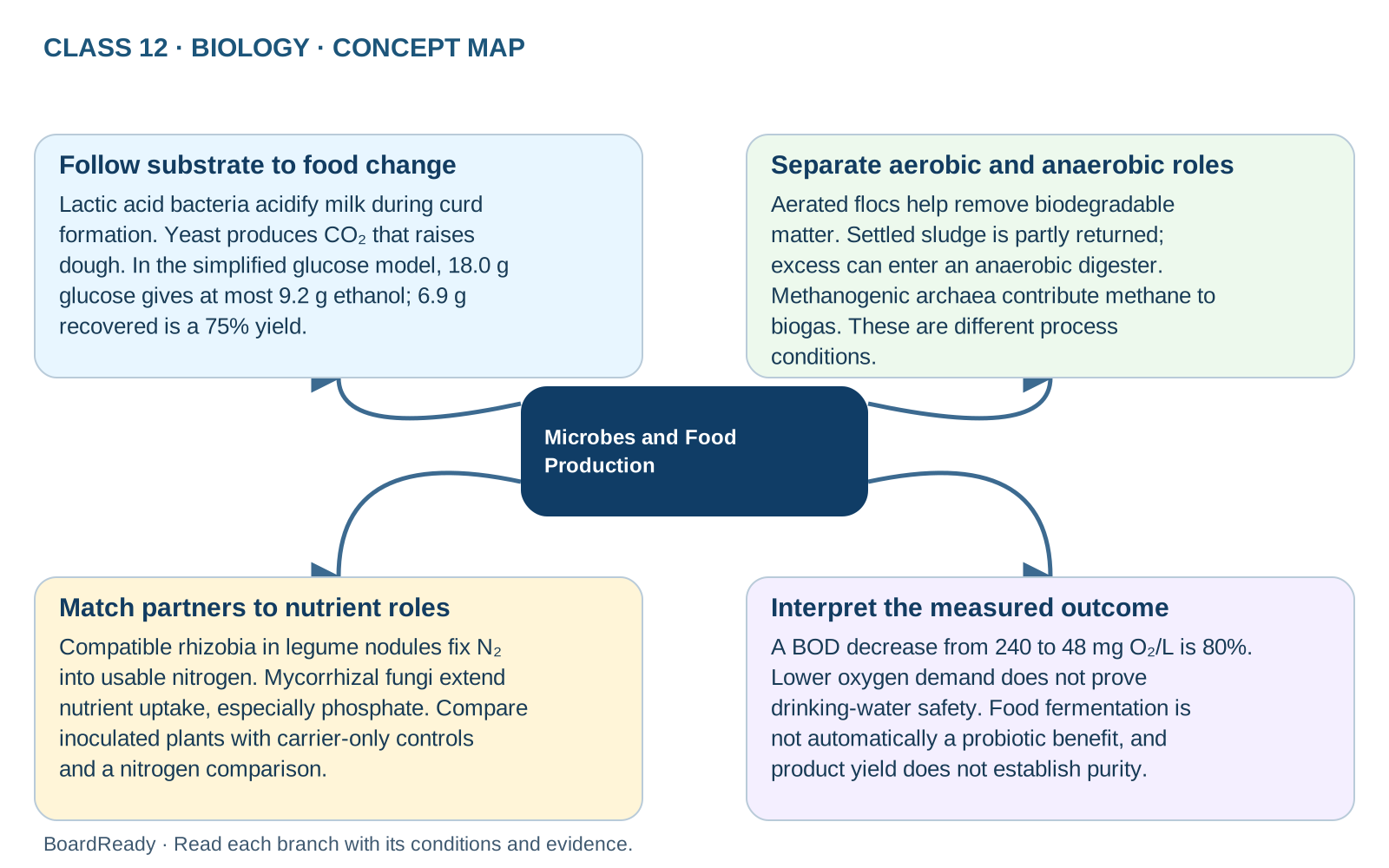
Connect each microbial application to its organism, substrate, process conditions and evidence of success. Separate a useful conversion from a safety claim. Follow substrate to food change: Lactic acid bacteria acidify milk during curd formation. Yeast produces CO₂ that raises dough. In the simplified glucose model, 18.0 g glucose gives at most 9.2 g ethanol; 6.9 g recovered is a 75% yield. Separate aerobic and anaerobic roles: Aerated flocs help remove biodegradable matter. Settled sludge is partly returned; excess can enter an anaerobic digester. Methanogenic archaea contribute methane to biogas. These are different process conditions. Match partners to nutrient roles: Compatible rhizobia in legume nodules fix N₂ into usable nitrogen. Mycorrhizal fungi extend nutrient uptake, especially phosphate. Compare inoculated plants with carrier-only controls and a nitrogen comparison. Interpret the measured outcome: A BOD decrease from 240 to 48 mg O₂/L is 80%. Lower oxygen demand does not prove drinking-water safety. Food fermentation is not automatically a probiotic benefit, and product yield does not establish purity.Exam cue: Name the microbe, conversion and conditions before the application. Use the initial value for percentage removal and theoretical product for percentage yield; preserve those different denominators and check safety separately.
- 1Microbes and Food Production -> Follow substrate to food change: Lactic acid bacteria acidify milk during curd formation. Yeast produces CO₂ that raises dough. In the simplified glucose model, 18.0 g glucose gives at most 9.2 g ethanol; 6.9 g recovered is a 75% yield.
- 2Microbes and Food Production -> Separate aerobic and anaerobic roles: Aerated flocs help remove biodegradable matter. Settled sludge is partly returned; excess can enter an anaerobic digester. Methanogenic archaea contribute methane to biogas. These are different process conditions.
- 3Microbes and Food Production -> Match partners to nutrient roles: Compatible rhizobia in legume nodules fix N₂ into usable nitrogen. Mycorrhizal fungi extend nutrient uptake, especially phosphate. Compare inoculated plants with carrier-only controls and a nitrogen comparison.
- 4Microbes and Food Production -> Interpret the measured outcome: A BOD decrease from 240 to 48 mg O₂/L is 80%. Lower oxygen demand does not prove drinking-water safety. Food fermentation is not automatically a probiotic benefit, and product yield does not establish purity.