Comparison map
Thermodynamics: relationships and examples
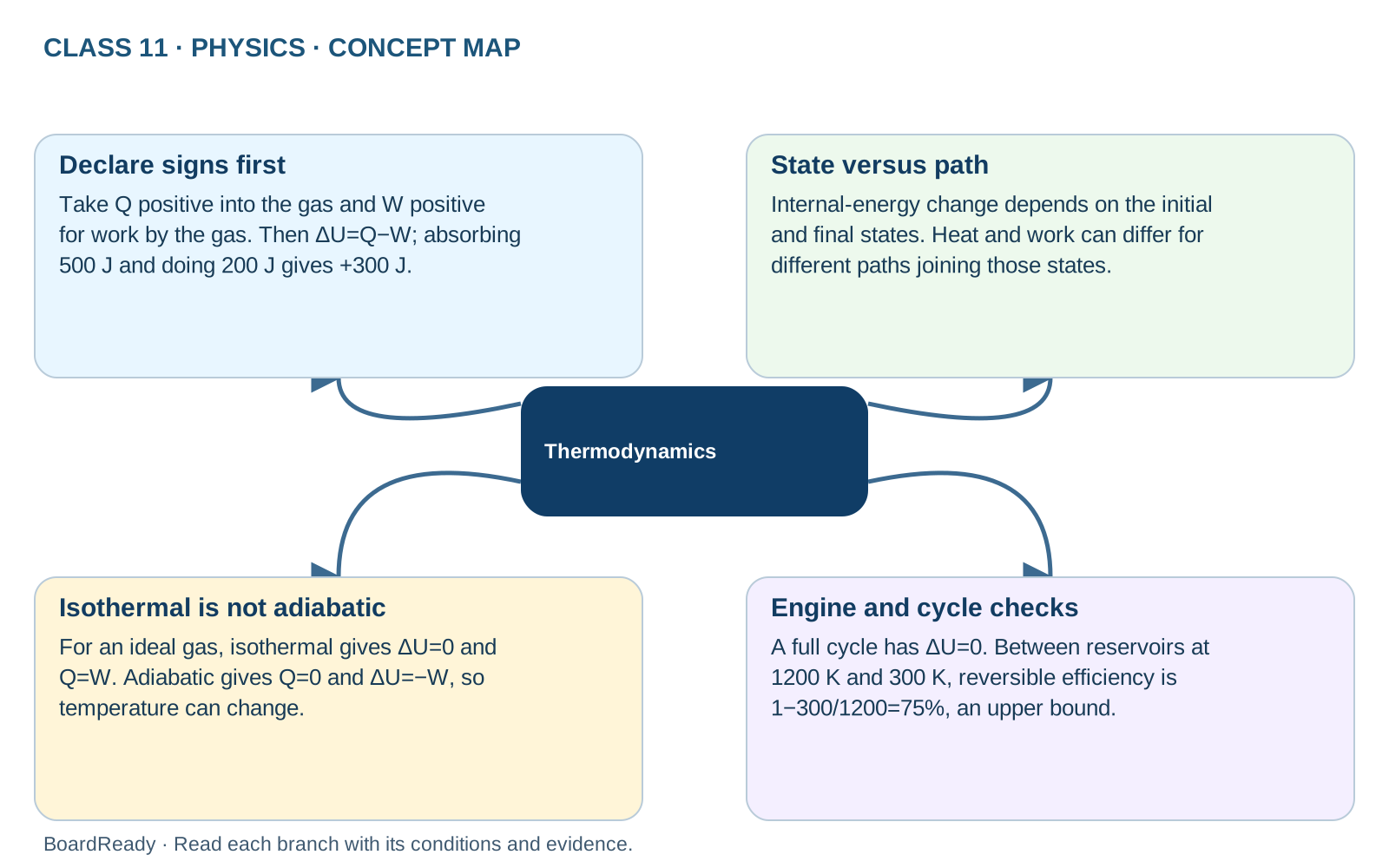
A sign convention and a process path connect heat, work and internal-energy change. Declare signs first: Take Q positive into the gas and W positive for work by the gas. Then ΔU=Q−W; absorbing 500 J and doing 200 J gives +300 J. State versus path: Internal-energy change depends on the initial and final states. Heat and work can differ for different paths joining those states. Isothermal is not adiabatic: For an ideal gas, isothermal gives ΔU=0 and Q=W. Adiabatic gives Q=0 and ΔU=−W, so temperature can change. Engine and cycle checks: A full cycle has ΔU=0. Between reservoirs at 1200 K and 300 K, reversible efficiency is 1−300/1200=75%, an upper bound.Exam cue: Use kelvin for reservoir ratios and keep the chosen work sign consistent throughout.
- 1Thermodynamics -> Declare signs first: Take Q positive into the gas and W positive for work by the gas. Then ΔU=Q−W; absorbing 500 J and doing 200 J gives +300 J.
- 2Thermodynamics -> State versus path: Internal-energy change depends on the initial and final states. Heat and work can differ for different paths joining those states.
- 3Thermodynamics -> Isothermal is not adiabatic: For an ideal gas, isothermal gives ΔU=0 and Q=W. Adiabatic gives Q=0 and ΔU=−W, so temperature can change.
- 4Thermodynamics -> Engine and cycle checks: A full cycle has ΔU=0. Between reservoirs at 1200 K and 300 K, reversible efficiency is 1−300/1200=75%, an upper bound.