Comparison map
Kinetic Theory: relationships and examples
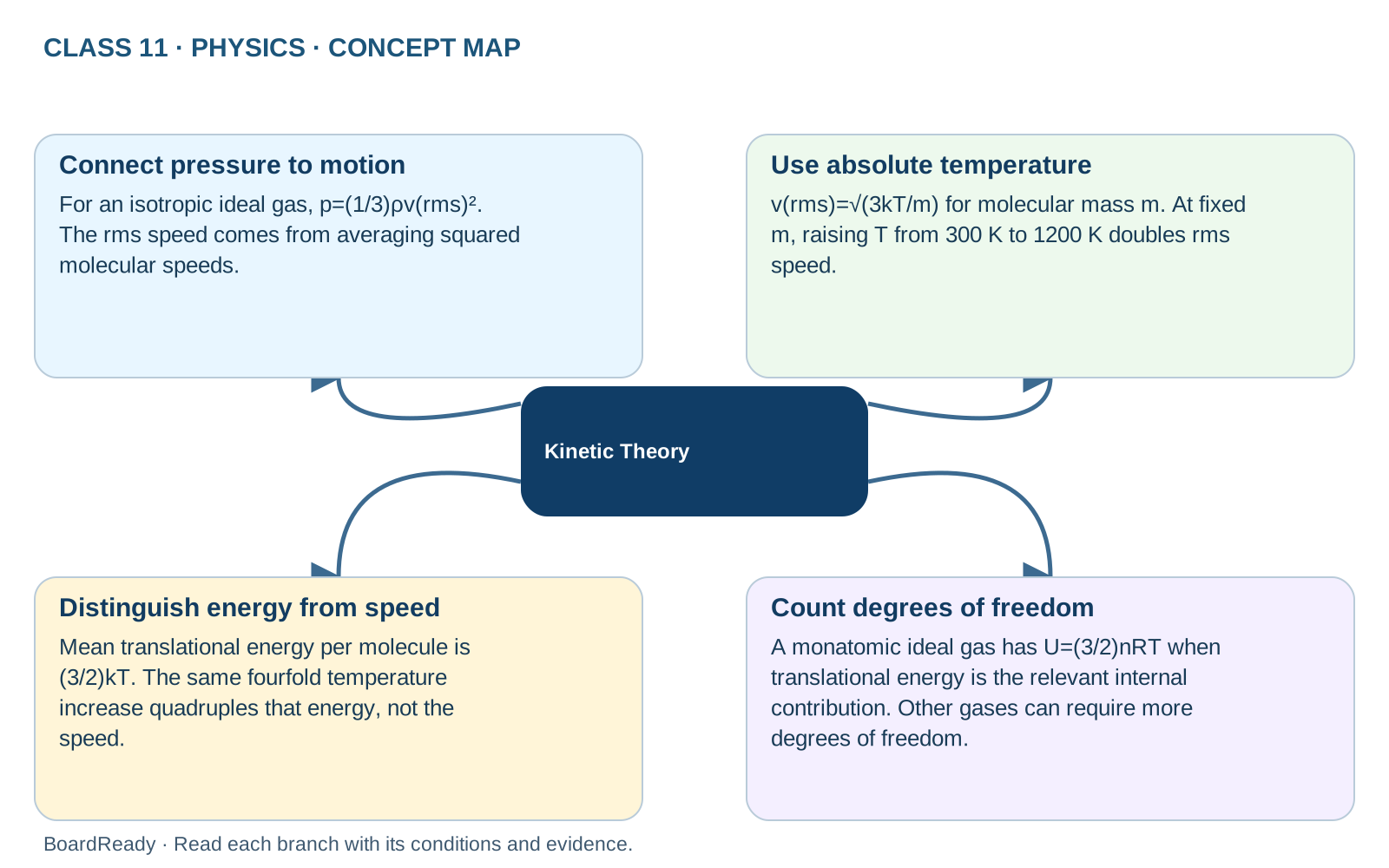
Gas pressure and thermal energy arise from molecular motion under ideal-gas assumptions. Connect pressure to motion: For an isotropic ideal gas, p=(1/3)ρv(rms)². The rms speed comes from averaging squared molecular speeds. Use absolute temperature: v(rms)=√(3kT/m) for molecular mass m. At fixed m, raising T from 300 K to 1200 K doubles rms speed. Distinguish energy from speed: Mean translational energy per molecule is (3/2)kT. The same fourfold temperature increase quadruples that energy, not the speed. Count degrees of freedom: A monatomic ideal gas has U=(3/2)nRT when translational energy is the relevant internal contribution. Other gases can require more degrees of freedom.Exam cue: Use molecular mass rather than molar mass with k, or use the equivalent molar-mass formula with R.
- 1Kinetic Theory -> Connect pressure to motion: For an isotropic ideal gas, p=(1/3)ρv(rms)². The rms speed comes from averaging squared molecular speeds.
- 2Kinetic Theory -> Use absolute temperature: v(rms)=√(3kT/m) for molecular mass m. At fixed m, raising T from 300 K to 1200 K doubles rms speed.
- 3Kinetic Theory -> Distinguish energy from speed: Mean translational energy per molecule is (3/2)kT. The same fourfold temperature increase quadruples that energy, not the speed.
- 4Kinetic Theory -> Count degrees of freedom: A monatomic ideal gas has U=(3/2)nRT when translational energy is the relevant internal contribution. Other gases can require more degrees of freedom.