Comparison map
Thermal Properties of Matter: relationships and examples
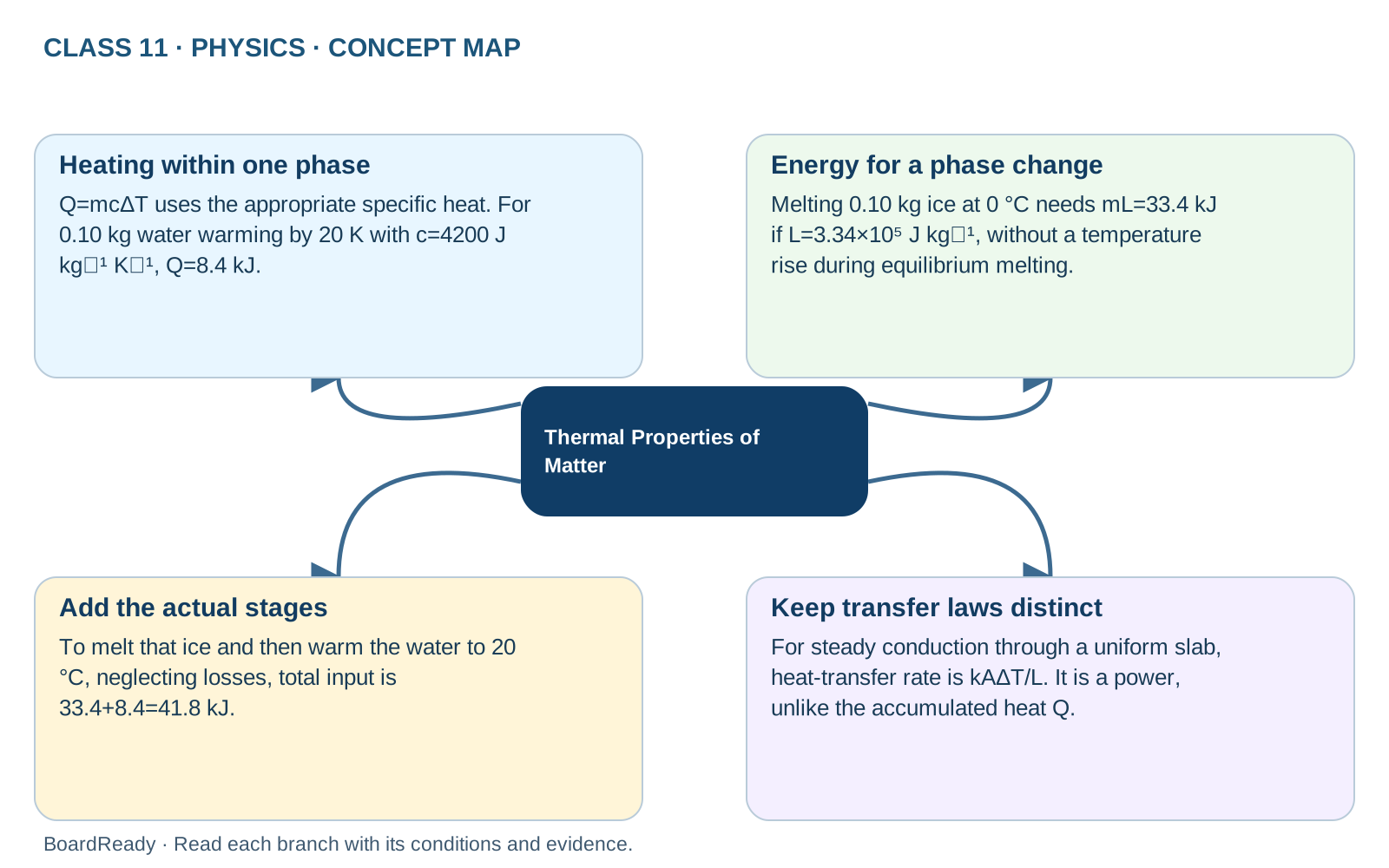
A thermal calculation follows the substance through each phase and temperature interval. Heating within one phase: Q=mcΔT uses the appropriate specific heat. For 0.10 kg water warming by 20 K with c=4200 J kg⁻¹ K⁻¹, Q=8.4 kJ. Energy for a phase change: Melting 0.10 kg ice at 0 °C needs mL=33.4 kJ if L=3.34×10⁵ J kg⁻¹, without a temperature rise during equilibrium melting. Add the actual stages: To melt that ice and then warm the water to 20 °C, neglecting losses, total input is 33.4+8.4=41.8 kJ. Keep transfer laws distinct: For steady conduction through a uniform slab, heat-transfer rate is kAΔT/L. It is a power, unlike the accumulated heat Q.Exam cue: Identify initial and final phases and use consistent energy units; temperature intervals of 1 K and 1 °C have equal size.
- 1Thermal Properties of Matter -> Heating within one phase: Q=mcΔT uses the appropriate specific heat. For 0.10 kg water warming by 20 K with c=4200 J kg⁻¹ K⁻¹, Q=8.4 kJ.
- 2Thermal Properties of Matter -> Energy for a phase change: Melting 0.10 kg ice at 0 °C needs mL=33.4 kJ if L=3.34×10⁵ J kg⁻¹, without a temperature rise during equilibrium melting.
- 3Thermal Properties of Matter -> Add the actual stages: To melt that ice and then warm the water to 20 °C, neglecting losses, total input is 33.4+8.4=41.8 kJ.
- 4Thermal Properties of Matter -> Keep transfer laws distinct: For steady conduction through a uniform slab, heat-transfer rate is kAΔT/L. It is a power, unlike the accumulated heat Q.