Comparison map
Projectile Motion: relationships and examples
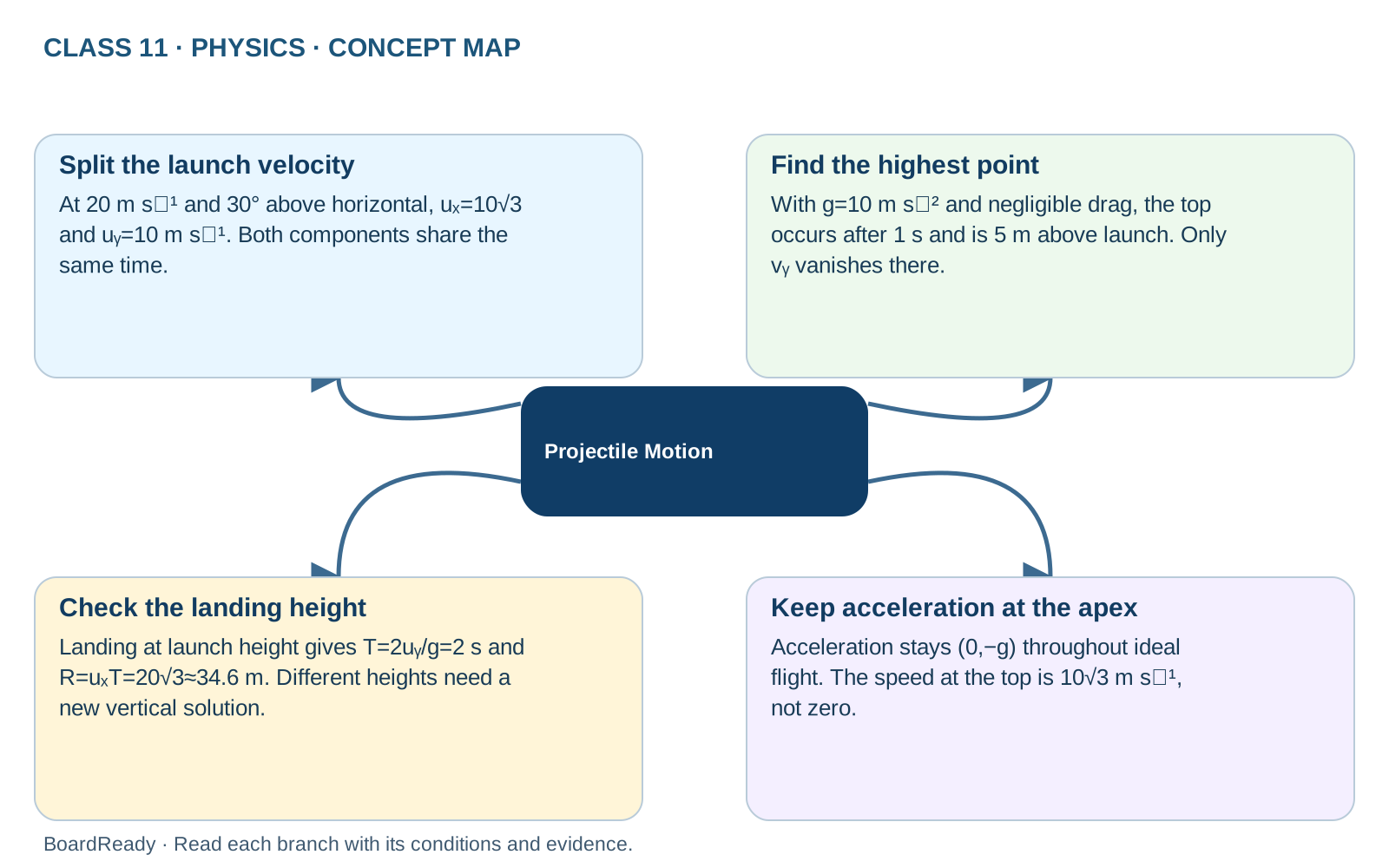
Ideal projectiles combine uniform horizontal motion with constant vertical acceleration. Split the launch velocity: At 20 m s⁻¹ and 30° above horizontal, uₓ=10√3 and uᵧ=10 m s⁻¹. Both components share the same time. Find the highest point: With g=10 m s⁻² and negligible drag, the top occurs after 1 s and is 5 m above launch. Only vᵧ vanishes there. Check the landing height: Landing at launch height gives T=2uᵧ/g=2 s and R=uₓT=20√3≈34.6 m. Different heights need a new vertical solution. Keep acceleration at the apex: Acceleration stays (0,−g) throughout ideal flight. The speed at the top is 10√3 m s⁻¹, not zero.Exam cue: State g, air-resistance assumptions and the launch/landing heights before using range shortcuts.
- 1Projectile Motion -> Split the launch velocity: At 20 m s⁻¹ and 30° above horizontal, uₓ=10√3 and uᵧ=10 m s⁻¹. Both components share the same time.
- 2Projectile Motion -> Find the highest point: With g=10 m s⁻² and negligible drag, the top occurs after 1 s and is 5 m above launch. Only vᵧ vanishes there.
- 3Projectile Motion -> Check the landing height: Landing at launch height gives T=2uᵧ/g=2 s and R=uₓT=20√3≈34.6 m. Different heights need a new vertical solution.
- 4Projectile Motion -> Keep acceleration at the apex: Acceleration stays (0,−g) throughout ideal flight. The speed at the top is 10√3 m s⁻¹, not zero.