Comparison map
Motion in a Plane and Projectiles: relationships and examples
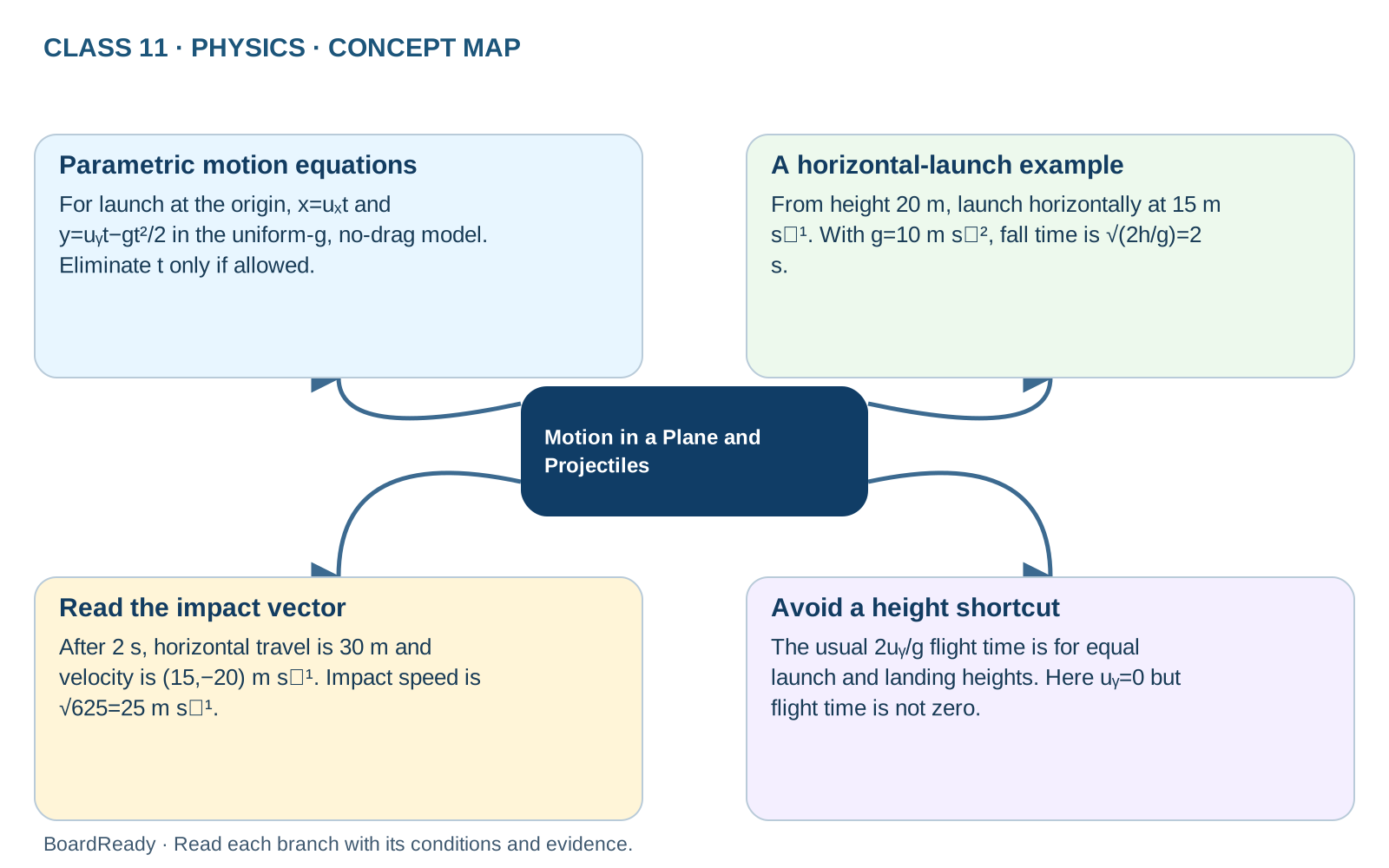
A curved path can arise from independent component equations tied to the same time. Parametric motion equations: For launch at the origin, x=uₓt and y=uᵧt−gt²/2 in the uniform-g, no-drag model. Eliminate t only if allowed. A horizontal-launch example: From height 20 m, launch horizontally at 15 m s⁻¹. With g=10 m s⁻², fall time is √(2h/g)=2 s. Read the impact vector: After 2 s, horizontal travel is 30 m and velocity is (15,−20) m s⁻¹. Impact speed is √625=25 m s⁻¹. Avoid a height shortcut: The usual 2uᵧ/g flight time is for equal launch and landing heights. Here uᵧ=0 but flight time is not zero.Exam cue: Write the actual vertical displacement before solving for time, then use that time in the horizontal equation.
- 1Motion in a Plane and Projectiles -> Parametric motion equations: For launch at the origin, x=uₓt and y=uᵧt−gt²/2 in the uniform-g, no-drag model. Eliminate t only if allowed.
- 2Motion in a Plane and Projectiles -> A horizontal-launch example: From height 20 m, launch horizontally at 15 m s⁻¹. With g=10 m s⁻², fall time is √(2h/g)=2 s.
- 3Motion in a Plane and Projectiles -> Read the impact vector: After 2 s, horizontal travel is 30 m and velocity is (15,−20) m s⁻¹. Impact speed is √625=25 m s⁻¹.
- 4Motion in a Plane and Projectiles -> Avoid a height shortcut: The usual 2uᵧ/g flight time is for equal launch and landing heights. Here uᵧ=0 but flight time is not zero.