Comparison map
Vectors and Two-Dimensional Motion: relationships and examples
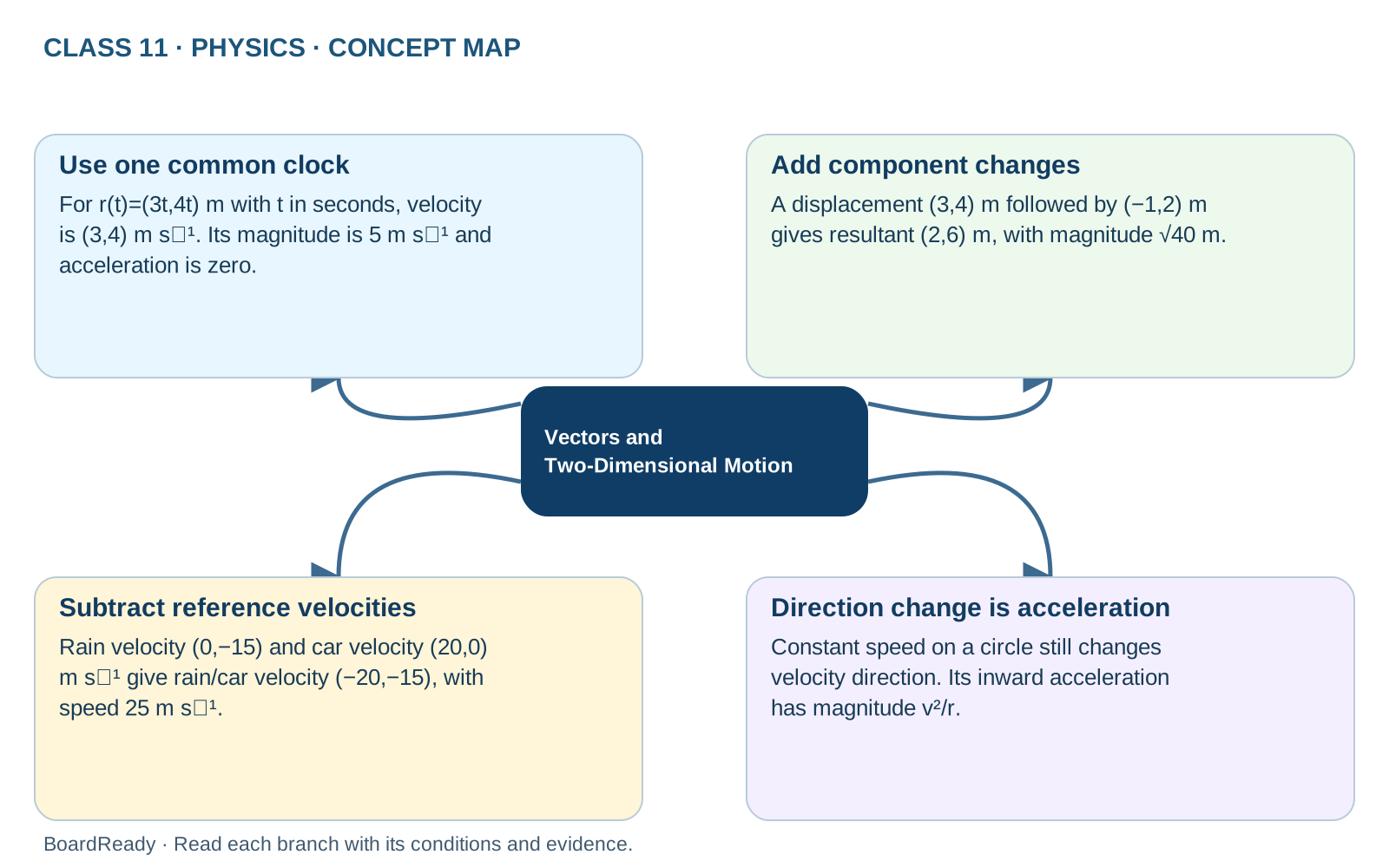
Two components describe one motion in a single chosen frame and common time. Use one common clock: For r(t)=(3t,4t) m with t in seconds, velocity is (3,4) m s⁻¹. Its magnitude is 5 m s⁻¹ and acceleration is zero. Add component changes: A displacement (3,4) m followed by (−1,2) m gives resultant (2,6) m, with magnitude √40 m. Subtract reference velocities: Rain velocity (0,−15) and car velocity (20,0) m s⁻¹ give rain/car velocity (−20,−15), with speed 25 m s⁻¹. Direction change is acceleration: Constant speed on a circle still changes velocity direction. Its inward acceleration has magnitude v²/r.Exam cue: Keep the reference frame and component signs consistent; subtract vectors rather than speed magnitudes.
- 1Vectors and Two-Dimensional Motion -> Use one common clock: For r(t)=(3t,4t) m with t in seconds, velocity is (3,4) m s⁻¹. Its magnitude is 5 m s⁻¹ and acceleration is zero.
- 2Vectors and Two-Dimensional Motion -> Add component changes: A displacement (3,4) m followed by (−1,2) m gives resultant (2,6) m, with magnitude √40 m.
- 3Vectors and Two-Dimensional Motion -> Subtract reference velocities: Rain velocity (0,−15) and car velocity (20,0) m s⁻¹ give rain/car velocity (−20,−15), with speed 25 m s⁻¹.
- 4Vectors and Two-Dimensional Motion -> Direction change is acceleration: Constant speed on a circle still changes velocity direction. Its inward acceleration has magnitude v²/r.