Comparison map
Complex Numbers: relationships and examples
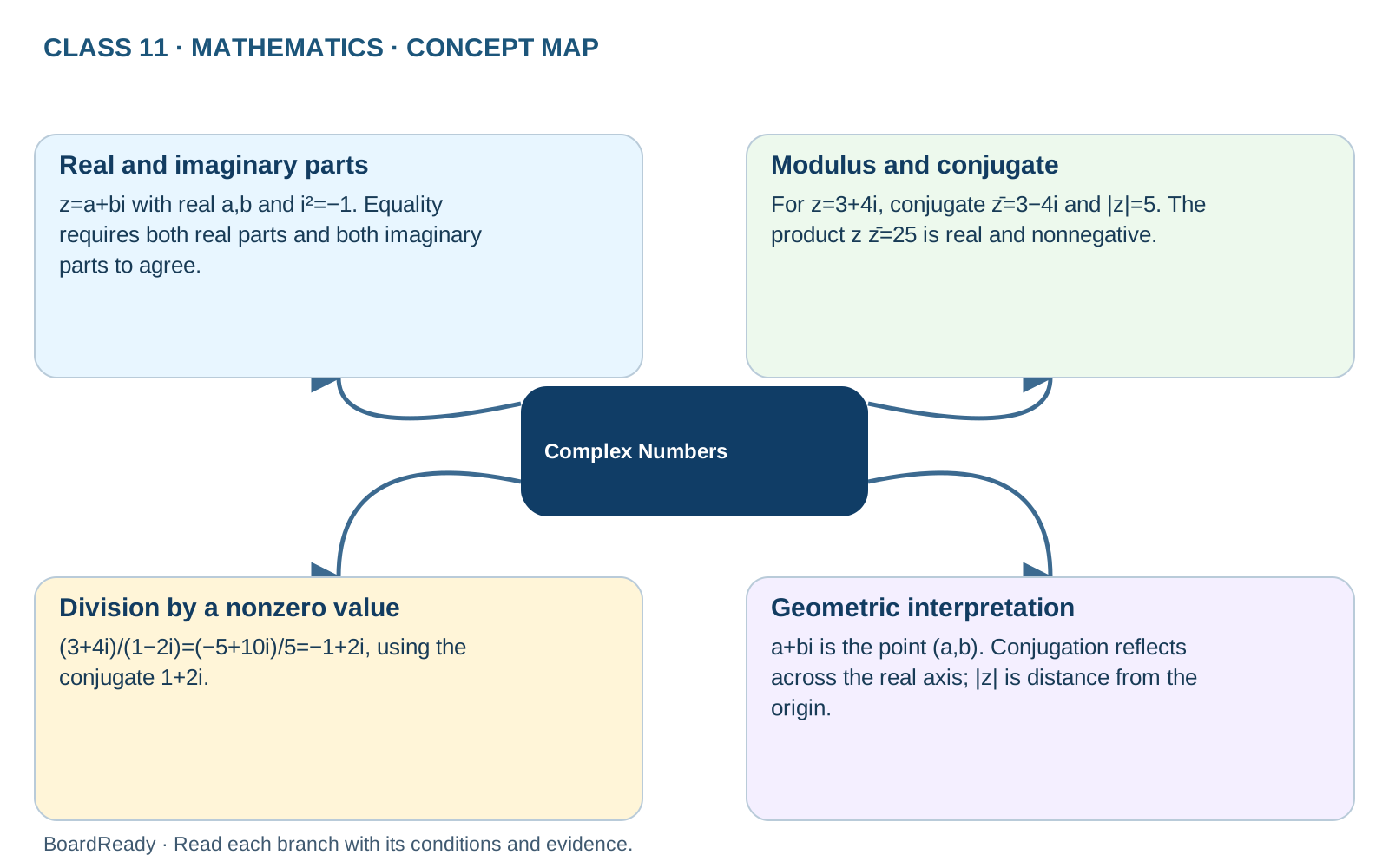
Pairs of real components connect algebra, conjugation and the complex plane. Real and imaginary parts: z=a+bi with real a,b and i²=−1. Equality requires both real parts and both imaginary parts to agree. Modulus and conjugate: For z=3+4i, conjugate z̄=3−4i and |z|=5. The product z z̄=25 is real and nonnegative. Division by a nonzero value: (3+4i)/(1−2i)=(−5+10i)/5=−1+2i, using the conjugate 1+2i. Geometric interpretation: a+bi is the point (a,b). Conjugation reflects across the real axis; |z| is distance from the origin.Exam cue: Multiply the quotient by its nonzero divisor to check both components.
- 1Complex Numbers -> Real and imaginary parts: z=a+bi with real a,b and i²=−1. Equality requires both real parts and both imaginary parts to agree.
- 2Complex Numbers -> Modulus and conjugate: For z=3+4i, conjugate z̄=3−4i and |z|=5. The product z z̄=25 is real and nonnegative.
- 3Complex Numbers -> Division by a nonzero value: (3+4i)/(1−2i)=(−5+10i)/5=−1+2i, using the conjugate 1+2i.
- 4Complex Numbers -> Geometric interpretation: a+bi is the point (a,b). Conjugation reflects across the real axis; |z| is distance from the origin.