Comparison map
Principle of Mathematical Induction: relationships and examples
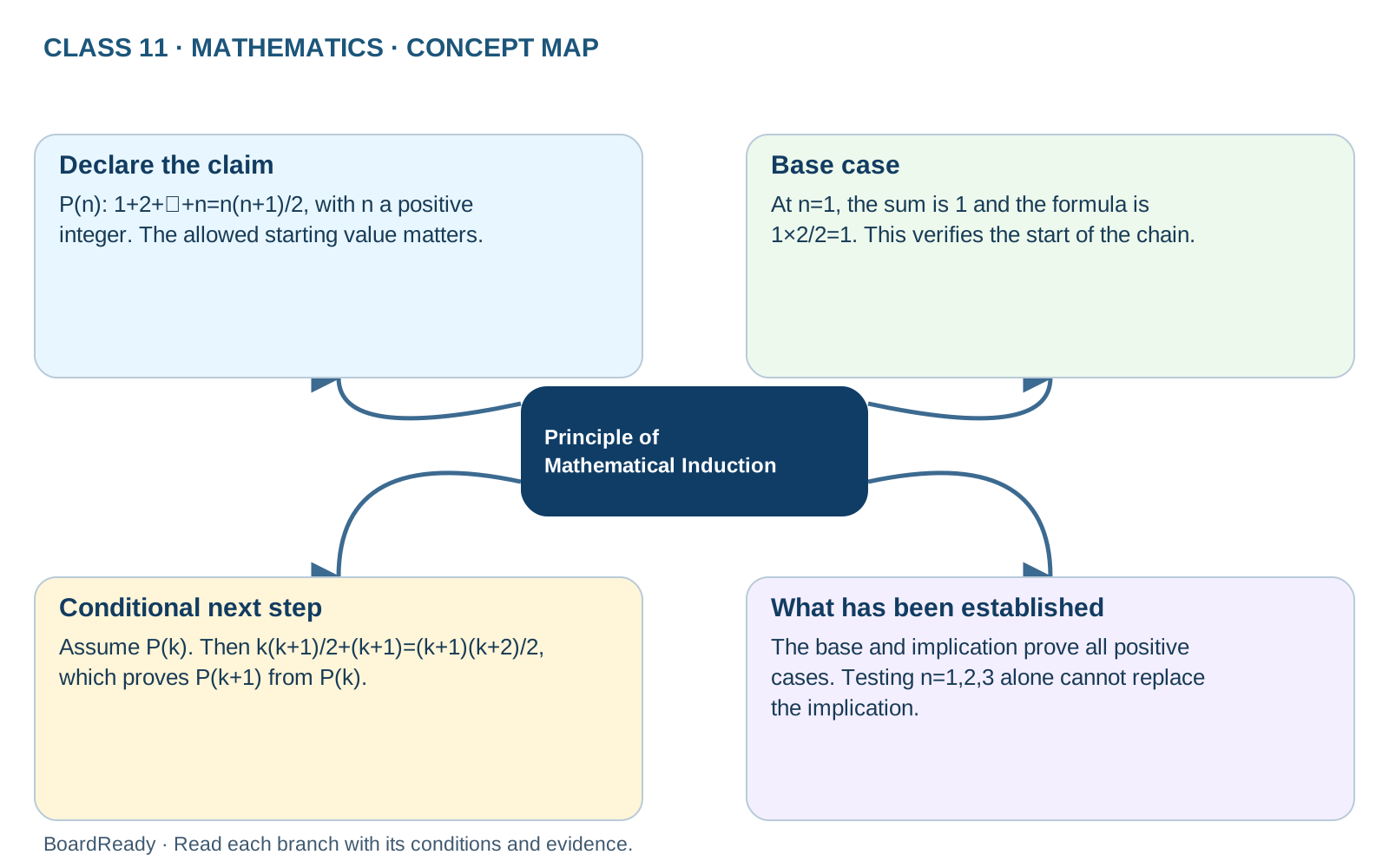
A verified base starts a chain; the implication carries it to every positive integer. Declare the claim: P(n): 1+2+⋯+n=n(n+1)/2, with n a positive integer. The allowed starting value matters. Base case: At n=1, the sum is 1 and the formula is 1×2/2=1. This verifies the start of the chain. Conditional next step: Assume P(k). Then k(k+1)/2+(k+1)=(k+1)(k+2)/2, which proves P(k+1) from P(k). What has been established: The base and implication prove all positive cases. Testing n=1,2,3 alone cannot replace the implication.Exam cue: Identify exactly where the induction hypothesis is used; do not assume all cases.
- 1Principle of Mathematical Induction -> Declare the claim: P(n): 1+2+⋯+n=n(n+1)/2, with n a positive integer. The allowed starting value matters.
- 2Principle of Mathematical Induction -> Base case: At n=1, the sum is 1 and the formula is 1×2/2=1. This verifies the start of the chain.
- 3Principle of Mathematical Induction -> Conditional next step: Assume P(k). Then k(k+1)/2+(k+1)=(k+1)(k+2)/2, which proves P(k+1) from P(k).
- 4Principle of Mathematical Induction -> What has been established: The base and implication prove all positive cases. Testing n=1,2,3 alone cannot replace the implication.