Comparison map
Quadratic Equations: relationships and examples
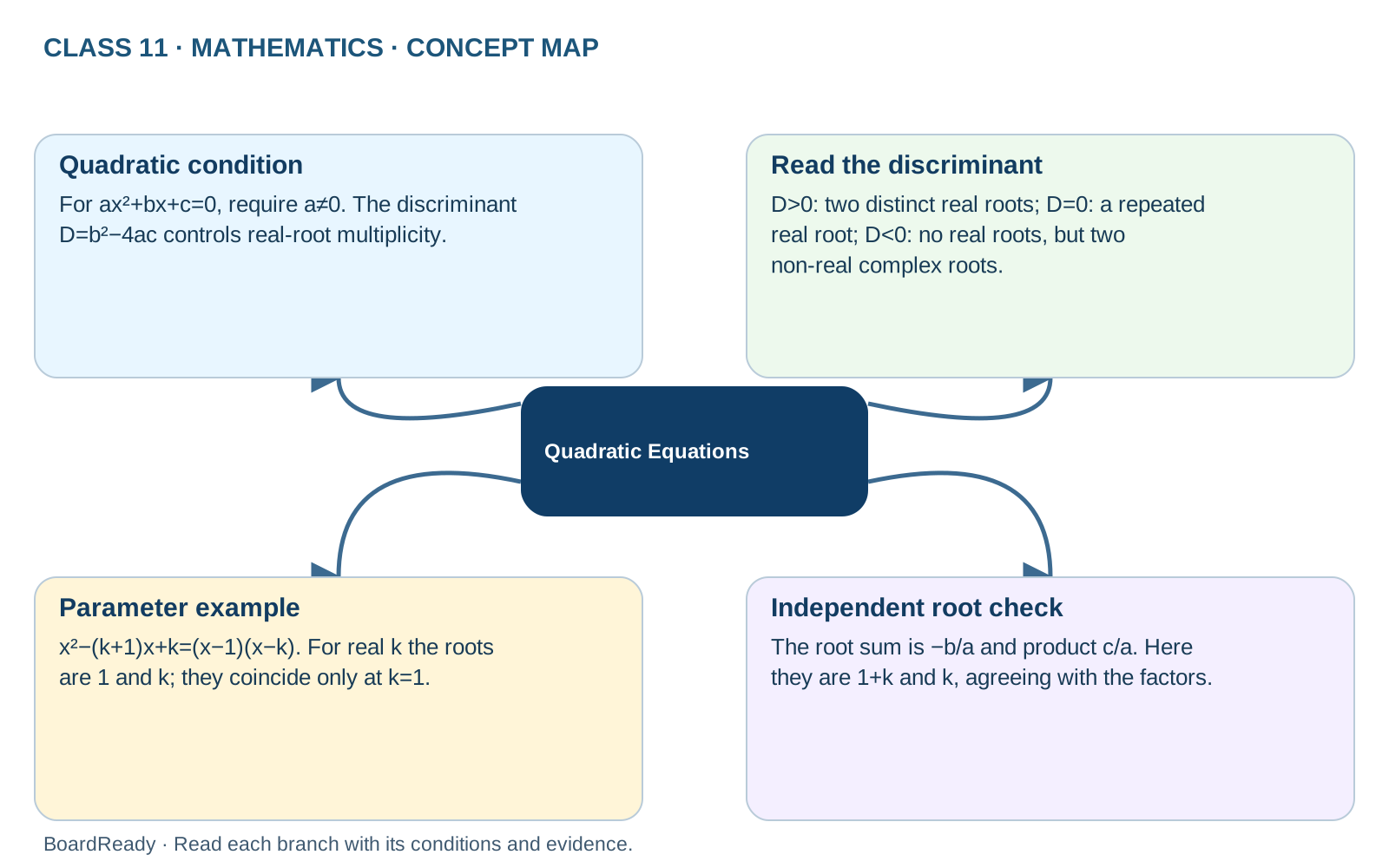
Factoring, the discriminant and root relations check one another. Quadratic condition: For ax²+bx+c=0, require a≠0. The discriminant D=b²−4ac controls real-root multiplicity. Read the discriminant: D>0: two distinct real roots; D=0: a repeated real root; D<0: no real roots, but two non-real complex roots. Parameter example: x²−(k+1)x+k=(x−1)(x−k). For real k the roots are 1 and k; they coincide only at k=1. Independent root check: The root sum is −b/a and product c/a. Here they are 1+k and k, agreeing with the factors.Exam cue: Keep the repeated-root case and state whether roots are sought over the reals or complexes.
- 1Quadratic Equations -> Quadratic condition: For ax²+bx+c=0, require a≠0. The discriminant D=b²−4ac controls real-root multiplicity.
- 2Quadratic Equations -> Read the discriminant: D>0: two distinct real roots; D=0: a repeated real root; D<0: no real roots, but two non-real complex roots.
- 3Quadratic Equations -> Parameter example: x²−(k+1)x+k=(x−1)(x−k). For real k the roots are 1 and k; they coincide only at k=1.
- 4Quadratic Equations -> Independent root check: The root sum is −b/a and product c/a. Here they are 1+k and k, agreeing with the factors.