Comparison map
Respiration in Plants: relationships and examples
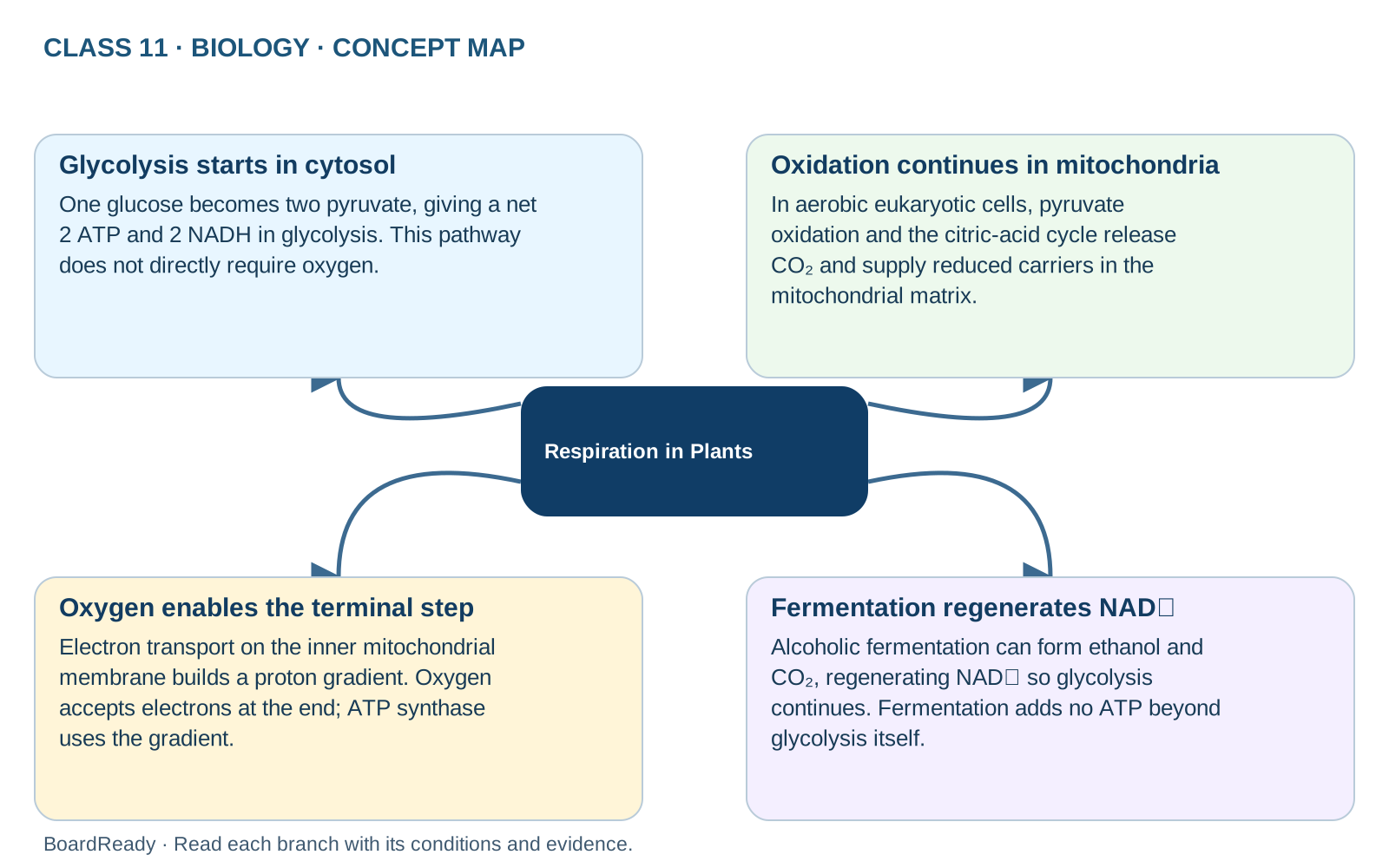
Trace carbon breakdown through compartments, electron carriers and ATP production, distinguishing aerobic respiration from fermentation. Glycolysis starts in cytosol: One glucose becomes two pyruvate, giving a net 2 ATP and 2 NADH in glycolysis. This pathway does not directly require oxygen. Oxidation continues in mitochondria: In aerobic eukaryotic cells, pyruvate oxidation and the citric-acid cycle release CO₂ and supply reduced carriers in the mitochondrial matrix. Oxygen enables the terminal step: Electron transport on the inner mitochondrial membrane builds a proton gradient. Oxygen accepts electrons at the end; ATP synthase uses the gradient. Fermentation regenerates NAD⁺: Alcoholic fermentation can form ethanol and CO₂, regenerating NAD⁺ so glycolysis continues. Fermentation adds no ATP beyond glycolysis itself.Exam cue: Name the compartment and distinguish substrate-level ATP formation from oxidative phosphorylation; do not assign a universal total ATP yield.
- 1Respiration in Plants -> Glycolysis starts in cytosol: One glucose becomes two pyruvate, giving a net 2 ATP and 2 NADH in glycolysis. This pathway does not directly require oxygen.
- 2Respiration in Plants -> Oxidation continues in mitochondria: In aerobic eukaryotic cells, pyruvate oxidation and the citric-acid cycle release CO₂ and supply reduced carriers in the mitochondrial matrix.
- 3Respiration in Plants -> Oxygen enables the terminal step: Electron transport on the inner mitochondrial membrane builds a proton gradient. Oxygen accepts electrons at the end; ATP synthase uses the gradient.
- 4Respiration in Plants -> Fermentation regenerates NAD⁺: Alcoholic fermentation can form ethanol and CO₂, regenerating NAD⁺ so glycolysis continues. Fermentation adds no ATP beyond glycolysis itself.