Comparison map
Photosynthesis in Higher Plants: relationships and examples
Connect light capture and carbon fixation while separating gross production, net exchange and adaptations that concentrate carbon dioxide. Light reactions supply energy: Thylakoid electron transport supports ATP and NADPH production. Splitting water supplies electrons and releases oxygen; oxygen does not come from CO₂. Carbon fixation uses the supply: The Calvin cycle in the stroma uses ATP and NADPH to support carbon assimilation and RuBP regeneration. It is not a night-only pathway. C₄ and CAM separate steps: C₄ plants typically separate initial fixation and the Calvin cycle spatially; CAM plants separate initial CO₂ fixation and its later use temporally. Net exchange needs assumptions: Net oxygen release 6 plus respiration assumed 2 gives gross estimate 8 units/hour. Respiration in light need not equal a measured dark rate.Exam cue: Label the compartment, carbon source and energy carriers. State the respiratory assumption when estimating gross from net gas exchange.
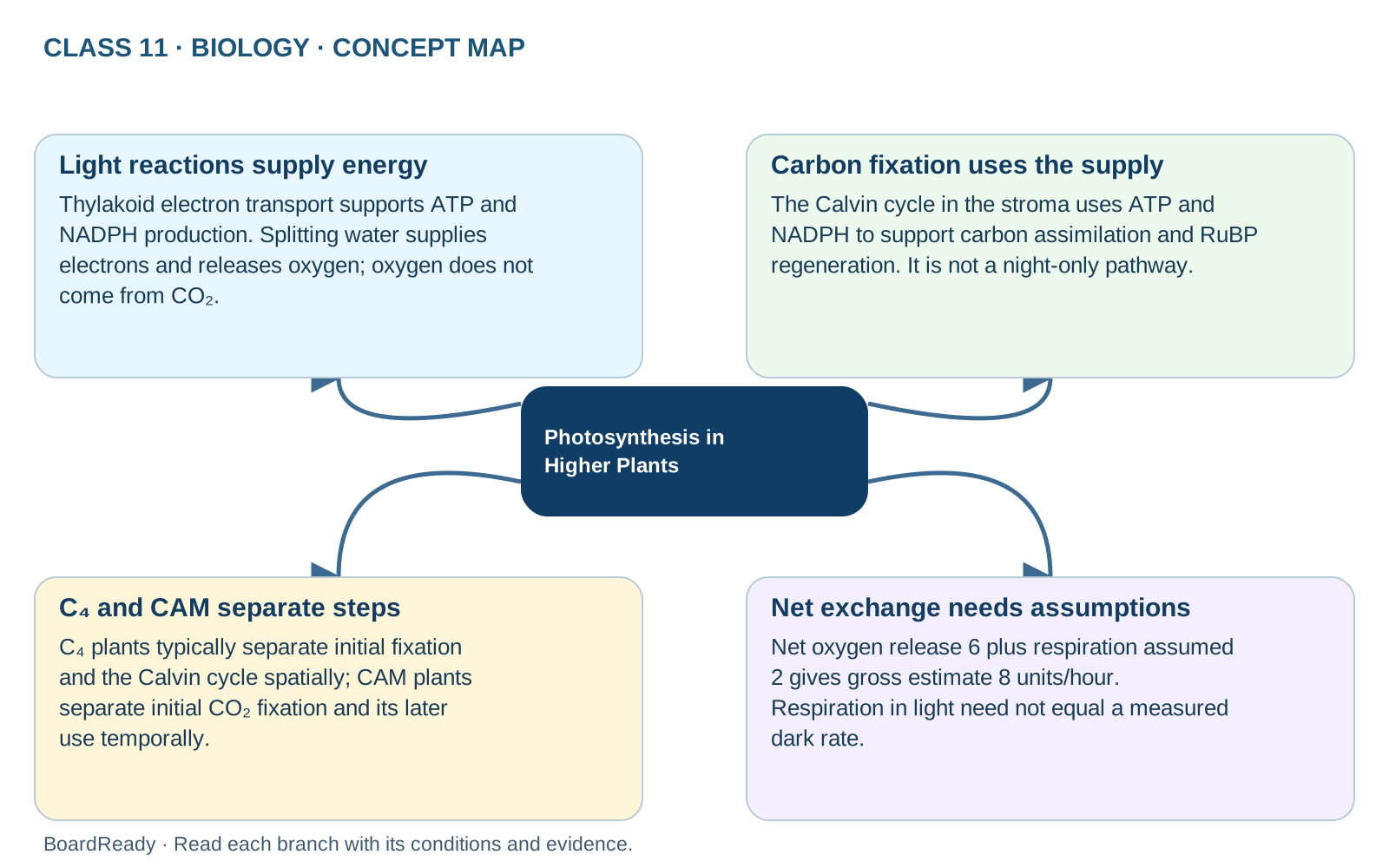
- 1Photosynthesis in Higher Plants -> Light reactions supply energy: Thylakoid electron transport supports ATP and NADPH production. Splitting water supplies electrons and releases oxygen; oxygen does not come from CO₂.
- 2Photosynthesis in Higher Plants -> Carbon fixation uses the supply: The Calvin cycle in the stroma uses ATP and NADPH to support carbon assimilation and RuBP regeneration. It is not a night-only pathway.
- 3Photosynthesis in Higher Plants -> C₄ and CAM separate steps: C₄ plants typically separate initial fixation and the Calvin cycle spatially; CAM plants separate initial CO₂ fixation and its later use temporally.
- 4Photosynthesis in Higher Plants -> Net exchange needs assumptions: Net oxygen release 6 plus respiration assumed 2 gives gross estimate 8 units/hour. Respiration in light need not equal a measured dark rate.