Comparison map
Cell Cycle and Division: relationships and examples
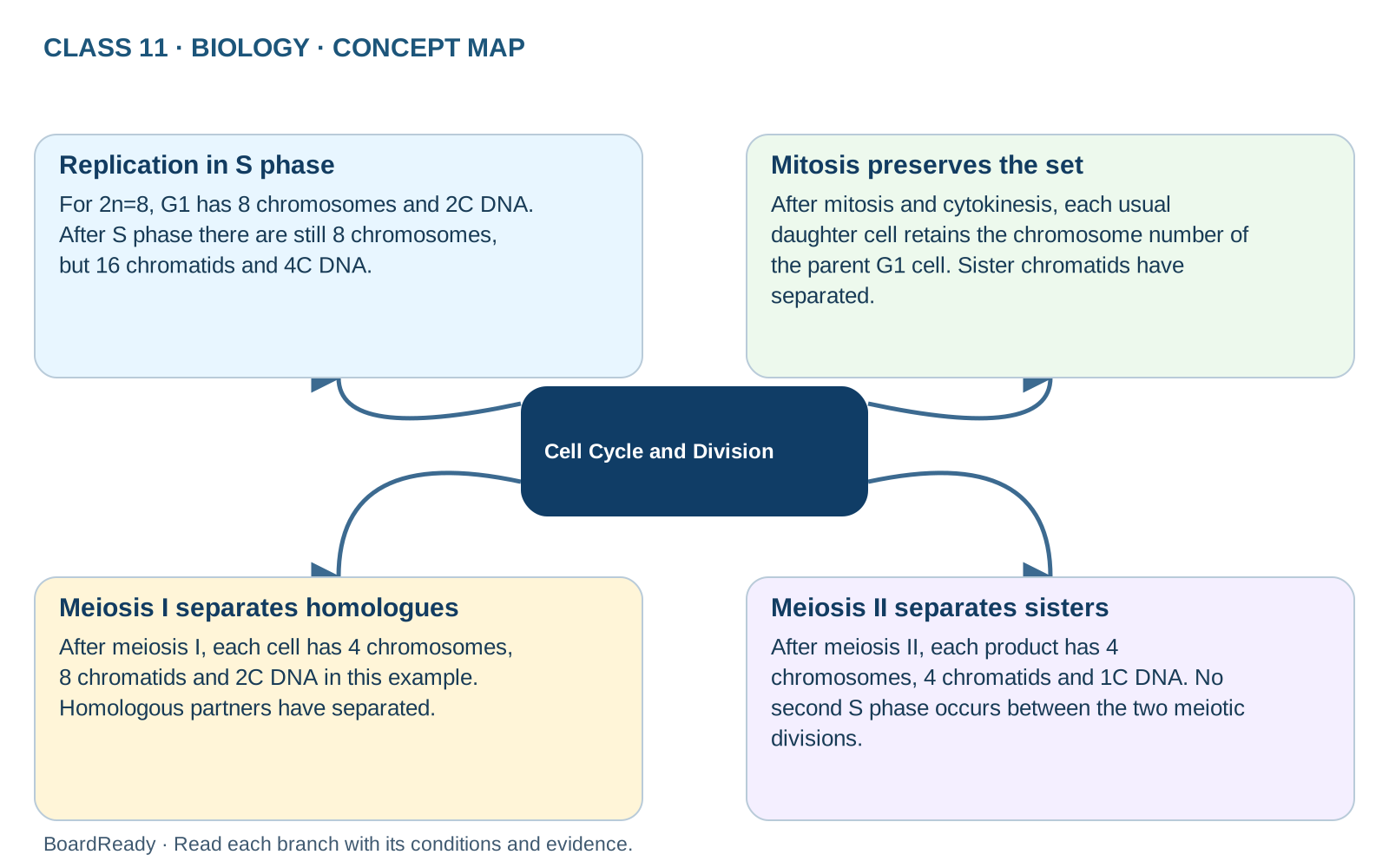
Track replication and division separately, using centromeres for chromosome counts and a clearly stated per-cell basis. Replication in S phase: For 2n=8, G1 has 8 chromosomes and 2C DNA. After S phase there are still 8 chromosomes, but 16 chromatids and 4C DNA. Mitosis preserves the set: After mitosis and cytokinesis, each usual daughter cell retains the chromosome number of the parent G1 cell. Sister chromatids have separated. Meiosis I separates homologues: After meiosis I, each cell has 4 chromosomes, 8 chromatids and 2C DNA in this example. Homologous partners have separated. Meiosis II separates sisters: After meiosis II, each product has 4 chromosomes, 4 chromatids and 1C DNA. No second S phase occurs between the two meiotic divisions.Exam cue: Specify the completed stage, chromosome/chromatid convention and per-cell counts; distinguish homologues from sister chromatids.
- 1Cell Cycle and Division -> Replication in S phase: For 2n=8, G1 has 8 chromosomes and 2C DNA. After S phase there are still 8 chromosomes, but 16 chromatids and 4C DNA.
- 2Cell Cycle and Division -> Mitosis preserves the set: After mitosis and cytokinesis, each usual daughter cell retains the chromosome number of the parent G1 cell. Sister chromatids have separated.
- 3Cell Cycle and Division -> Meiosis I separates homologues: After meiosis I, each cell has 4 chromosomes, 8 chromatids and 2C DNA in this example. Homologous partners have separated.
- 4Cell Cycle and Division -> Meiosis II separates sisters: After meiosis II, each product has 4 chromosomes, 4 chromatids and 1C DNA. No second S phase occurs between the two meiotic divisions.