Comparison map
Cell Cycle and Cell Division: relationships and examples
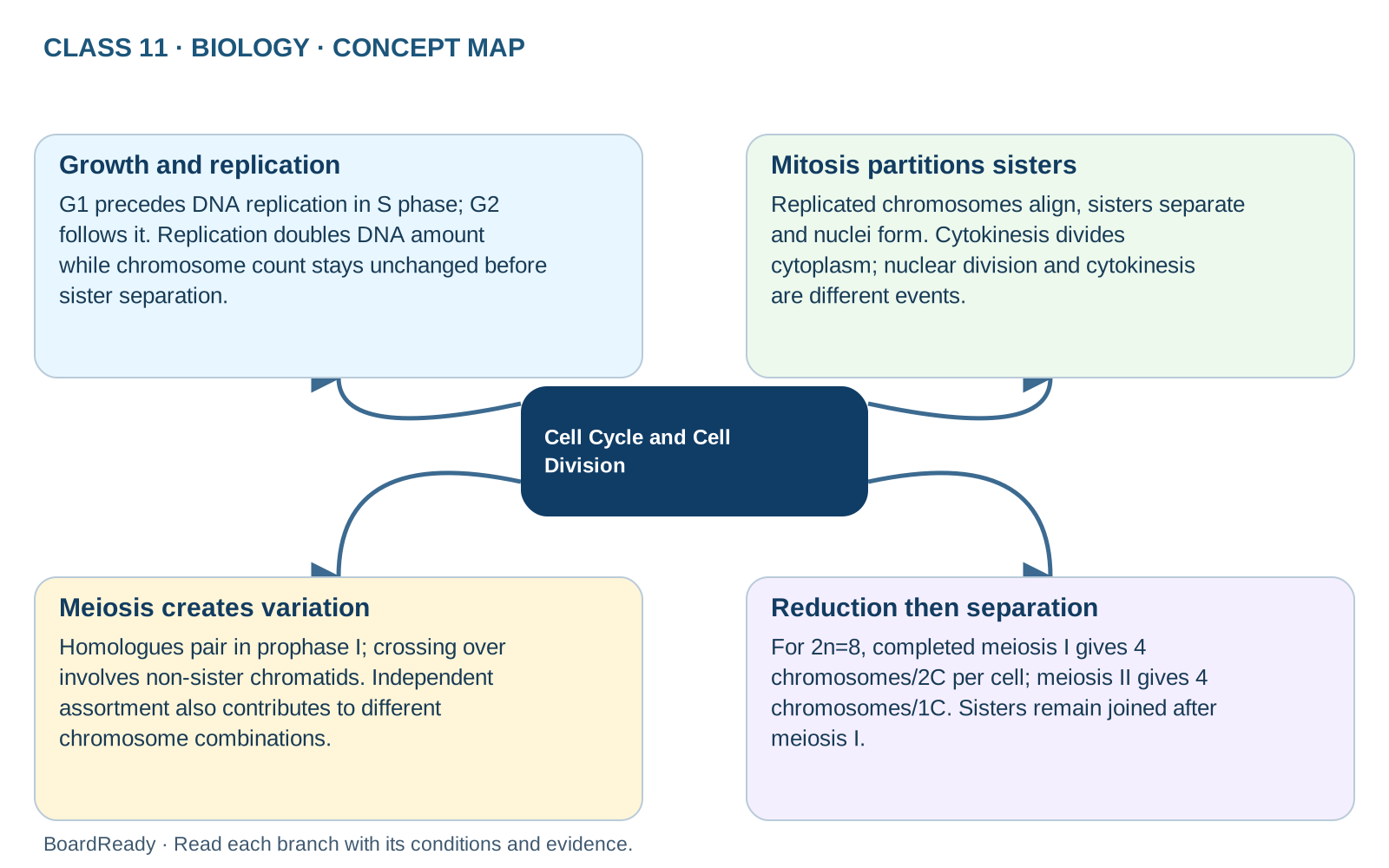
Connect the events of the cell cycle to chromosome behaviour and the generation of variation during meiosis. Growth and replication: G1 precedes DNA replication in S phase; G2 follows it. Replication doubles DNA amount while chromosome count stays unchanged before sister separation. Mitosis partitions sisters: Replicated chromosomes align, sisters separate and nuclei form. Cytokinesis divides cytoplasm; nuclear division and cytokinesis are different events. Meiosis creates variation: Homologues pair in prophase I; crossing over involves non-sister chromatids. Independent assortment also contributes to different chromosome combinations. Reduction then separation: For 2n=8, completed meiosis I gives 4 chromosomes/2C per cell; meiosis II gives 4 chromosomes/1C. Sisters remain joined after meiosis I.Exam cue: Link each named event to what separates and whether ploidy or DNA content changes.
- 1Cell Cycle and Cell Division -> Growth and replication: G1 precedes DNA replication in S phase; G2 follows it. Replication doubles DNA amount while chromosome count stays unchanged before sister separation.
- 2Cell Cycle and Cell Division -> Mitosis partitions sisters: Replicated chromosomes align, sisters separate and nuclei form. Cytokinesis divides cytoplasm; nuclear division and cytokinesis are different events.
- 3Cell Cycle and Cell Division -> Meiosis creates variation: Homologues pair in prophase I; crossing over involves non-sister chromatids. Independent assortment also contributes to different chromosome combinations.
- 4Cell Cycle and Cell Division -> Reduction then separation: For 2n=8, completed meiosis I gives 4 chromosomes/2C per cell; meiosis II gives 4 chromosomes/1C. Sisters remain joined after meiosis I.