Comparison map
Biomolecules: relationships and examples
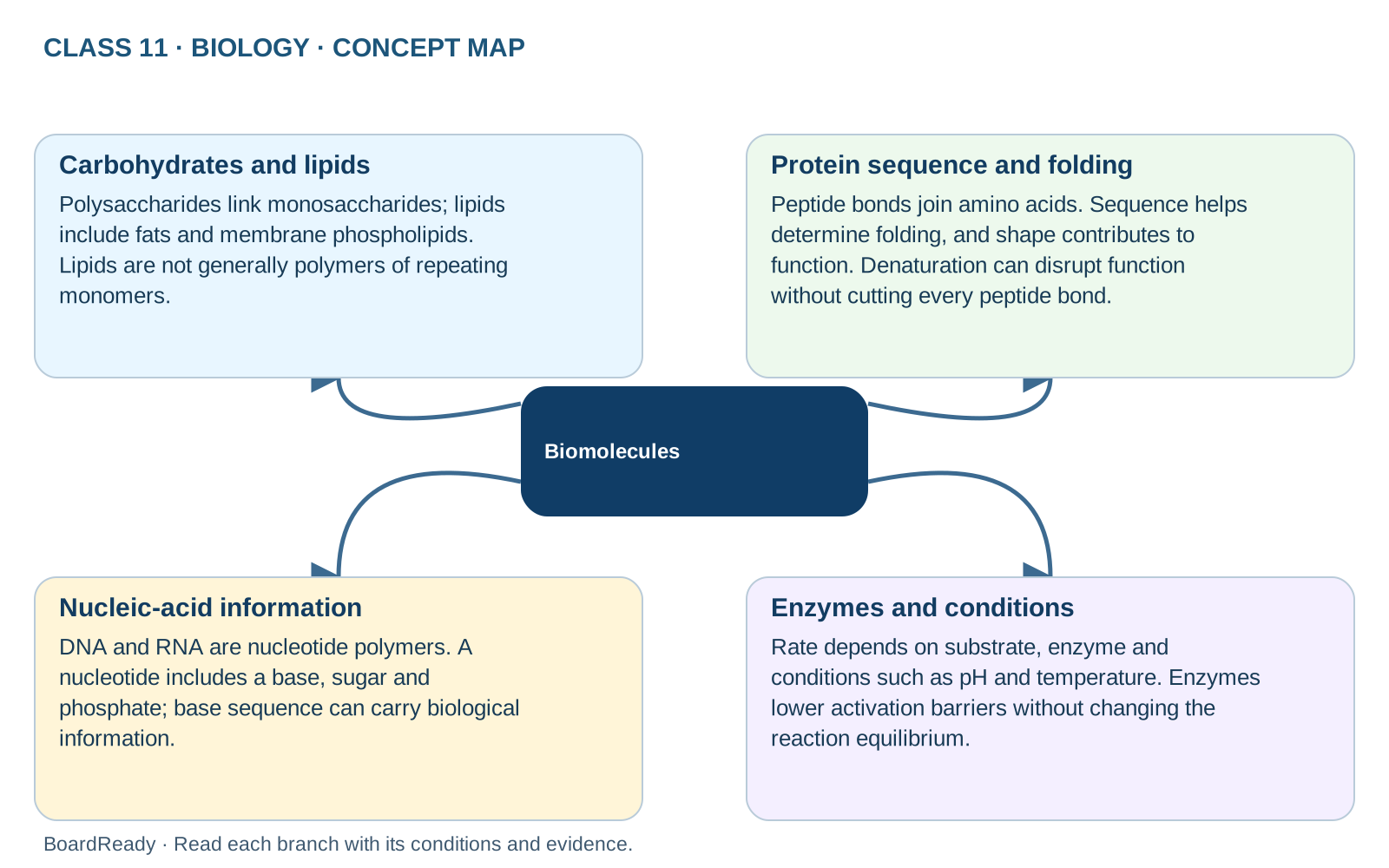
Connect molecular building blocks to macromolecule structure, biological function and enzyme behaviour. Carbohydrates and lipids: Polysaccharides link monosaccharides; lipids include fats and membrane phospholipids. Lipids are not generally polymers of repeating monomers. Protein sequence and folding: Peptide bonds join amino acids. Sequence helps determine folding, and shape contributes to function. Denaturation can disrupt function without cutting every peptide bond. Nucleic-acid information: DNA and RNA are nucleotide polymers. A nucleotide includes a base, sugar and phosphate; base sequence can carry biological information. Enzymes and conditions: Rate depends on substrate, enzyme and conditions such as pH and temperature. Enzymes lower activation barriers without changing the reaction equilibrium.Exam cue: Identify the building unit and bond, connect structure to function, and state the conditions of any enzyme-rate comparison.
- 1Biomolecules -> Carbohydrates and lipids: Polysaccharides link monosaccharides; lipids include fats and membrane phospholipids. Lipids are not generally polymers of repeating monomers.
- 2Biomolecules -> Protein sequence and folding: Peptide bonds join amino acids. Sequence helps determine folding, and shape contributes to function. Denaturation can disrupt function without cutting every peptide bond.
- 3Biomolecules -> Nucleic-acid information: DNA and RNA are nucleotide polymers. A nucleotide includes a base, sugar and phosphate; base sequence can carry biological information.
- 4Biomolecules -> Enzymes and conditions: Rate depends on substrate, enzyme and conditions such as pH and temperature. Enzymes lower activation barriers without changing the reaction equilibrium.