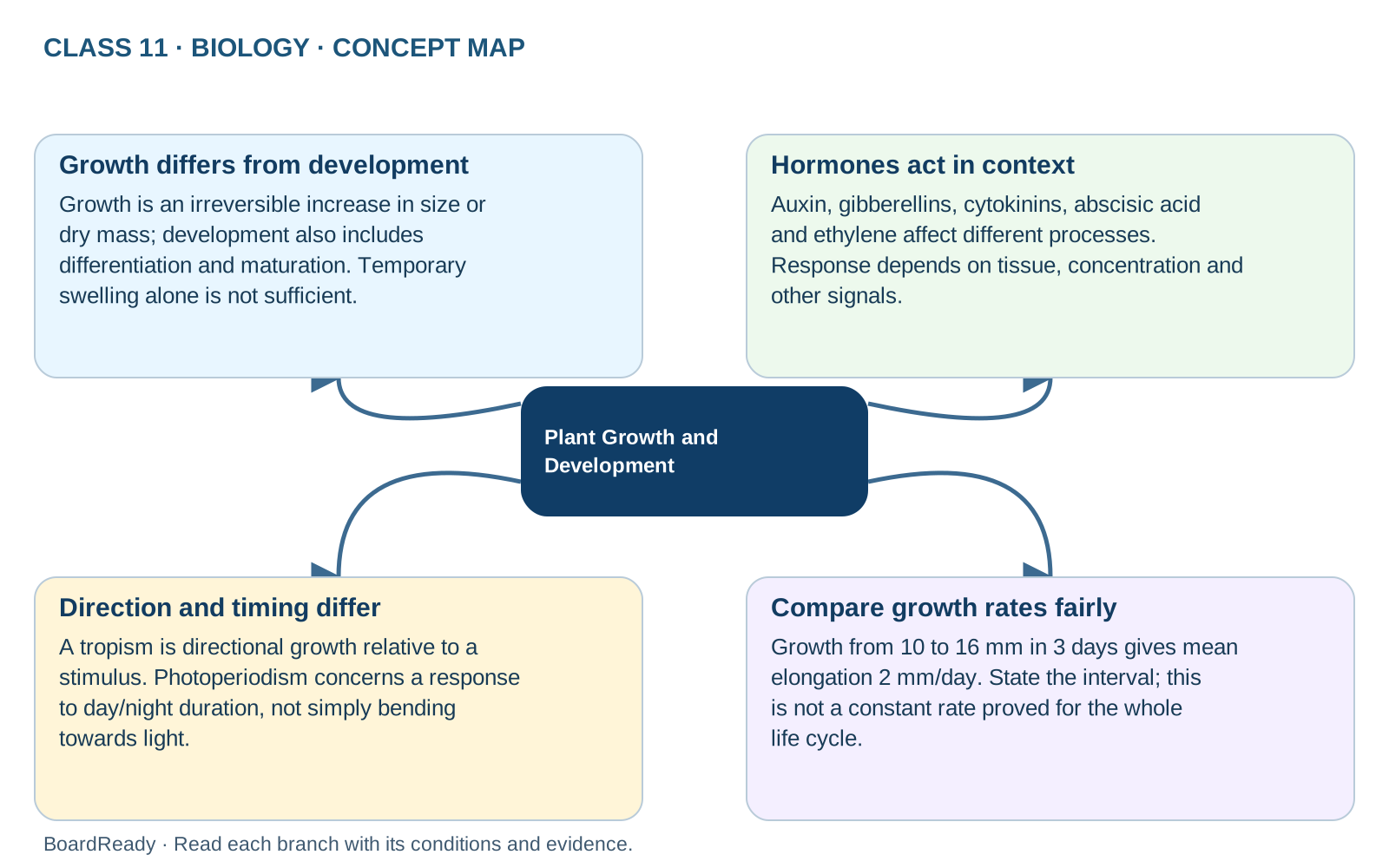
Comparison map
Plant Growth and Development: relationships and examples
Connect irreversible growth, developmental changes and environmental responses with experiments that test specific conditions. Growth differs from development: Growth is an irreversible increase in size or dry mass; development also includes differentiation and maturation. Temporary swelling alone is not sufficient. Hormones act in context: Auxin, gibberellins, cytokinins, abscisic acid and ethylene affect different processes. Response depends on tissue, concentration and other signals. Direction and timing differ: A tropism is directional growth relative to a stimulus. Photoperiodism concerns a response to day/night duration, not simply bending towards light. Compare growth rates fairly: Growth from 10 to 16 mm in 3 days gives mean elongation 2 mm/day. State the interval; this is not a constant rate proved for the whole life cycle.Exam cue: Define the measured growth variable, time interval and control conditions before attributing a response to a hormone or environmental signal.
- 1Plant Growth and Development -> Growth differs from development: Growth is an irreversible increase in size or dry mass; development also includes differentiation and maturation. Temporary swelling alone is not sufficient.
- 2Plant Growth and Development -> Hormones act in context: Auxin, gibberellins, cytokinins, abscisic acid and ethylene affect different processes. Response depends on tissue, concentration and other signals.
- 3Plant Growth and Development -> Direction and timing differ: A tropism is directional growth relative to a stimulus. Photoperiodism concerns a response to day/night duration, not simply bending towards light.
- 4Plant Growth and Development -> Compare growth rates fairly: Growth from 10 to 16 mm in 3 days gives mean elongation 2 mm/day. State the interval; this is not a constant rate proved for the whole life cycle.