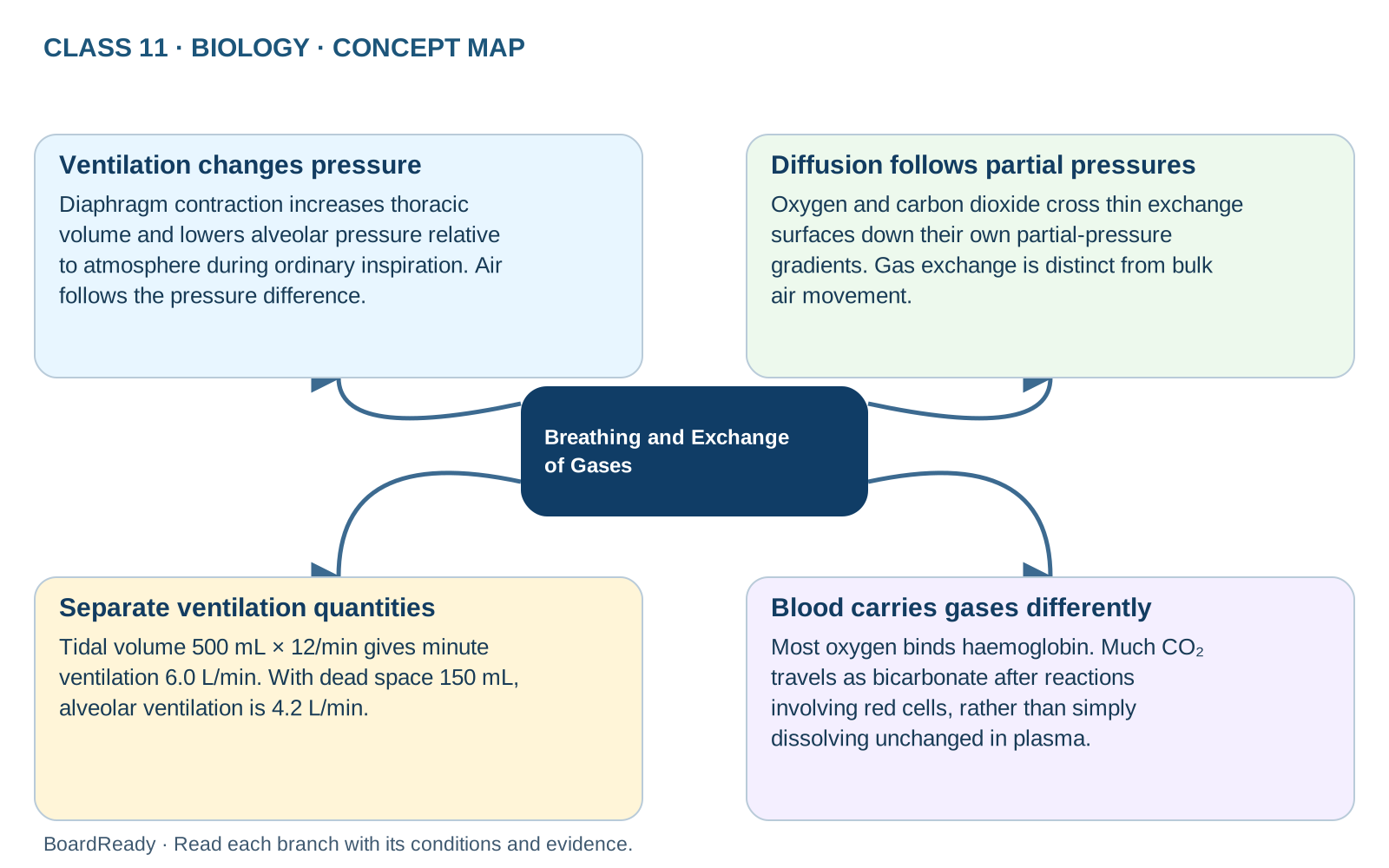
Comparison map
Breathing and Exchange of Gases: relationships and examples
Connect pressure-driven ventilation, diffusion at exchange surfaces and gas transport in blood. Ventilation changes pressure: Diaphragm contraction increases thoracic volume and lowers alveolar pressure relative to atmosphere during ordinary inspiration. Air follows the pressure difference. Diffusion follows partial pressures: Oxygen and carbon dioxide cross thin exchange surfaces down their own partial-pressure gradients. Gas exchange is distinct from bulk air movement. Separate ventilation quantities: Tidal volume 500 mL × 12/min gives minute ventilation 6.0 L/min. With dead space 150 mL, alveolar ventilation is 4.2 L/min. Blood carries gases differently: Most oxygen binds haemoglobin. Much CO₂ travels as bicarbonate after reactions involving red cells, rather than simply dissolving unchanged in plasma.Exam cue: Trace air movement, alveolar diffusion and blood transport separately; keep frequency, tidal volume and ventilation rate distinct.
- 1Breathing and Exchange of Gases -> Ventilation changes pressure: Diaphragm contraction increases thoracic volume and lowers alveolar pressure relative to atmosphere during ordinary inspiration. Air follows the pressure difference.
- 2Breathing and Exchange of Gases -> Diffusion follows partial pressures: Oxygen and carbon dioxide cross thin exchange surfaces down their own partial-pressure gradients. Gas exchange is distinct from bulk air movement.
- 3Breathing and Exchange of Gases -> Separate ventilation quantities: Tidal volume 500 mL × 12/min gives minute ventilation 6.0 L/min. With dead space 150 mL, alveolar ventilation is 4.2 L/min.
- 4Breathing and Exchange of Gases -> Blood carries gases differently: Most oxygen binds haemoglobin. Much CO₂ travels as bicarbonate after reactions involving red cells, rather than simply dissolving unchanged in plasma.