Comparison map
Body Fluids and Circulation: relationships and examples
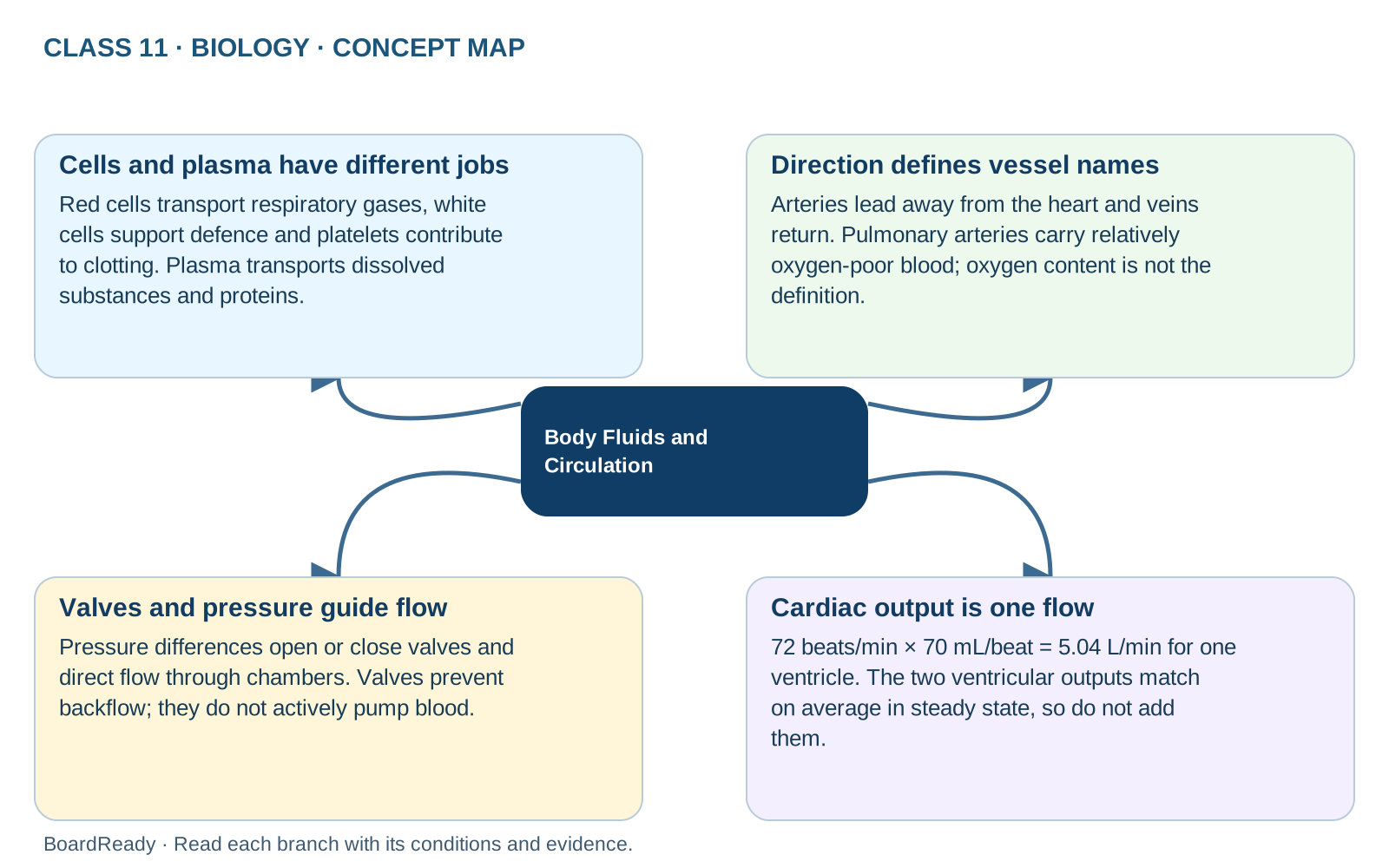
Connect blood composition, the cardiac cycle and serial pulmonary/systemic flow to material transport. Cells and plasma have different jobs: Red cells transport respiratory gases, white cells support defence and platelets contribute to clotting. Plasma transports dissolved substances and proteins. Direction defines vessel names: Arteries lead away from the heart and veins return. Pulmonary arteries carry relatively oxygen-poor blood; oxygen content is not the definition. Valves and pressure guide flow: Pressure differences open or close valves and direct flow through chambers. Valves prevent backflow; they do not actively pump blood. Cardiac output is one flow: 72 beats/min × 70 mL/beat = 5.04 L/min for one ventricle. The two ventricular outputs match on average in steady state, so do not add them.Exam cue: Follow one complete circuit and state the basis of a flow calculation; avoid double counting serial ventricular flows.
- 1Body Fluids and Circulation -> Cells and plasma have different jobs: Red cells transport respiratory gases, white cells support defence and platelets contribute to clotting. Plasma transports dissolved substances and proteins.
- 2Body Fluids and Circulation -> Direction defines vessel names: Arteries lead away from the heart and veins return. Pulmonary arteries carry relatively oxygen-poor blood; oxygen content is not the definition.
- 3Body Fluids and Circulation -> Valves and pressure guide flow: Pressure differences open or close valves and direct flow through chambers. Valves prevent backflow; they do not actively pump blood.
- 4Body Fluids and Circulation -> Cardiac output is one flow: 72 beats/min × 70 mL/beat = 5.04 L/min for one ventricle. The two ventricular outputs match on average in steady state, so do not add them.