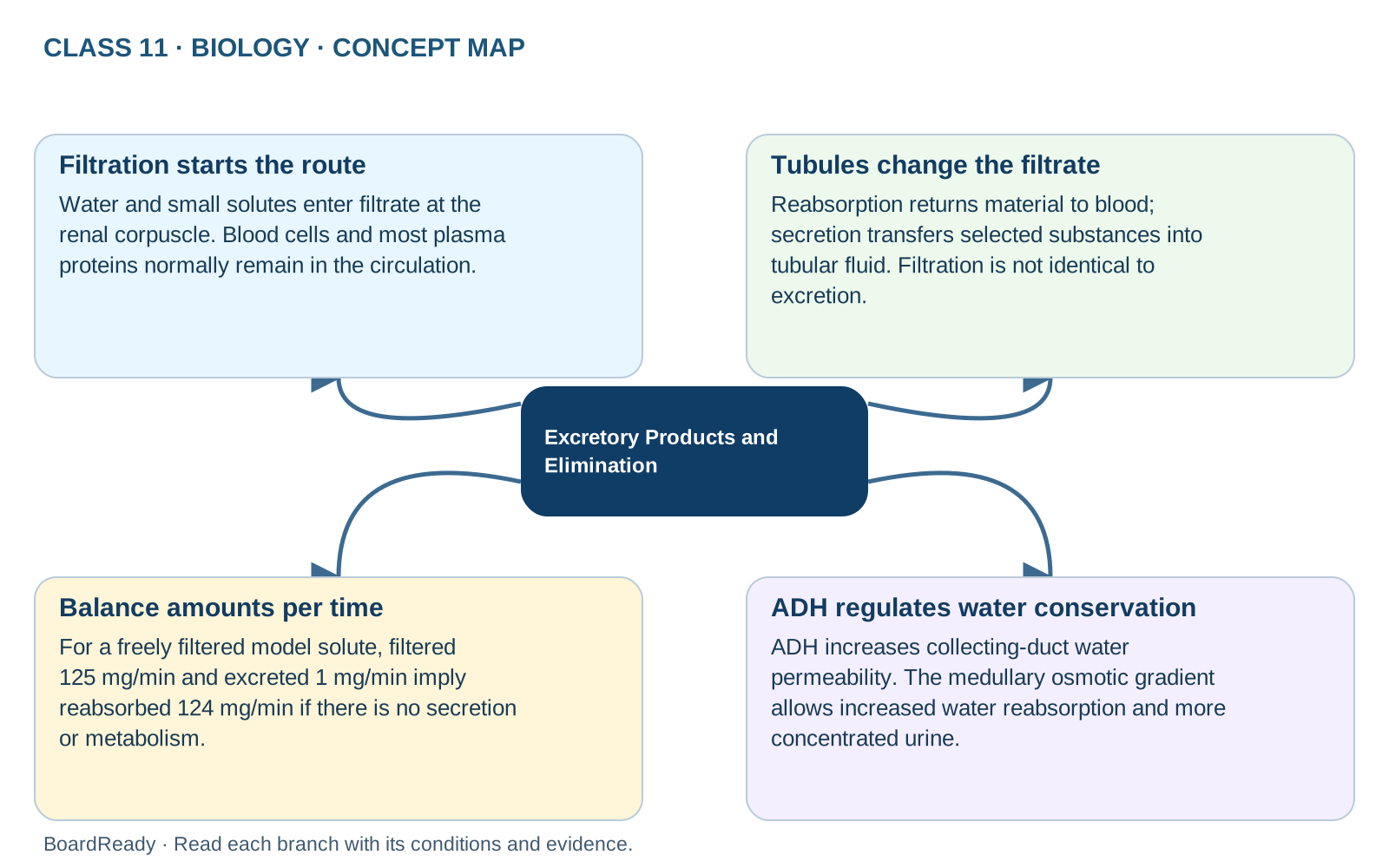
Comparison map
Excretory Products and Elimination: relationships and examples
Connect nephron transfers, final urine loss and water regulation through explicit compartment and substance balances. Filtration starts the route: Water and small solutes enter filtrate at the renal corpuscle. Blood cells and most plasma proteins normally remain in the circulation. Tubules change the filtrate: Reabsorption returns material to blood; secretion transfers selected substances into tubular fluid. Filtration is not identical to excretion. Balance amounts per time: For a freely filtered model solute, filtered 125 mg/min and excreted 1 mg/min imply reabsorbed 124 mg/min if there is no secretion or metabolism. ADH regulates water conservation: ADH increases collecting-duct water permeability. The medullary osmotic gradient allows increased water reabsorption and more concentrated urine.Exam cue: Multiply concentration by flow to obtain a mass rate. State secretion and metabolism assumptions before interpreting the difference.
- 1Excretory Products and Elimination -> Filtration starts the route: Water and small solutes enter filtrate at the renal corpuscle. Blood cells and most plasma proteins normally remain in the circulation.
- 2Excretory Products and Elimination -> Tubules change the filtrate: Reabsorption returns material to blood; secretion transfers selected substances into tubular fluid. Filtration is not identical to excretion.
- 3Excretory Products and Elimination -> Balance amounts per time: For a freely filtered model solute, filtered 125 mg/min and excreted 1 mg/min imply reabsorbed 124 mg/min if there is no secretion or metabolism.
- 4Excretory Products and Elimination -> ADH regulates water conservation: ADH increases collecting-duct water permeability. The medullary osmotic gradient allows increased water reabsorption and more concentrated urine.