Comparison map
Locomotion and Movement: relationships and examples
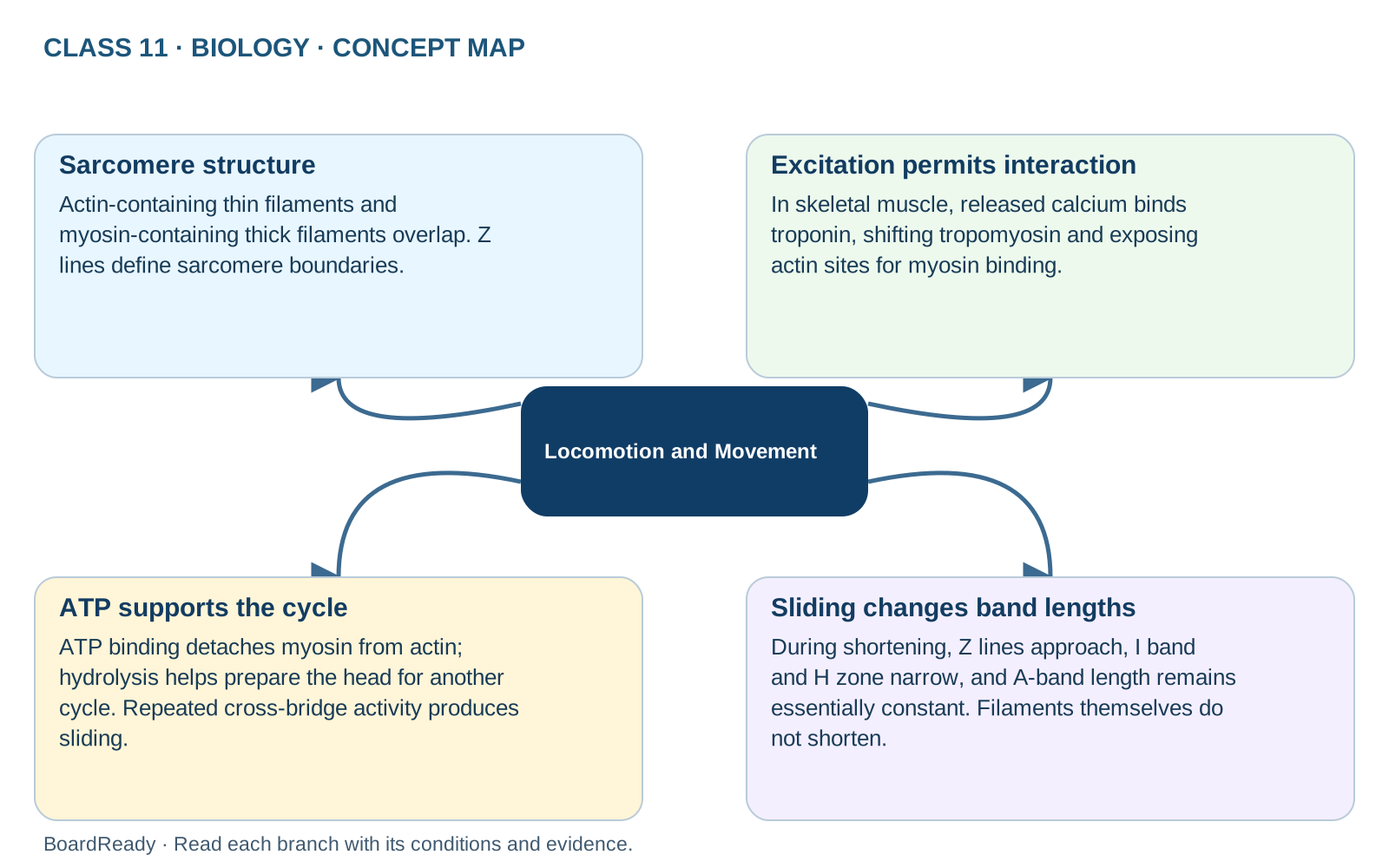
Connect filament interactions, excitation and force transmission without confusing muscle shortening with filament shortening. Sarcomere structure: Actin-containing thin filaments and myosin-containing thick filaments overlap. Z lines define sarcomere boundaries. Excitation permits interaction: In skeletal muscle, released calcium binds troponin, shifting tropomyosin and exposing actin sites for myosin binding. ATP supports the cycle: ATP binding detaches myosin from actin; hydrolysis helps prepare the head for another cycle. Repeated cross-bridge activity produces sliding. Sliding changes band lengths: During shortening, Z lines approach, I band and H zone narrow, and A-band length remains essentially constant. Filaments themselves do not shorten.Exam cue: Trace excitation → calcium → cross-bridge cycling → sliding, then distinguish sarcomere, band and filament lengths.
- 1Locomotion and Movement -> Sarcomere structure: Actin-containing thin filaments and myosin-containing thick filaments overlap. Z lines define sarcomere boundaries.
- 2Locomotion and Movement -> Excitation permits interaction: In skeletal muscle, released calcium binds troponin, shifting tropomyosin and exposing actin sites for myosin binding.
- 3Locomotion and Movement -> ATP supports the cycle: ATP binding detaches myosin from actin; hydrolysis helps prepare the head for another cycle. Repeated cross-bridge activity produces sliding.
- 4Locomotion and Movement -> Sliding changes band lengths: During shortening, Z lines approach, I band and H zone narrow, and A-band length remains essentially constant. Filaments themselves do not shorten.