Comparison map
Digestion and Absorption: relationships and examples
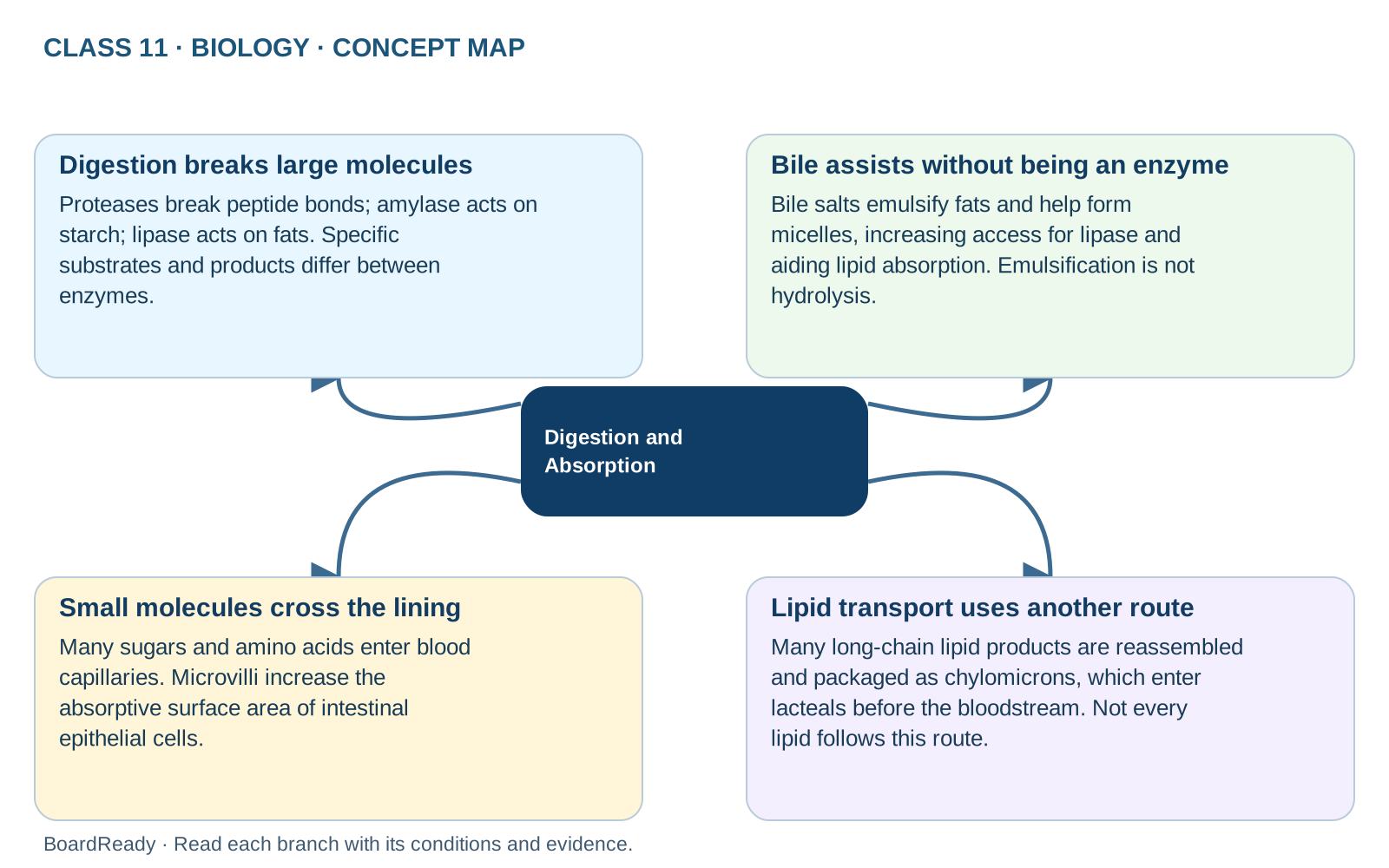
Connect food breakdown to absorbable products and routes across the intestinal epithelium. Digestion breaks large molecules: Proteases break peptide bonds; amylase acts on starch; lipase acts on fats. Specific substrates and products differ between enzymes. Bile assists without being an enzyme: Bile salts emulsify fats and help form micelles, increasing access for lipase and aiding lipid absorption. Emulsification is not hydrolysis. Small molecules cross the lining: Many sugars and amino acids enter blood capillaries. Microvilli increase the absorptive surface area of intestinal epithelial cells. Lipid transport uses another route: Many long-chain lipid products are reassembled and packaged as chylomicrons, which enter lacteals before the bloodstream. Not every lipid follows this route.Exam cue: Separate digestion, absorption and assimilation, and name both the molecular product and its transport route.
- 1Digestion and Absorption -> Digestion breaks large molecules: Proteases break peptide bonds; amylase acts on starch; lipase acts on fats. Specific substrates and products differ between enzymes.
- 2Digestion and Absorption -> Bile assists without being an enzyme: Bile salts emulsify fats and help form micelles, increasing access for lipase and aiding lipid absorption. Emulsification is not hydrolysis.
- 3Digestion and Absorption -> Small molecules cross the lining: Many sugars and amino acids enter blood capillaries. Microvilli increase the absorptive surface area of intestinal epithelial cells.
- 4Digestion and Absorption -> Lipid transport uses another route: Many long-chain lipid products are reassembled and packaged as chylomicrons, which enter lacteals before the bloodstream. Not every lipid follows this route.