Comparison map
Household Circuits and Electrical Safety: relationships and examples
Circuit protection addresses different faults. Overcurrent protection, protective earthing and residual-current protection serve distinct roles.Exam cue: A fuse responds to overcurrent. Dangerous body currents can be far below an appliance fuse rating, so other protective measures are also necessary.
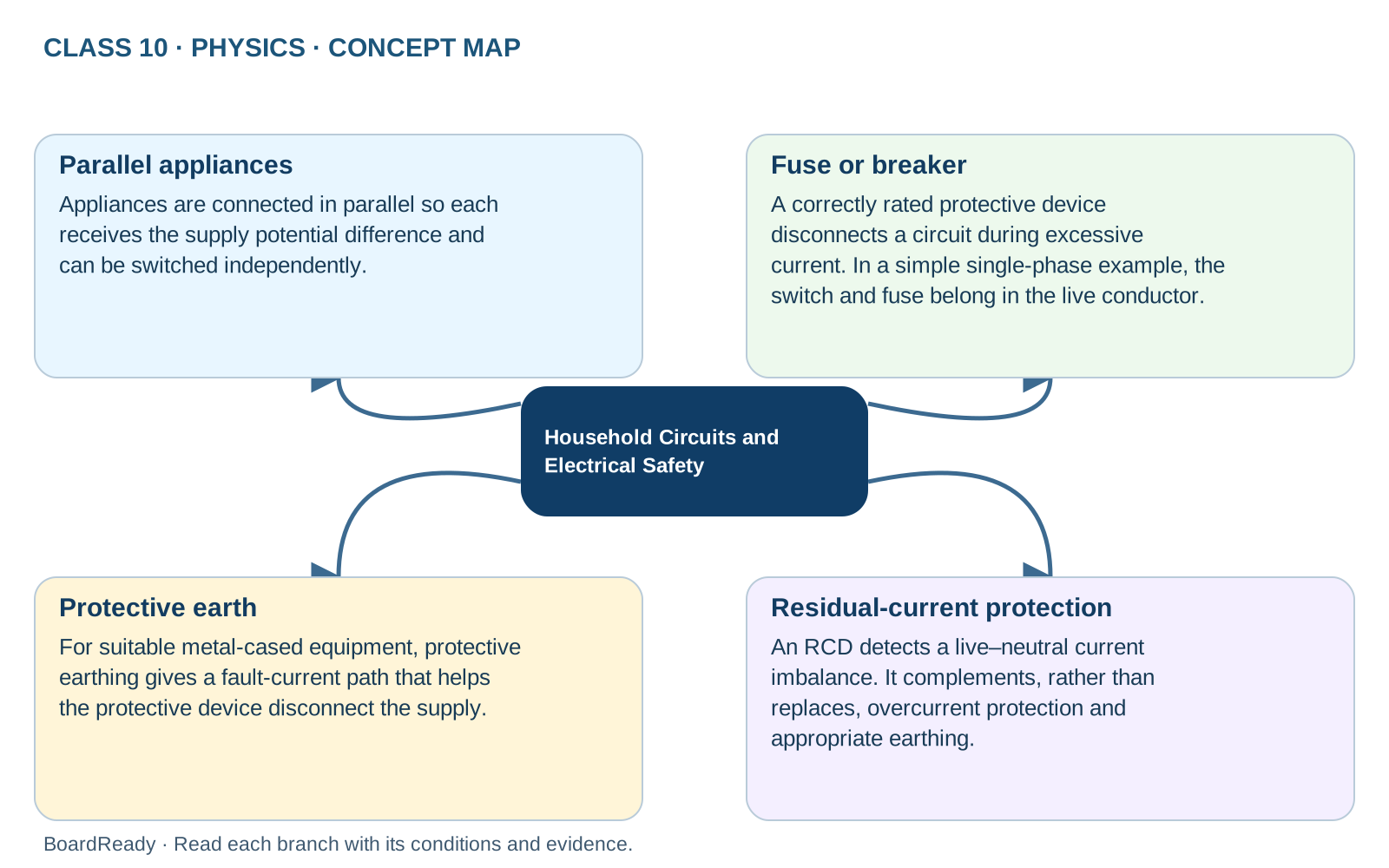
- 1Household Circuits and Electrical Safety -> Parallel appliances: Appliances are connected in parallel so each receives the supply potential difference and can be switched independently.
- 2Household Circuits and Electrical Safety -> Fuse or breaker: A correctly rated protective device disconnects a circuit during excessive current. In a simple single-phase example, the switch and fuse belong in the live conductor.
- 3Household Circuits and Electrical Safety -> Protective earth: For suitable metal-cased equipment, protective earthing gives a fault-current path that helps the protective device disconnect the supply.
- 4Household Circuits and Electrical Safety -> Residual-current protection: An RCD detects a live–neutral current imbalance. It complements, rather than replaces, overcurrent protection and appropriate earthing.