Comparison map
EMF, Terminal Potential Difference, and Internal Resistance: relationships and examples
A cell supplies energy per coulomb. When it delivers current, some energy per coulomb is transferred inside its own internal resistance.Exam cue: When the cell supplies current, internal resistance reduces terminal voltage. The stated relation assumes discharge, not charging.
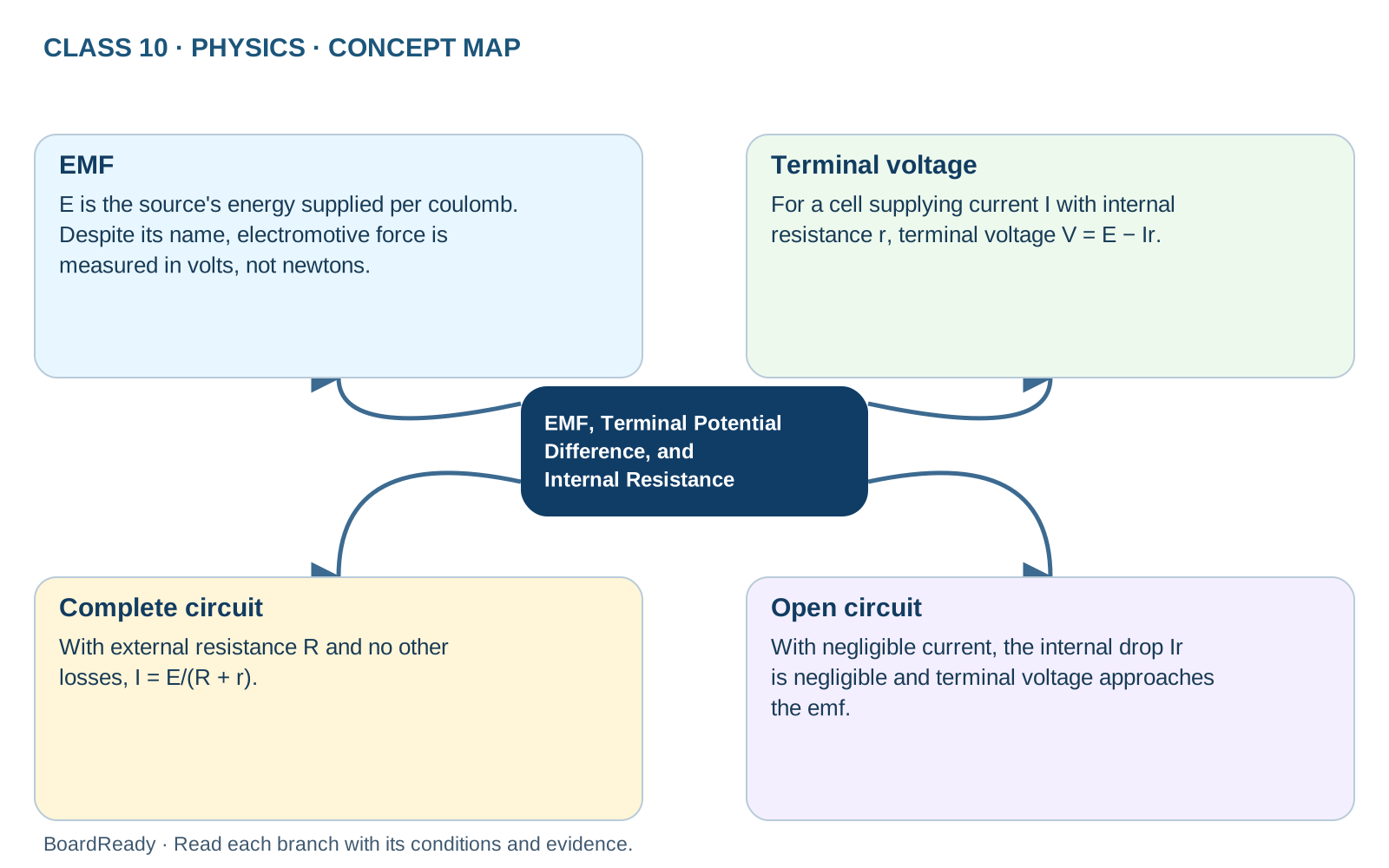
- 1EMF, Terminal Potential Difference, and Internal Resistance -> EMF: E is the source's energy supplied per coulomb. Despite its name, electromotive force is measured in volts, not newtons.
- 2EMF, Terminal Potential Difference, and Internal Resistance -> Terminal voltage: For a cell supplying current I with internal resistance r, terminal voltage V = E − Ir.
- 3EMF, Terminal Potential Difference, and Internal Resistance -> Complete circuit: With external resistance R and no other losses, I = E/(R + r).
- 4EMF, Terminal Potential Difference, and Internal Resistance -> Open circuit: With negligible current, the internal drop Ir is negligible and terminal voltage approaches the emf.