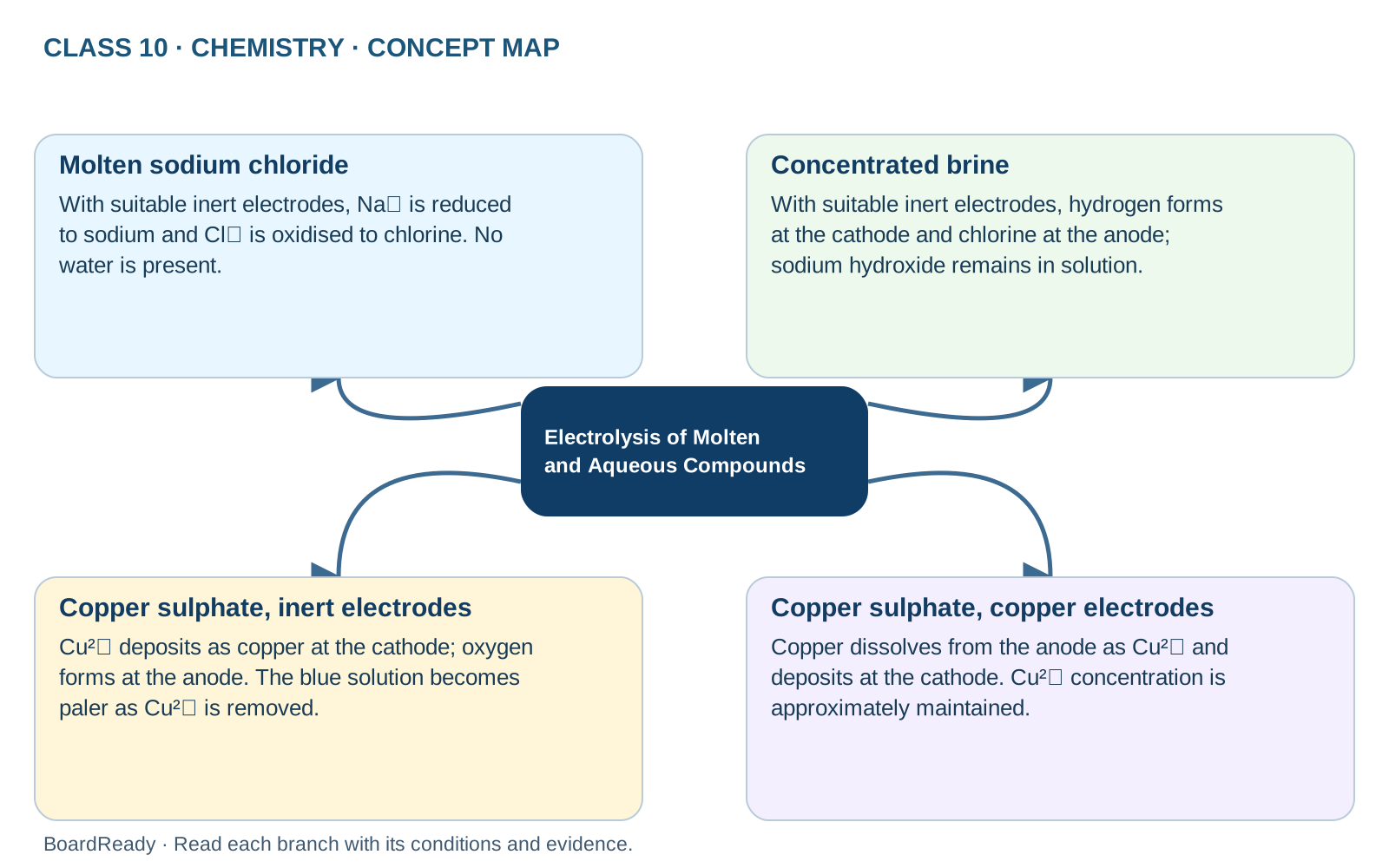
Comparison map
Electrolysis of Molten and Aqueous Compounds: relationships and examples
Water adds competing species in aqueous electrolysis. A molten salt and its aqueous solution need not yield the same cathode product.Exam cue: In aqueous solutions, reduction of water or hydrogen ions can compete with reduction of metal ions. State whether the electrolyte is molten or aqueous.
- 1Electrolysis of Molten and Aqueous Compounds -> Molten sodium chloride: With suitable inert electrodes, Na⁺ is reduced to sodium and Cl⁻ is oxidised to chlorine. No water is present.
- 2Electrolysis of Molten and Aqueous Compounds -> Concentrated brine: With suitable inert electrodes, hydrogen forms at the cathode and chlorine at the anode; sodium hydroxide remains in solution.
- 3Electrolysis of Molten and Aqueous Compounds -> Copper sulphate, inert electrodes: Cu²⁺ deposits as copper at the cathode; oxygen forms at the anode. The blue solution becomes paler as Cu²⁺ is removed.
- 4Electrolysis of Molten and Aqueous Compounds -> Copper sulphate, copper electrodes: Copper dissolves from the anode as Cu²⁺ and deposits at the cathode. Cu²⁺ concentration is approximately maintained.