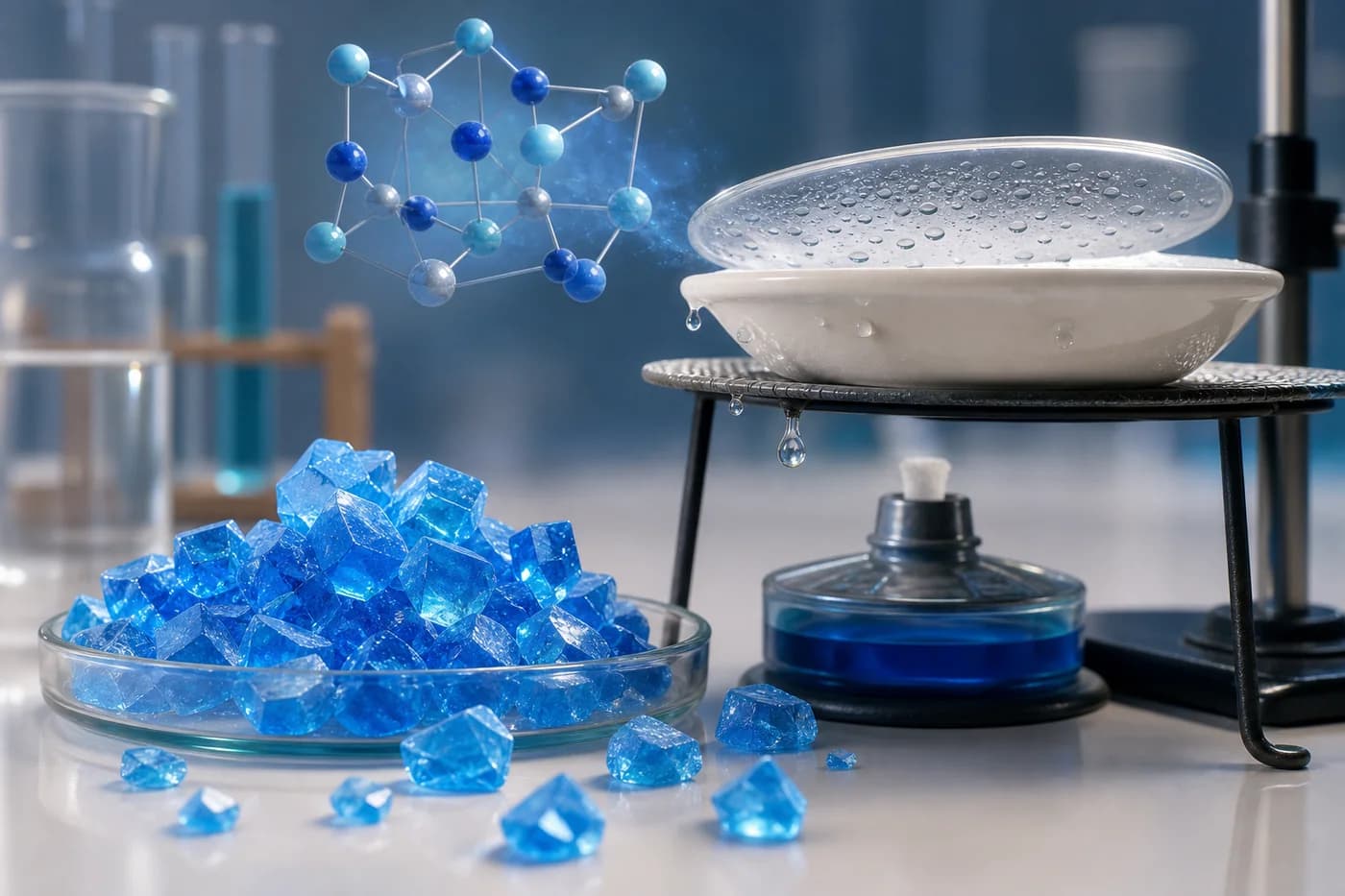
Water of Crystallisation focuses on Water of Crystallisation focuses on Water of Crystallisation focuses on Study hydrated salts, anhydrous salts, heating effects, and examples such as copper sulphate. Hydrated salts have a fixed number of water molecules attached to them, which can be determined by heating the salt and measuring the mass lost as water vapor. In exams, you may encounter questions asking for the formula of hydrated salts or how much water is removed during dehydration. Always balance your chemical equations and use molar masses correctly to find x in hydrate formulas. Hydrated salts contain a fixed number of water molecules within their crystal structure. Water of crystallisation is the fixed water present inside the crystal structure of some salts. Water of Crystallisation focuses on Study hydrated salts, anhydrous salts, heating effects, and examples such as copper sulphate. Hydrated salts have a fixed number of water molecules attached to them, which can be determined by heating the salt and measuring the mass lost as water vapor. In exams, you may encounter questions asking for the formula of hydrated salts or how much water is removed during dehydration. Always balance your chemical equations and use molar masses correctly to find x in hydrate formulas. Hydrated salts contain a fixed number of water molecules within their crystal structure. Hydrated salts have a fixed number of water molecules attached to them, which can be determined by heating the salt and measuring the mass lost as water vapor. Water of crystallisation is part of the crystal lattice, not water simply sticking to the surface. Water of crystallisation is the fixed water present inside the crystal structure of some salts. Water of Crystallisation focuses on Water of Crystallisation focuses on Study hydrated salts, anhydrous salts, heating effects, and examples such as copper sulphate. Hydrated salts have a fixed number of water molecules attached to them, which can be determined by heating the salt and measuring the mass lost as water vapor. In exams, you may encounter questions asking for the formula of hydrated salts or how much water is removed during dehydration. Always balance your chemical equations and use molar masses correctly to find x in hydrate formulas. Hydrated salts contain a fixed number of water molecules within their crystal structure. Water of crystallisation is the fixed water present inside the crystal structure of some salts. Water of Crystallisation focuses on Study hydrated salts, anhydrous salts, heating effects, and examples such as copper sulphate. Hydrated salts have a fixed number of water molecules attached to them, which can be determined by heating the salt and measuring the mass lost as water vapor. In exams, you may encounter questions asking for the formula of hydrated salts or how much water is removed during dehydration. Always balance your chemical equations and use molar masses correctly to find x in hydrate formulas. Hydrated salts contain a fixed number of water molecules within their crystal structure. Hydrated salts have a fixed number of water molecules attached to them, which can be determined by heating the salt and measuring the mass lost as water vapor. Water of crystallisation is part of the crystal lattice, not water simply sticking to the surface. Water of crystallisation is the fixed water present inside the crystal structure of some salts. Water of crystallisation is part of the crystal lattice, not water simply sticking to the surface.