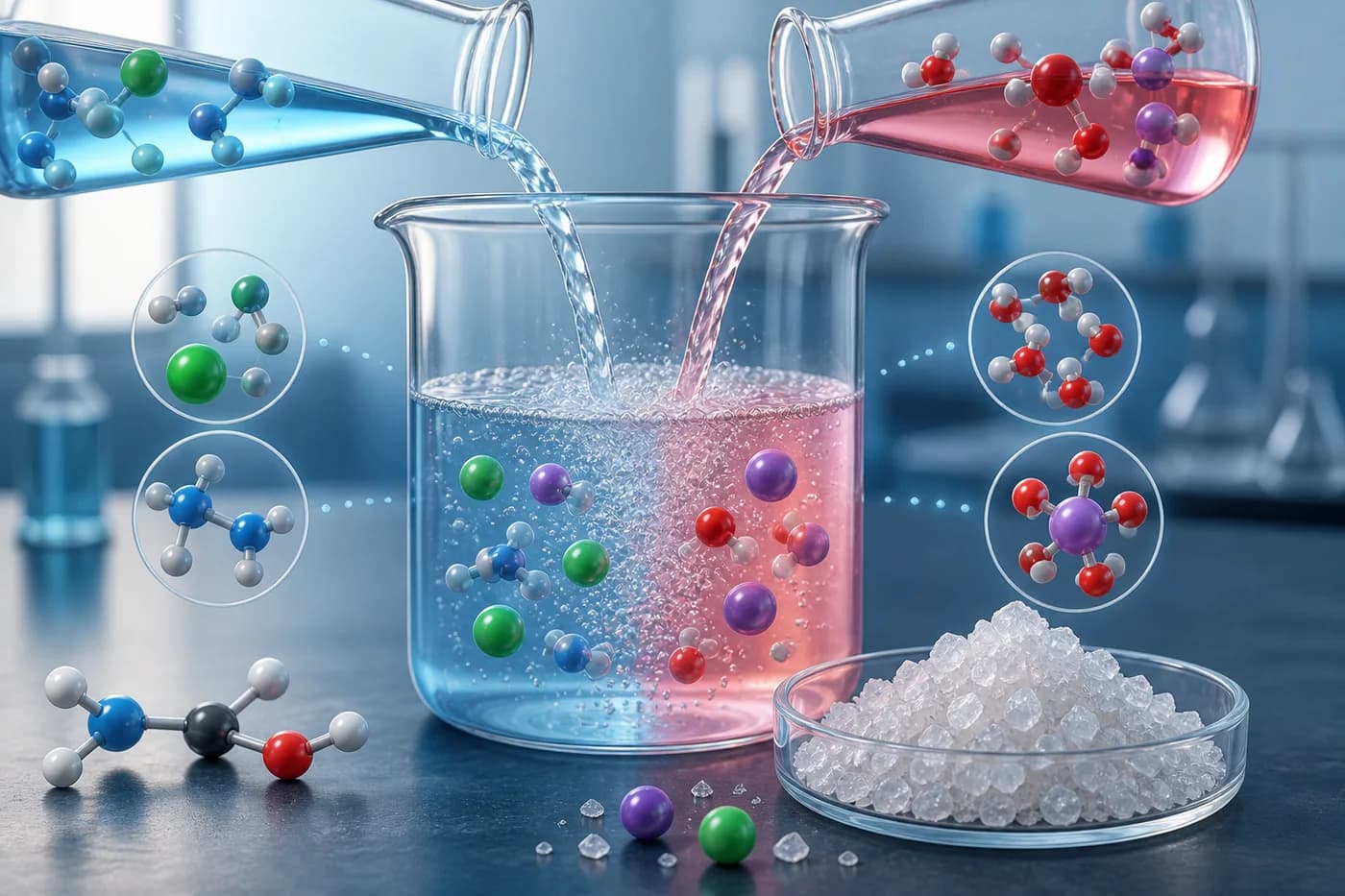
Neutralisation and Salt Formation focuses on Neutralisation and Salt Formation focuses on Neutralisation and Salt Formation focuses on Explain neutralisation, salt formation, ionic equations, and practical preparation of salts. Neutralisation reactions always produce water and a salt. When writing ionic equations, only the reacting ions are shown, not spectator ions that do not participate in the reaction. When preparing salts from acids and bases, ensure you understand how to balance the equation correctly. Common mistakes include forgetting to write all products or incorrectly balancing the number of hydrogen and hydroxide ions. A process where an acid and a base react to form water and a salt. Neutralisation happens when hydrogen ions and hydroxide ions combine to form water while the remaining ions form a salt. Neutralisation and Salt Formation focuses on Explain neutralisation, salt formation, ionic equations, and practical preparation of salts. Neutralisation reactions always produce water and a salt. When writing ionic equations, only the reacting ions are shown, not spectator ions that do not participate in the reaction. When preparing salts from acids and bases, ensure you understand how to balance the equation correctly. Common mistakes include forgetting to write all products or incorrectly balancing the number of hydrogen and hydroxide ions. A process where an acid and a base react to form water and a salt. Neutralisation reactions always produce water and a salt. When writing ionic equations, only the reacting ions are shown, not spectator ions that do not participate in the reaction. Neutralisation and Salt Formation must be answered with exact chemistry vocabulary, not only general description. Neutralisation happens when hydrogen ions and hydroxide ions combine to form water while the remaining ions form a salt. Neutralisation and Salt Formation focuses on Neutralisation and Salt Formation focuses on Explain neutralisation, salt formation, ionic equations, and practical preparation of salts. Neutralisation reactions always produce water and a salt. When writing ionic equations, only the reacting ions are shown, not spectator ions that do not participate in the reaction. When preparing salts from acids and bases, ensure you understand how to balance the equation correctly. Common mistakes include forgetting to write all products or incorrectly balancing the number of hydrogen and hydroxide ions. A process where an acid and a base react to form water and a salt. Neutralisation happens when hydrogen ions and hydroxide ions combine to form water while the remaining ions form a salt. Neutralisation and Salt Formation focuses on Explain neutralisation, salt formation, ionic equations, and practical preparation of salts. Neutralisation reactions always produce water and a salt. When writing ionic equations, only the reacting ions are shown, not spectator ions that do not participate in the reaction. When preparing salts from acids and bases, ensure you understand how to balance the equation correctly. Common mistakes include forgetting to write all products or incorrectly balancing the number of hydrogen and hydroxide ions. A process where an acid and a base react to form water and a salt. Neutralisation reactions always produce water and a salt. When writing ionic equations, only the reacting ions are shown, not spectator ions that do not participate in the reaction. Neutralisation and Salt Formation must be answered with exact chemistry vocabulary, not only general description. Neutralisation happens when hydrogen ions and hydroxide ions combine to form water while the remaining ions form a salt. Neutralisation and Salt Formation must be answered with exact chemistry vocabulary, not only general description.