
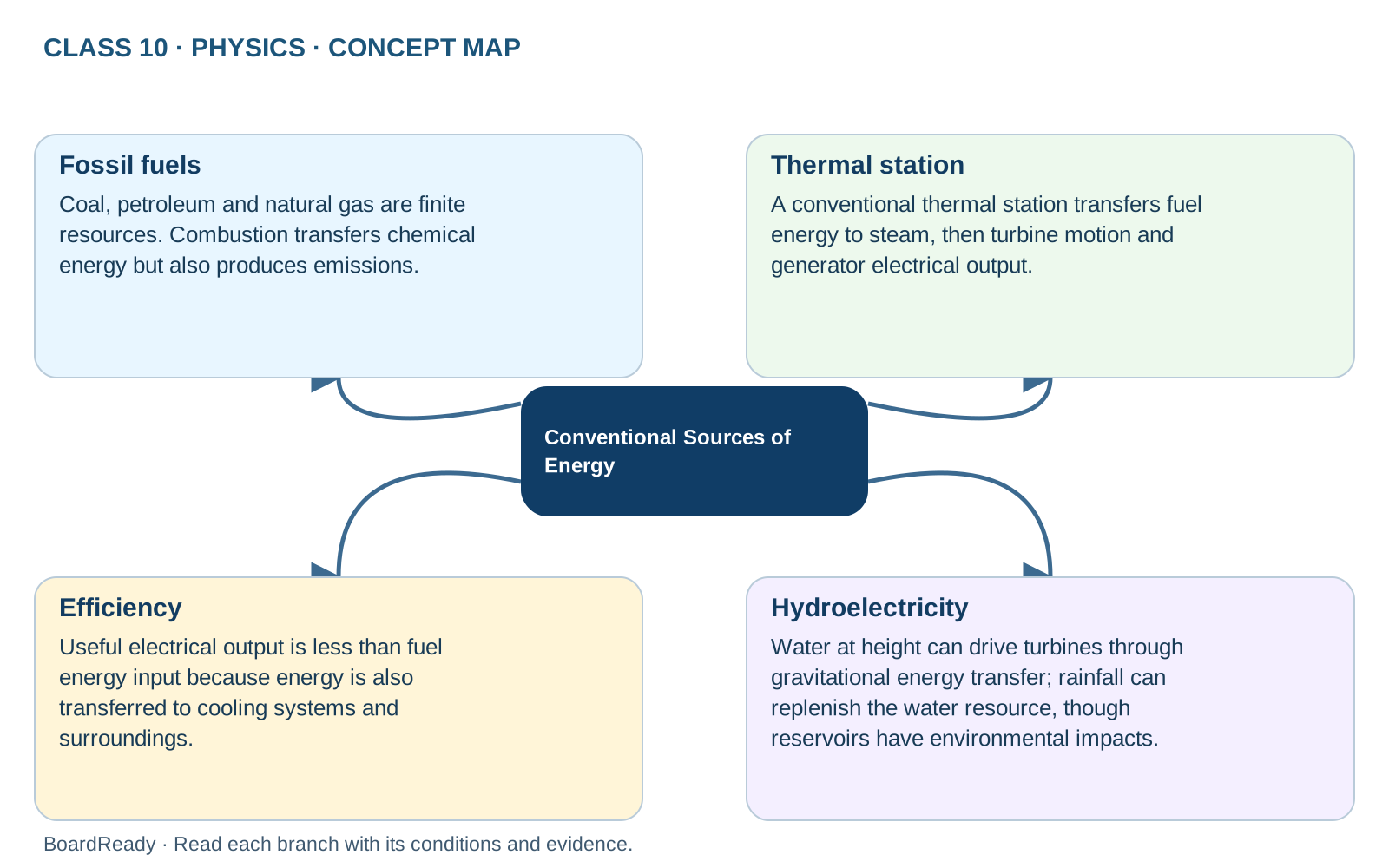
Comparison map
Conventional Sources of Energy: relationships and examples
Compare a fuel's stored energy with the useful output and the resources consumed by the complete energy pathway.Exam cue: The station contains several energy-transfer stages. The generator converts mechanical input, and the complete pathway has losses from the useful-output perspective.
- 1Conventional Sources of Energy -> Fossil fuels: Coal, petroleum and natural gas are finite resources. Combustion transfers chemical energy but also produces emissions.
- 2Conventional Sources of Energy -> Thermal station: A conventional thermal station transfers fuel energy to steam, then turbine motion and generator electrical output.
- 3Conventional Sources of Energy -> Efficiency: Useful electrical output is less than fuel energy input because energy is also transferred to cooling systems and surroundings.
- 4Conventional Sources of Energy -> Hydroelectricity: Water at height can drive turbines through gravitational energy transfer; rainfall can replenish the water resource, though reservoirs have environmental impacts.