
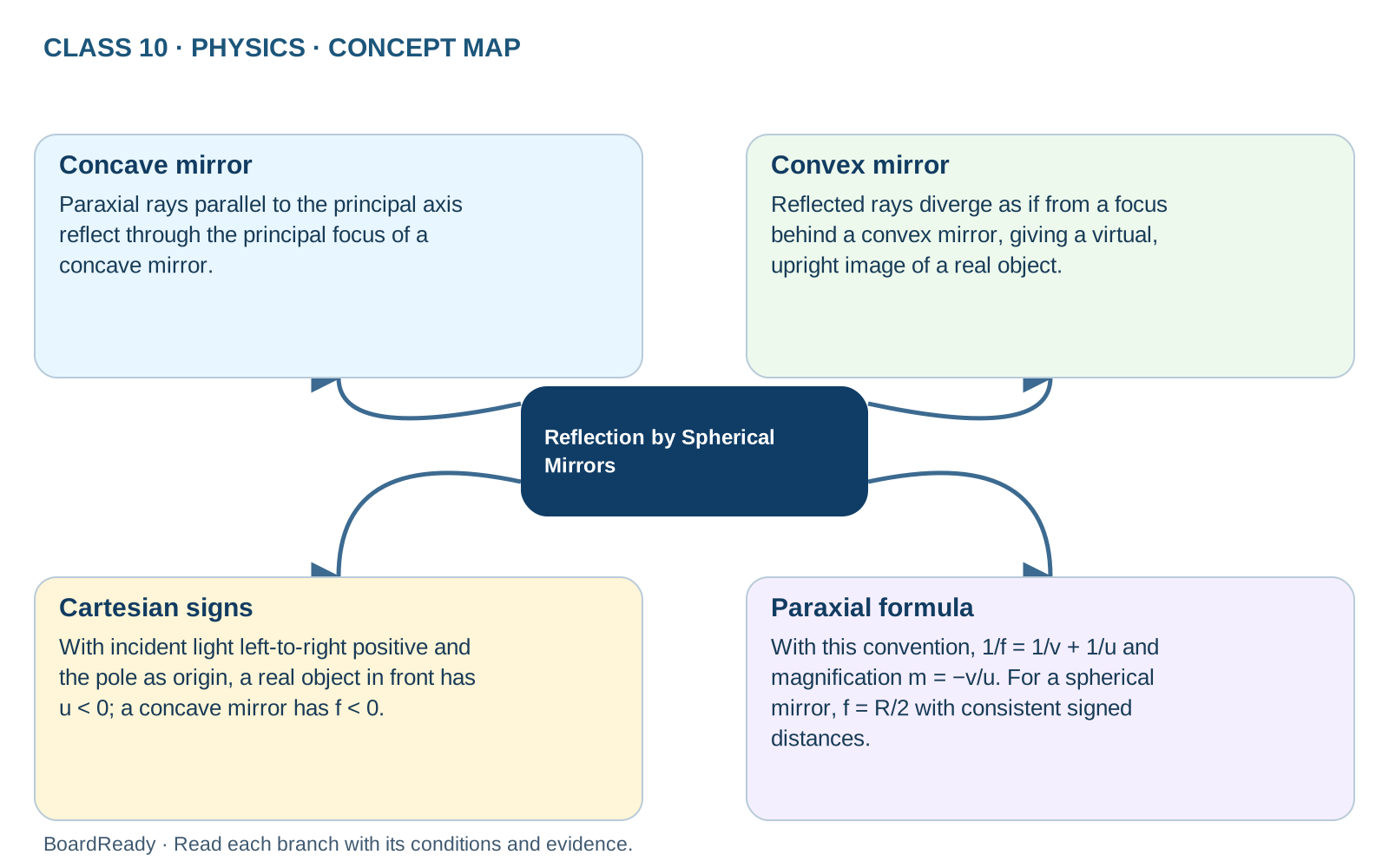
Comparison map
Reflection by Spherical Mirrors: relationships and examples
A spherical mirror forms images by reflection. Mirror and lens equations must not be mixed without checking the sign convention.Exam cue: Use the equation and signs appropriate to reflection and to the stated convention; here the mirror equation contains +1/u.
- 1Reflection by Spherical Mirrors -> Concave mirror: Paraxial rays parallel to the principal axis reflect through the principal focus of a concave mirror.
- 2Reflection by Spherical Mirrors -> Convex mirror: Reflected rays diverge as if from a focus behind a convex mirror, giving a virtual, upright image of a real object.
- 3Reflection by Spherical Mirrors -> Cartesian signs: With incident light left-to-right positive and the pole as origin, a real object in front has u < 0; a concave mirror has f < 0.
- 4Reflection by Spherical Mirrors -> Paraxial formula: With this convention, 1/f = 1/v + 1/u and magnification m = −v/u. For a spherical mirror, f = R/2 with consistent signed distances.