
Comparison map
Newton's Laws and Free Body Diagrams: relationships and examples
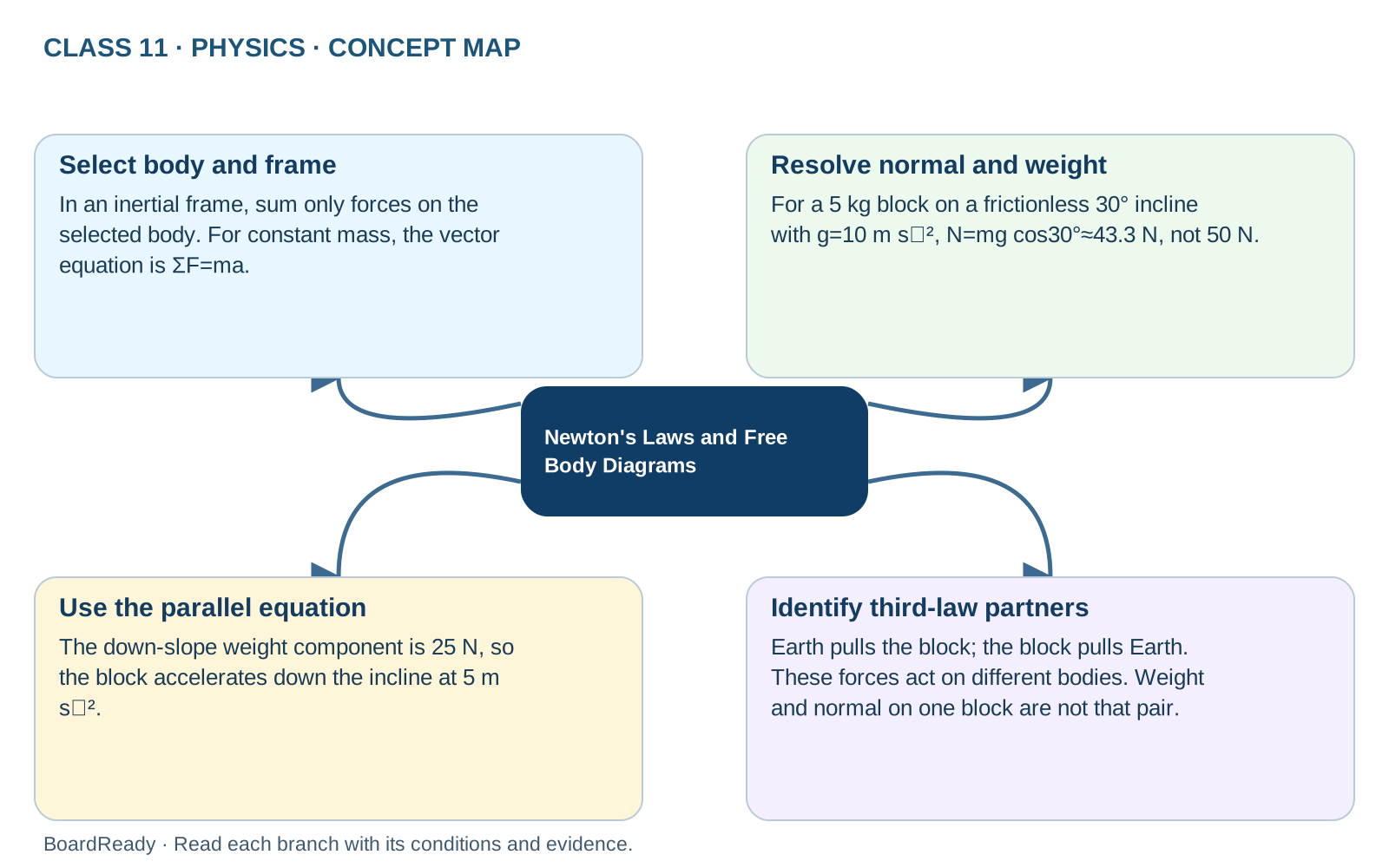
A free-body diagram links a chosen body’s interactions to its acceleration. Select body and frame: In an inertial frame, sum only forces on the selected body. For constant mass, the vector equation is ΣF=ma. Resolve normal and weight: For a 5 kg block on a frictionless 30° incline with g=10 m s⁻², N=mg cos30°≈43.3 N, not 50 N. Use the parallel equation: The down-slope weight component is 25 N, so the block accelerates down the incline at 5 m s⁻². Identify third-law partners: Earth pulls the block; the block pulls Earth. These forces act on different bodies. Weight and normal on one block are not that pair.Exam cue: Keep each body’s force diagram separate and check every component against its acceleration.
- 1Newton's Laws and Free Body Diagrams -> Select body and frame: In an inertial frame, sum only forces on the selected body. For constant mass, the vector equation is ΣF=ma.
- 2Newton's Laws and Free Body Diagrams -> Resolve normal and weight: For a 5 kg block on a frictionless 30° incline with g=10 m s⁻², N=mg cos30°≈43.3 N, not 50 N.
- 3Newton's Laws and Free Body Diagrams -> Use the parallel equation: The down-slope weight component is 25 N, so the block accelerates down the incline at 5 m s⁻².
- 4Newton's Laws and Free Body Diagrams -> Identify third-law partners: Earth pulls the block; the block pulls Earth. These forces act on different bodies. Weight and normal on one block are not that pair.