CompareLimits and Derivatives
Limits and Derivatives: relationships and examples
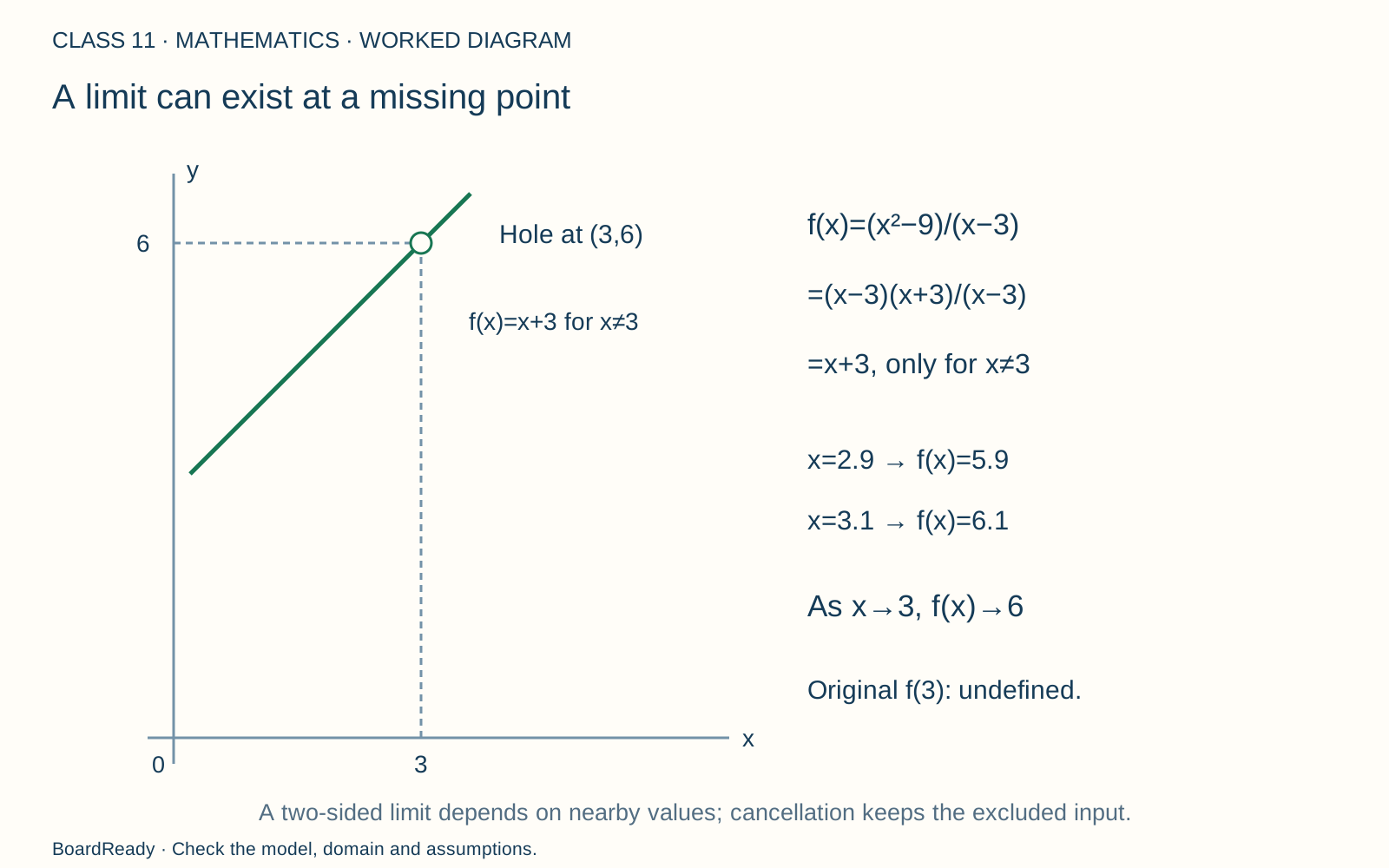
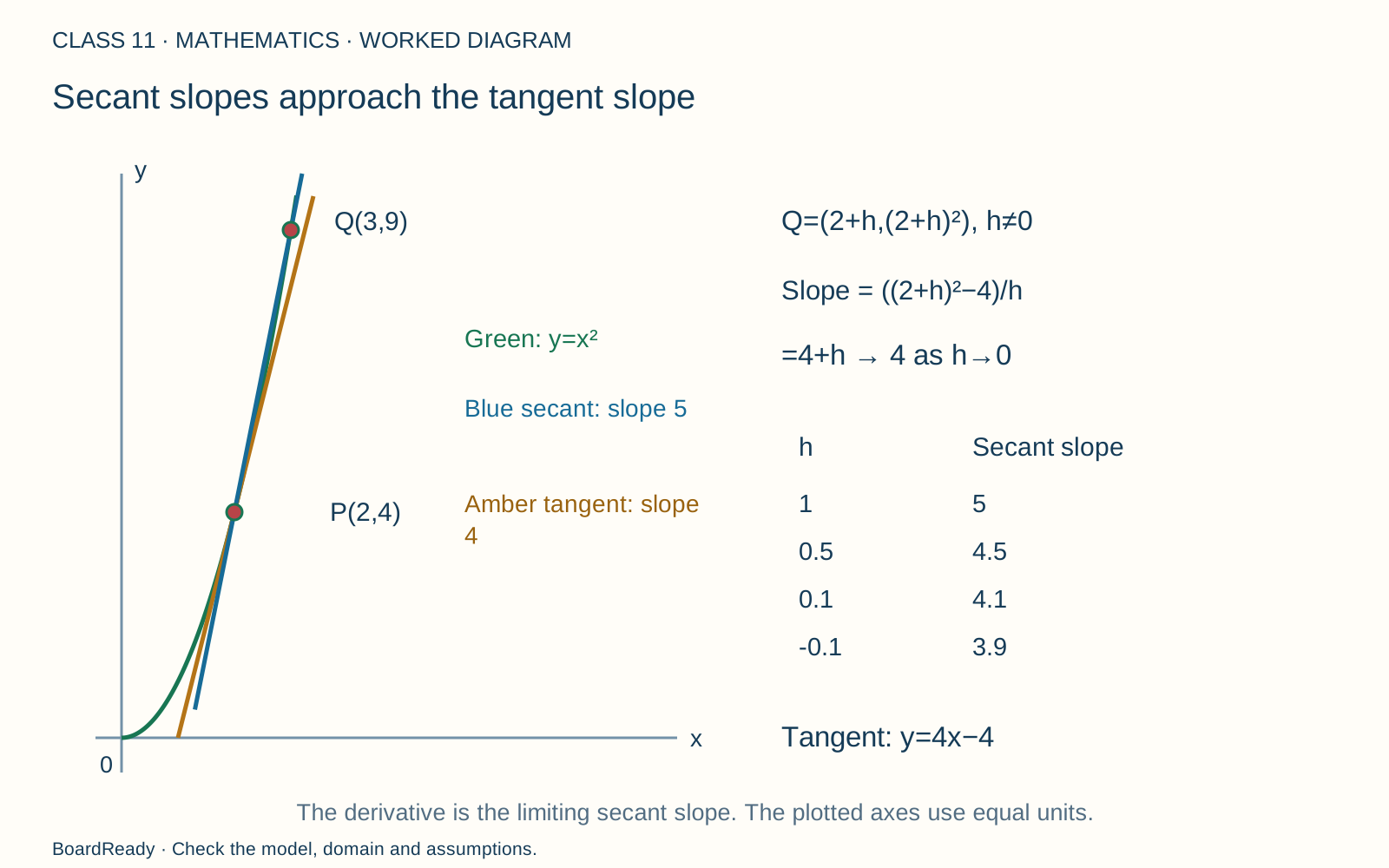
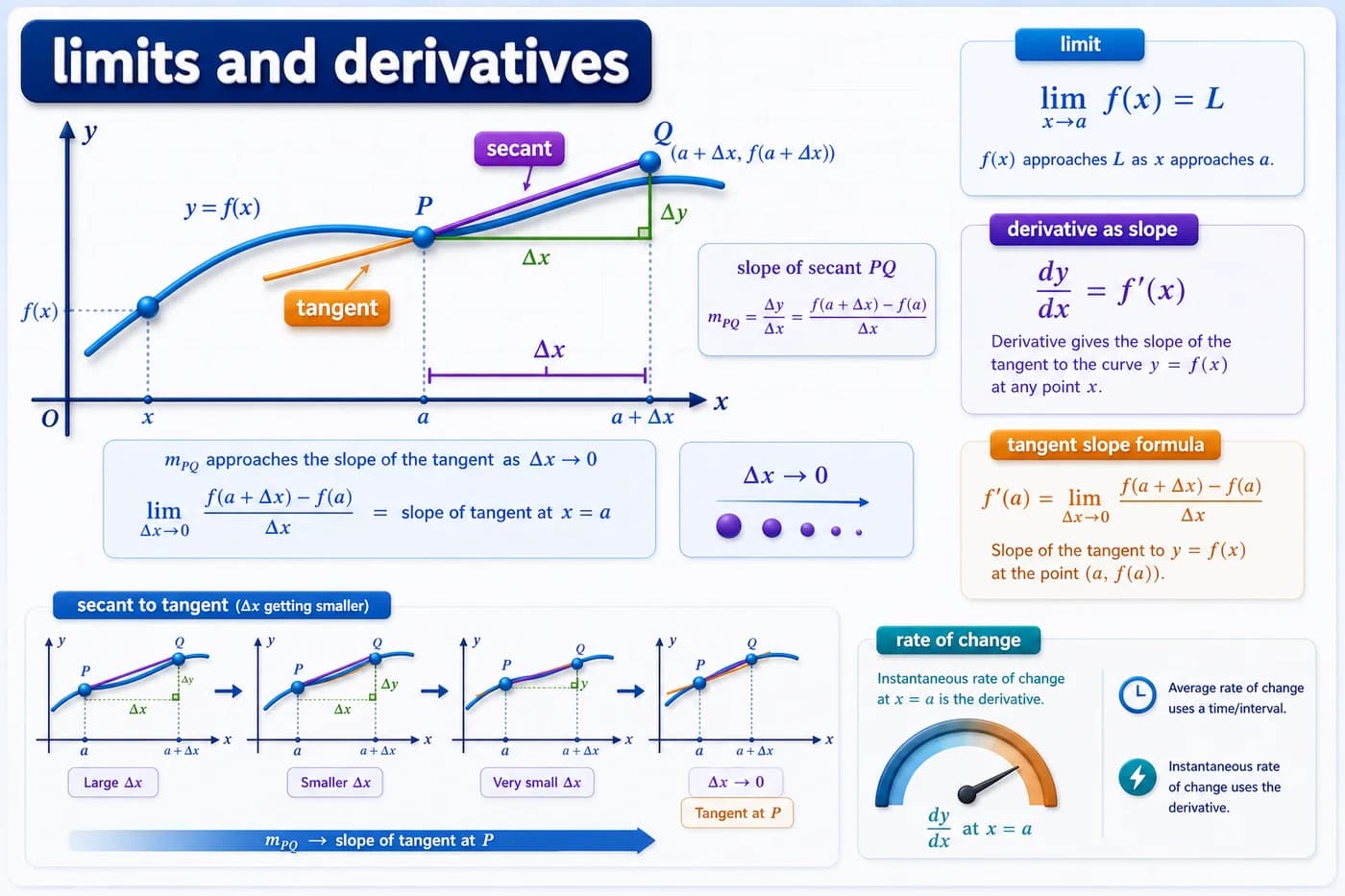
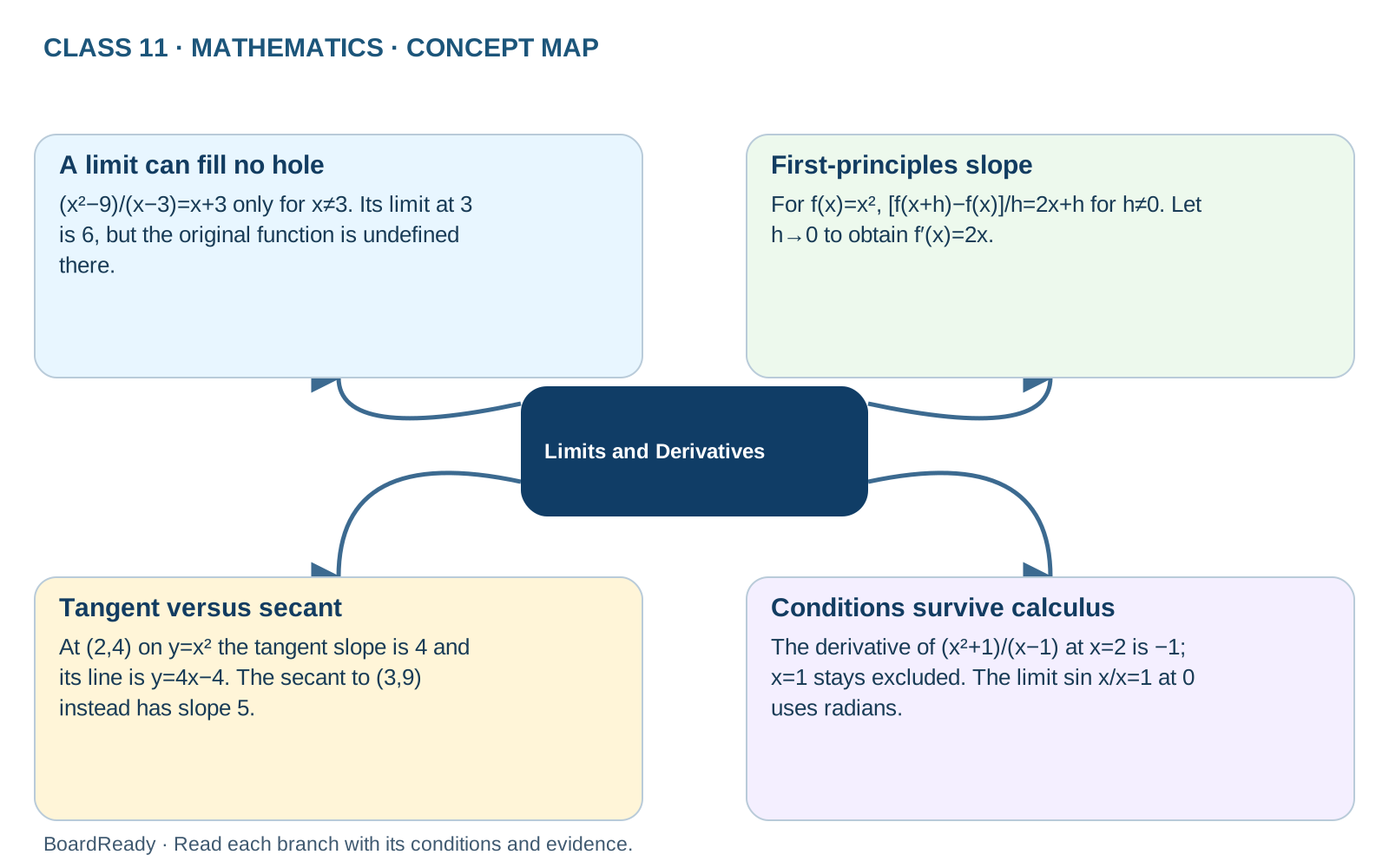
A nearby limiting value, a function value and a tangent slope are different objects. A limit can fill no hole: (x²−9)/(x−3)=x+3 only for x≠3. Its limit at 3 is 6, but the original function is undefined there. First-principles slope: For f(x)=x², [f(x+h)−f(x)]/h=2x+h for h≠0. Let h→0 to obtain f′(x)=2x. Tangent versus secant: At (2,4) on y=x² the tangent slope is 4 and its line is y=4x−4. The secant to (3,9) instead has slope 5. Conditions survive calculus: The derivative of (x²+1)/(x−1) at x=2 is −1; x=1 stays excluded. The limit sin x/x=1 at 0 uses radians.A limit can fill no hole
(x²−9)/(x−3)=x+3 only for x≠3. Its limit at 3 is 6, but the original function is undefined there.First-principles slope
For f(x)=x², [f(x+h)−f(x)]/h=2x+h for h≠0. Let h→0 to obtain f′(x)=2x.Check: Simplification near a point does not define the original expression at that point.