Comparison map
Distance and Displacement: relationships and examples
Separate path length from the directed change between positions.Exam cue: Read the arrowheads and start/end positions before adding numbers.
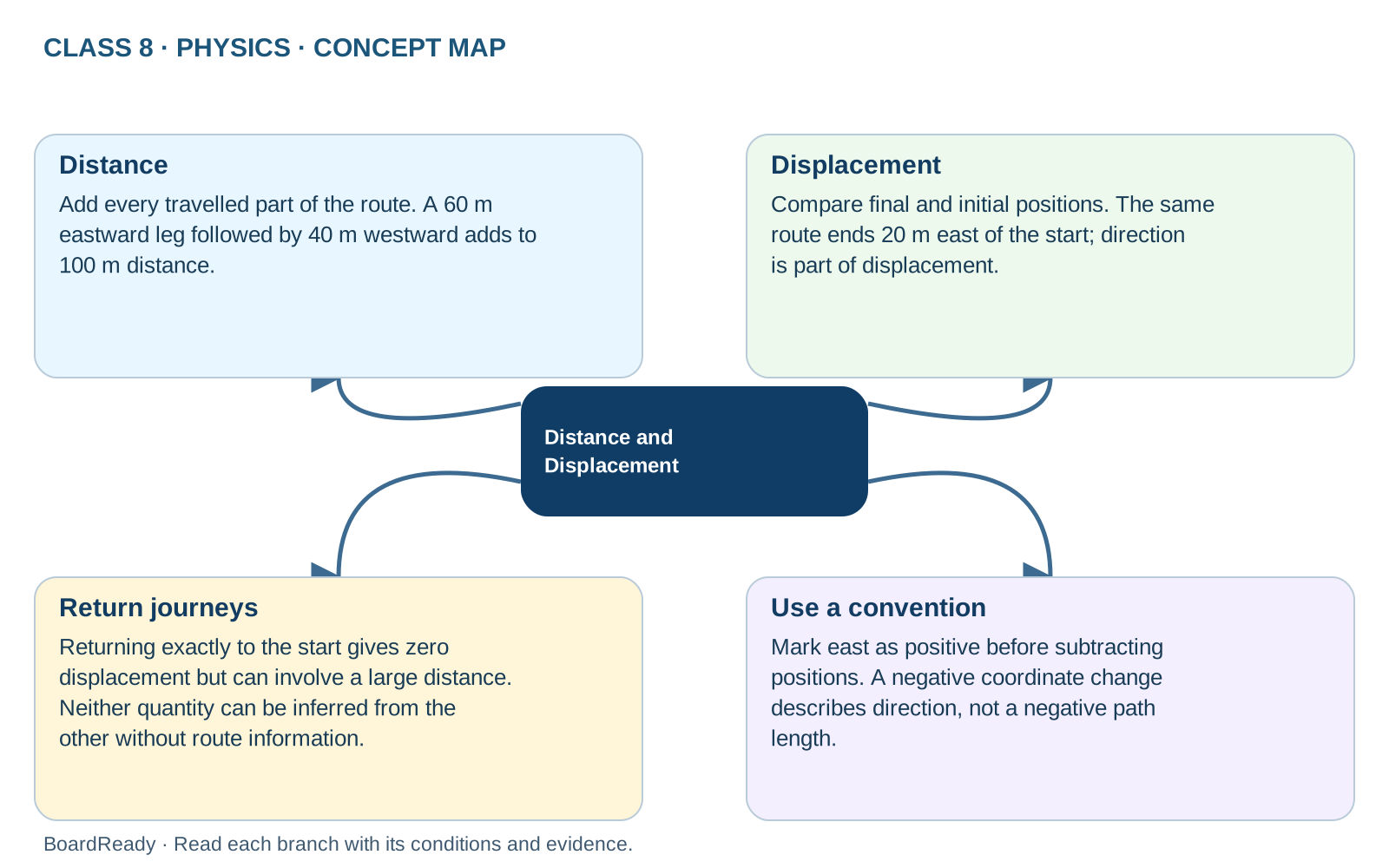
- 1Distance and Displacement -> Distance: Add every travelled part of the route. A 60 m eastward leg followed by 40 m westward adds to 100 m distance.
- 2Distance and Displacement -> Displacement: Compare final and initial positions. The same route ends 20 m east of the start; direction is part of displacement.
- 3Distance and Displacement -> Return journeys: Returning exactly to the start gives zero displacement but can involve a large distance. Neither quantity can be inferred from the other without route information.
- 4Distance and Displacement -> Use a convention: Mark east as positive before subtracting positions. A negative coordinate change describes direction, not a negative path length.