Comparison map
Density and Relative Density: relationships and examples
Follow the measurement that supplies volume before dividing mass by it.Exam cue: State the volume method and reference density with the result.
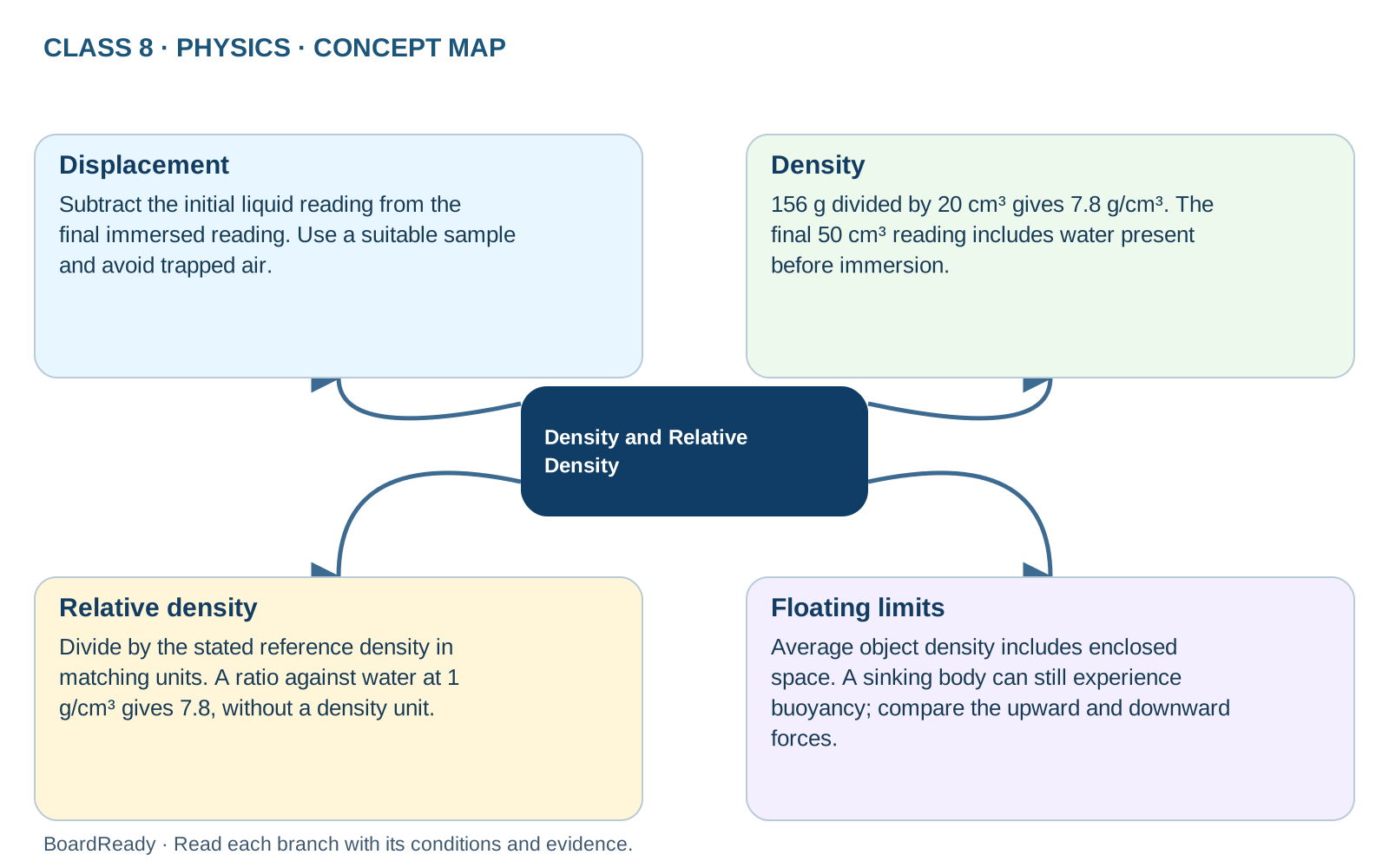
- 1Density and Relative Density -> Displacement: Subtract the initial liquid reading from the final immersed reading. Use a suitable sample and avoid trapped air.
- 2Density and Relative Density -> Density: 156 g divided by 20 cm³ gives 7.8 g/cm³. The final 50 cm³ reading includes water present before immersion.
- 3Density and Relative Density -> Relative density: Divide by the stated reference density in matching units. A ratio against water at 1 g/cm³ gives 7.8, without a density unit.
- 4Density and Relative Density -> Floating limits: Average object density includes enclosed space. A sinking body can still experience buoyancy; compare the upward and downward forces.