Comparison map
Types of Forces: relationships and examples
Classify interactions and then combine forces acting on the same object.Exam cue: Keep forces on one object separate from an interaction pair acting on two objects.
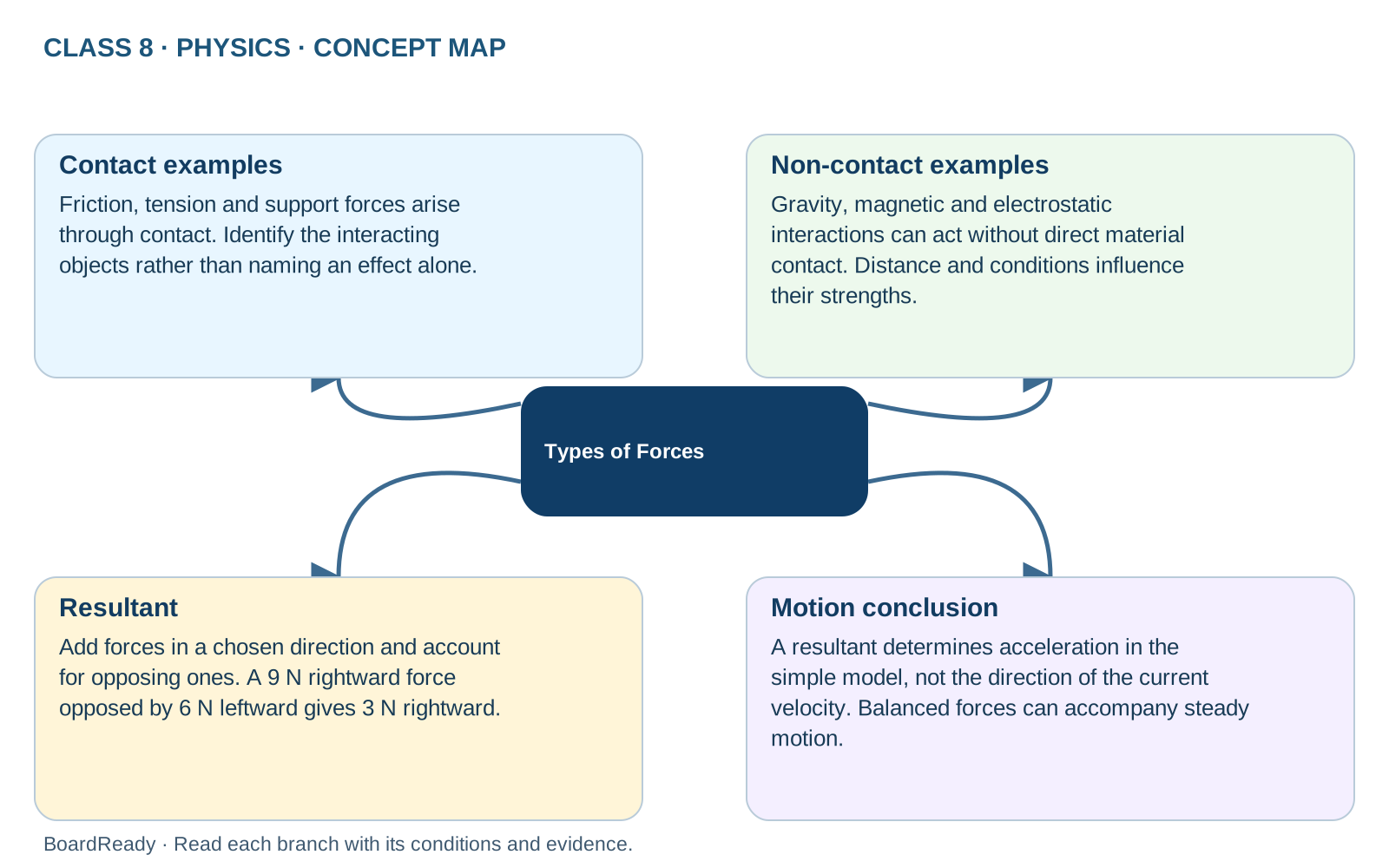
- 1Types of Forces -> Contact examples: Friction, tension and support forces arise through contact. Identify the interacting objects rather than naming an effect alone.
- 2Types of Forces -> Non-contact examples: Gravity, magnetic and electrostatic interactions can act without direct material contact. Distance and conditions influence their strengths.
- 3Types of Forces -> Resultant: Add forces in a chosen direction and account for opposing ones. A₉N rightward force opposed by 6 N leftward gives 3 N rightward.
- 4Types of Forces -> Motion conclusion: A resultant determines acceleration in the simple model, not the direction of the current velocity. Balanced forces can accompany steady motion.