Comparison map
Data Interpretation: relationships and examples
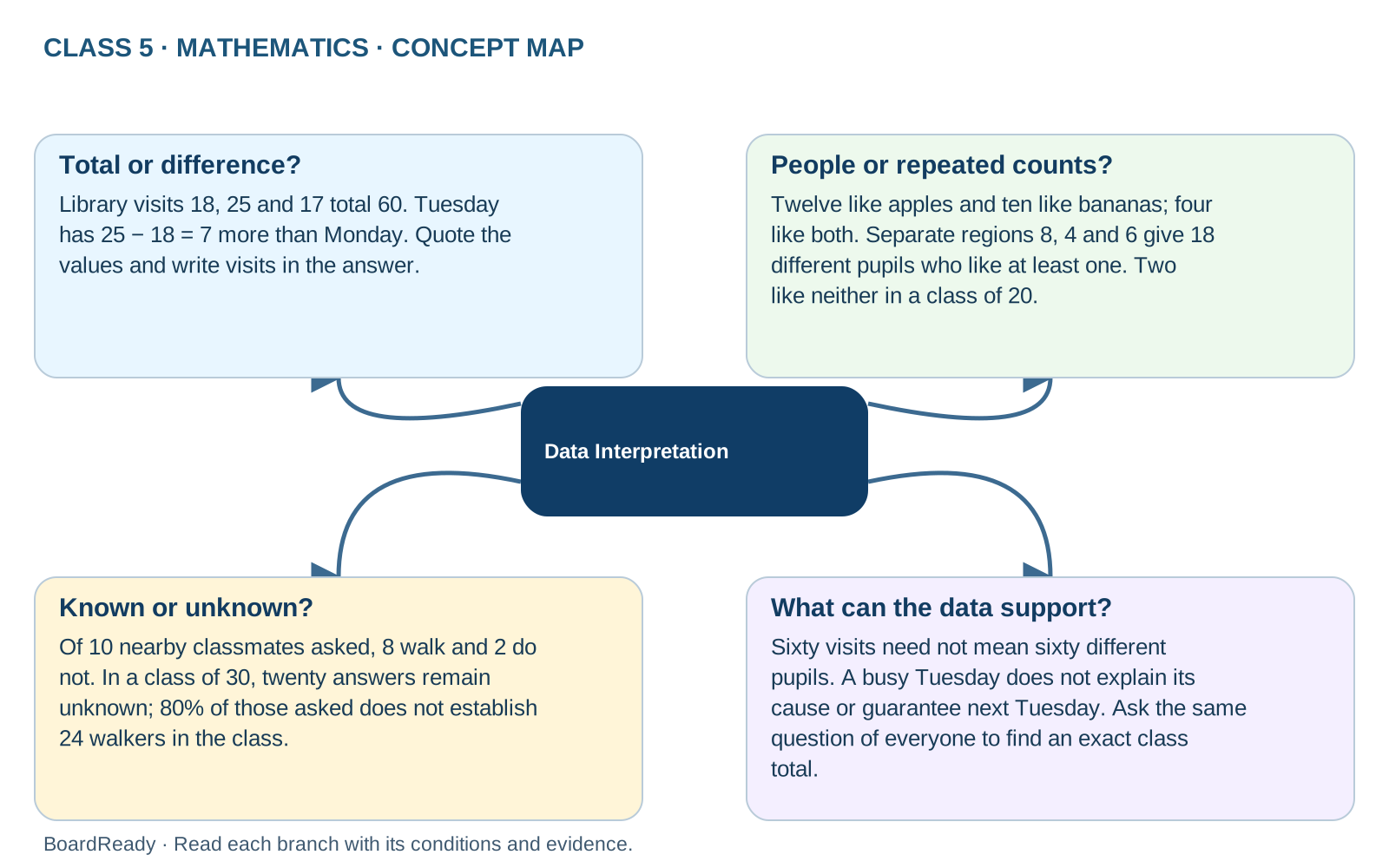
Choose values and operations to answer the exact question, count the right unit, and limit conclusions to the evidence shown. Total or difference?: Library visits 18, 25 and 17 total 60. Tuesday has 25 − 18 = 7 more than Monday. Quote the values and write visits in the answer. People or repeated counts?: Twelve like apples and ten like bananas; four like both. Separate regions 8, 4 and 6 give 18 different pupils who like at least one. Two like neither in a class of 20. Known or unknown?: Of 10 nearby classmates asked, 8 walk and 2 do not. In a class of 30, twenty answers remain unknown; 80% of those asked does not establish 24 walkers in the class. What can the data support?: Sixty visits need not mean sixty different pupils. A busy Tuesday does not explain its cause or guarantee next Tuesday. Ask the same question of everyone to find an exact class total.Exam cue: Read the question, identify the unit and any overlap, calculate, then state what is known and what is still unknown.
- 1Data Interpretation -> Total or difference?: Library visits 18, 25 and 17 total 60. Tuesday has 25 − 18 = 7 more than Monday. Quote the values and write visits in the answer.
- 2Data Interpretation -> People or repeated counts?: Twelve like apples and ten like bananas; four like both. Separate regions 8, 4 and 6 give 18 different pupils who like at least one. Two like neither in a class of 20.
- 3Data Interpretation -> Known or unknown?: Of 10 nearby classmates asked, 8 walk and 2 do not. In a class of 30, twenty answers remain unknown; 80% of those asked does not establish 24 walkers in the class.
- 4Data Interpretation -> What can the data support?: Sixty visits need not mean sixty different pupils. A busy Tuesday does not explain its cause or guarantee next Tuesday. Ask the same question of everyone to find an exact class total.