Comparison map
Separating Materials: relationships and examples
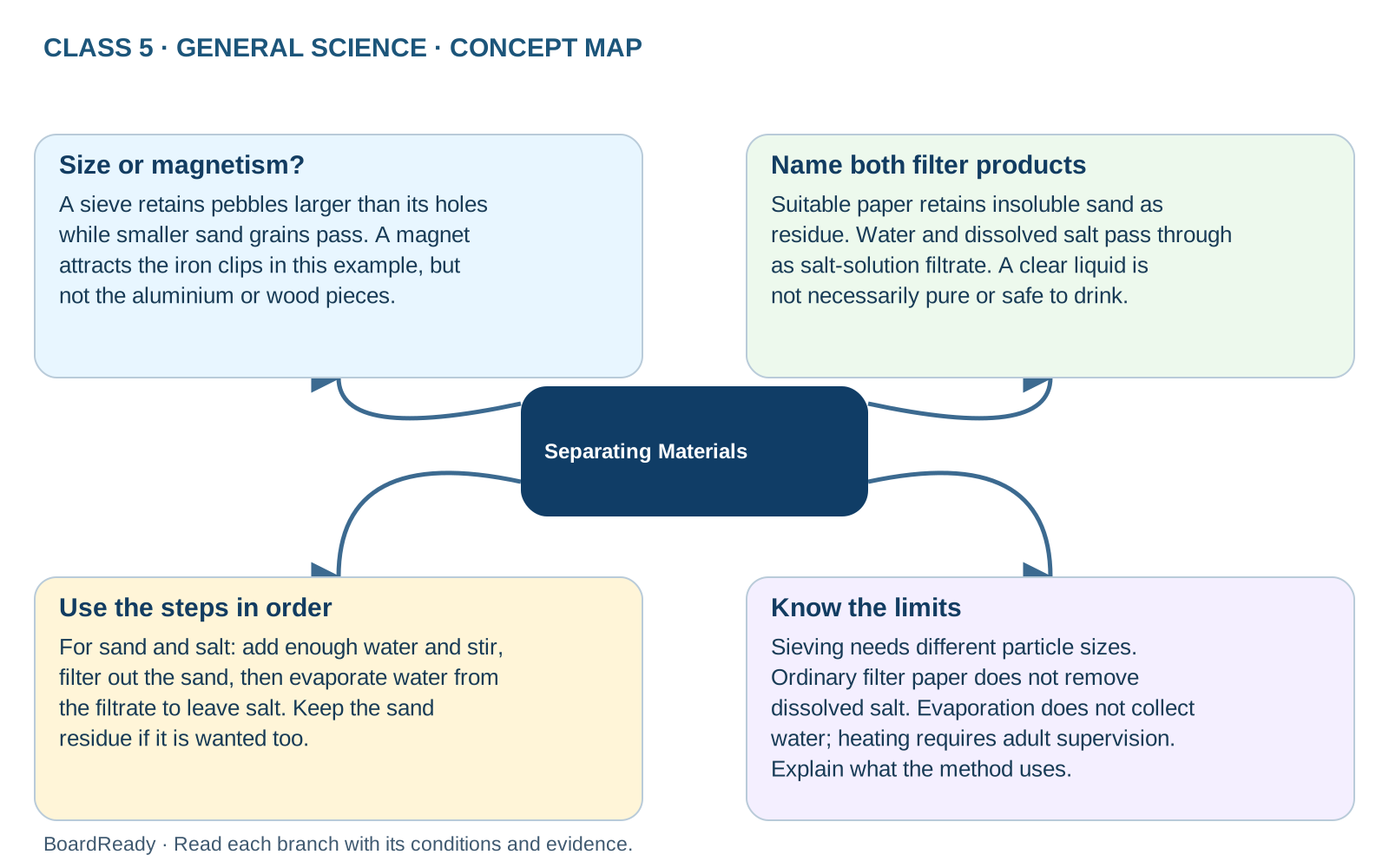
Identify the mixture, choose a relevant property difference and track what is collected at each step. Size or magnetism?: A sieve retains pebbles larger than its holes while smaller sand grains pass. A magnet attracts the iron clips in this example, but not the aluminium or wood pieces. Name both filter products: Suitable paper retains insoluble sand as residue. Water and dissolved salt pass through as salt-solution filtrate. A clear liquid is not necessarily pure or safe to drink. Use the steps in order: For sand and salt: add enough water and stir, filter out the sand, then evaporate water from the filtrate to leave salt. Keep the sand residue if it is wanted too. Know the limits: Sieving needs different particle sizes. Ordinary filter paper does not remove dissolved salt. Evaporation does not collect water; heating requires adult supervision. Explain what the method uses.Exam cue: Method → property difference → material collected. For several steps, track both the residue and the solution.
- 1Separating Materials -> Size or magnetism?: A sieve retains pebbles larger than its holes while smaller sand grains pass. A magnet attracts the iron clips in this example, but not the aluminium or wood pieces.
- 2Separating Materials -> Name both filter products: Suitable paper retains insoluble sand as residue. Water and dissolved salt pass through as salt-solution filtrate. A clear liquid is not necessarily pure or safe to drink.
- 3Separating Materials -> Use the steps in order: For sand and salt: add enough water and stir, filter out the sand, then evaporate water from the filtrate to leave salt. Keep the sand residue if it is wanted too.
- 4Separating Materials -> Know the limits: Sieving needs different particle sizes. Ordinary filter paper does not remove dissolved salt. Evaporation does not collect water; heating requires adult supervision. Explain what the method uses.