Comparison map
Light, Sound, and Heat: relationships and examples
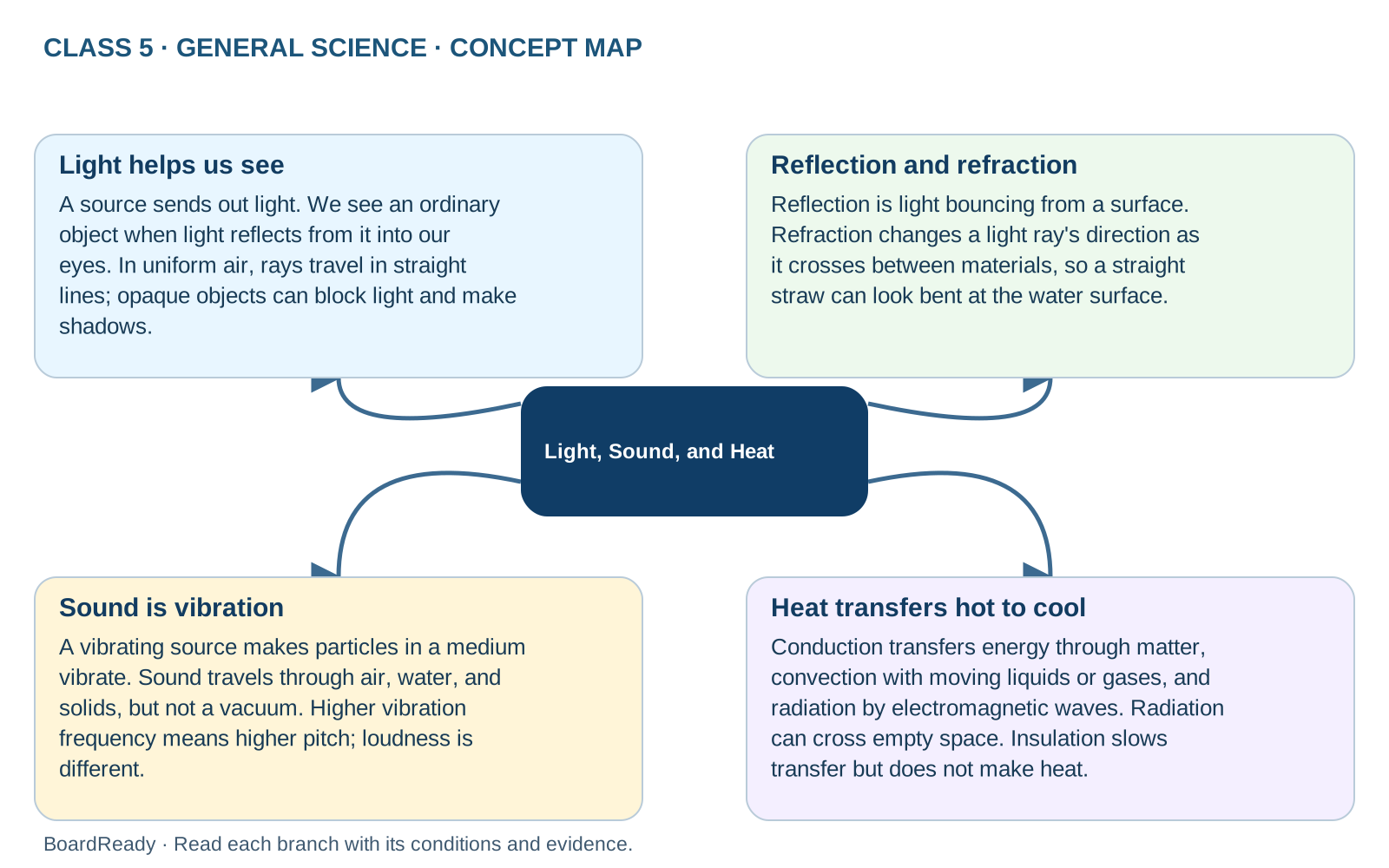
Trace light from a source to the eye, connect sound to vibrations, and compare the three main ways heat energy transfers. Light helps us see: A source sends out light. We see an ordinary object when light reflects from it into our eyes. In uniform air, rays travel in straight lines; opaque objects can block light and make shadows. Reflection and refraction: Reflection is light bouncing from a surface. Refraction changes a light ray's direction as it crosses between materials, so a straight straw can look bent at the water surface. Sound is vibration: A vibrating source makes particles in a medium vibrate. Sound travels through air, water, and solids, but not a vacuum. Higher vibration frequency means higher pitch; loudness is different. Heat transfers hot to cool: Conduction transfers energy through matter, convection with moving liquids or gases, and radiation by electromagnetic waves. Radiation can cross empty space. Insulation slows transfer but does not make heat.Exam cue: For light, trace source → object → eye. For sound, identify vibrations and the medium. For heat, name the hot and cool regions and the transfer process.
- 1Light, Sound, and Heat -> Light helps us see: A source sends out light. We see an ordinary object when light reflects from it into our eyes. In uniform air, rays travel in straight lines; opaque objects can block light and make shadows.
- 2Light, Sound, and Heat -> Reflection and refraction: Reflection is light bouncing from a surface. Refraction changes a light ray's direction as it crosses between materials, so a straight straw can look bent at the water surface.
- 3Light, Sound, and Heat -> Sound is vibration: A vibrating source makes particles in a medium vibrate. Sound travels through air, water, and solids, but not a vacuum. Higher vibration frequency means higher pitch; loudness is different.
- 4Light, Sound, and Heat -> Heat transfers hot to cool: Conduction transfers energy through matter, convection with moving liquids or gases, and radiation by electromagnetic waves. Radiation can cross empty space. Insulation slows transfer but does not make heat.