Comparison map
Simple Machines: relationships and examples
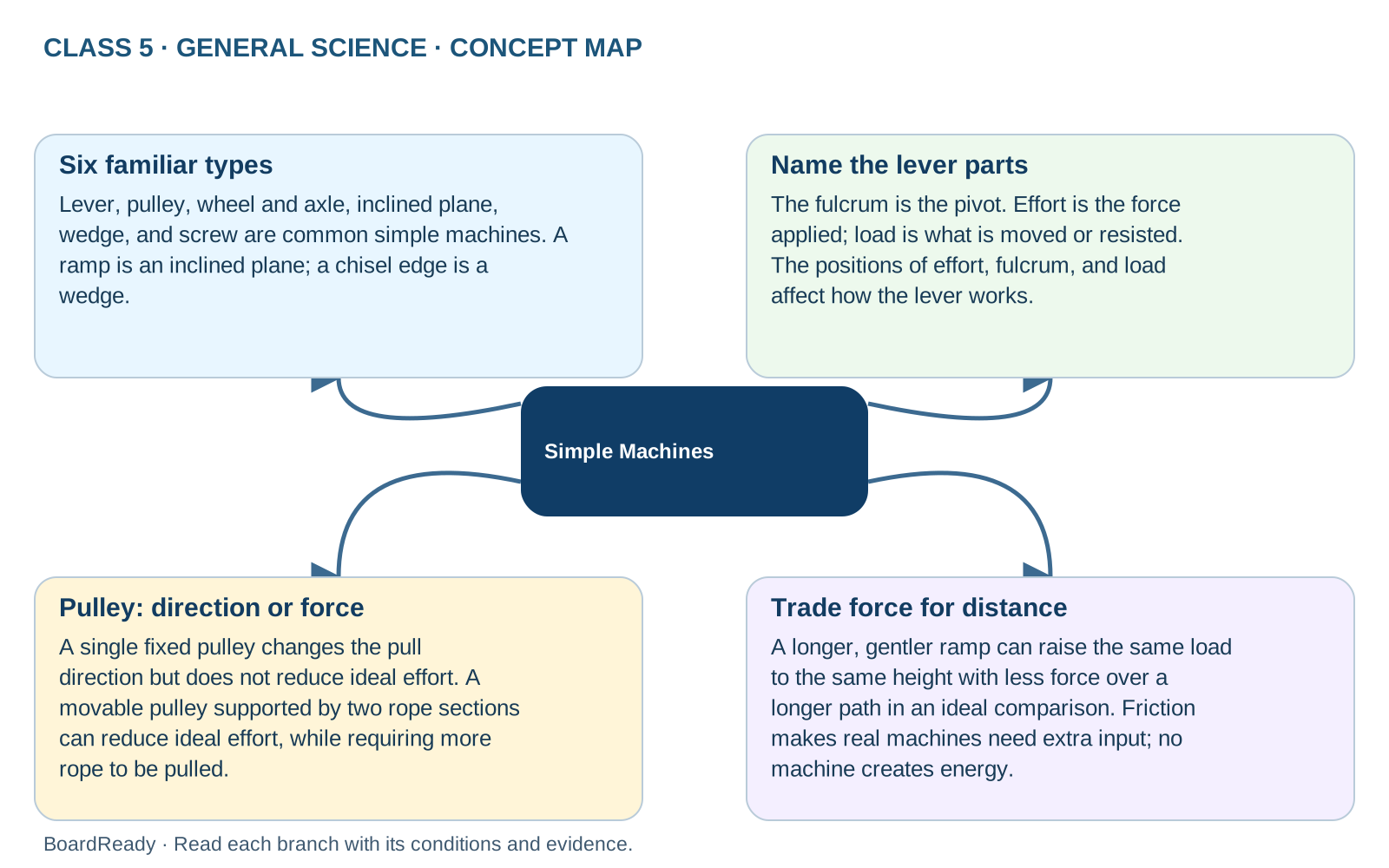
Recognise six common simple machines, identify the parts that act, and compare how effort, direction, and distance can change. Six familiar types: Lever, pulley, wheel and axle, inclined plane, wedge, and screw are common simple machines. A ramp is an inclined plane; a chisel edge is a wedge. Name the lever parts: The fulcrum is the pivot. Effort is the force applied; load is what is moved or resisted. The positions of effort, fulcrum, and load affect how the lever works. Pulley: direction or force: A single fixed pulley changes the pull direction but does not reduce ideal effort. A movable pulley supported by two rope sections can reduce ideal effort, while requiring more rope to be pulled. Trade force for distance: A longer, gentler ramp can raise the same load to the same height with less force over a longer path in an ideal comparison. Friction makes real machines need extra input; no machine creates energy.Exam cue: Name the machine and moving parts. State whether it changes direction or effort, then include the distance trade-off and real friction where relevant.
- 1Simple Machines -> Six familiar types: Lever, pulley, wheel and axle, inclined plane, wedge, and screw are common simple machines. A ramp is an inclined plane; a chisel edge is a wedge.
- 2Simple Machines -> Name the lever parts: The fulcrum is the pivot. Effort is the force applied; load is what is moved or resisted. The positions of effort, fulcrum, and load affect how the lever works.
- 3Simple Machines -> Pulley: direction or force: A single fixed pulley changes the pull direction but does not reduce ideal effort. A movable pulley supported by two rope sections can reduce ideal effort, while requiring more rope to be pulled.
- 4Simple Machines -> Trade force for distance: A longer, gentler ramp can raise the same load to the same height with less force over a longer path in an ideal comparison. Friction makes real machines need extra input; no machine creates energy.