Comparison map
Solar System: relationships and examples
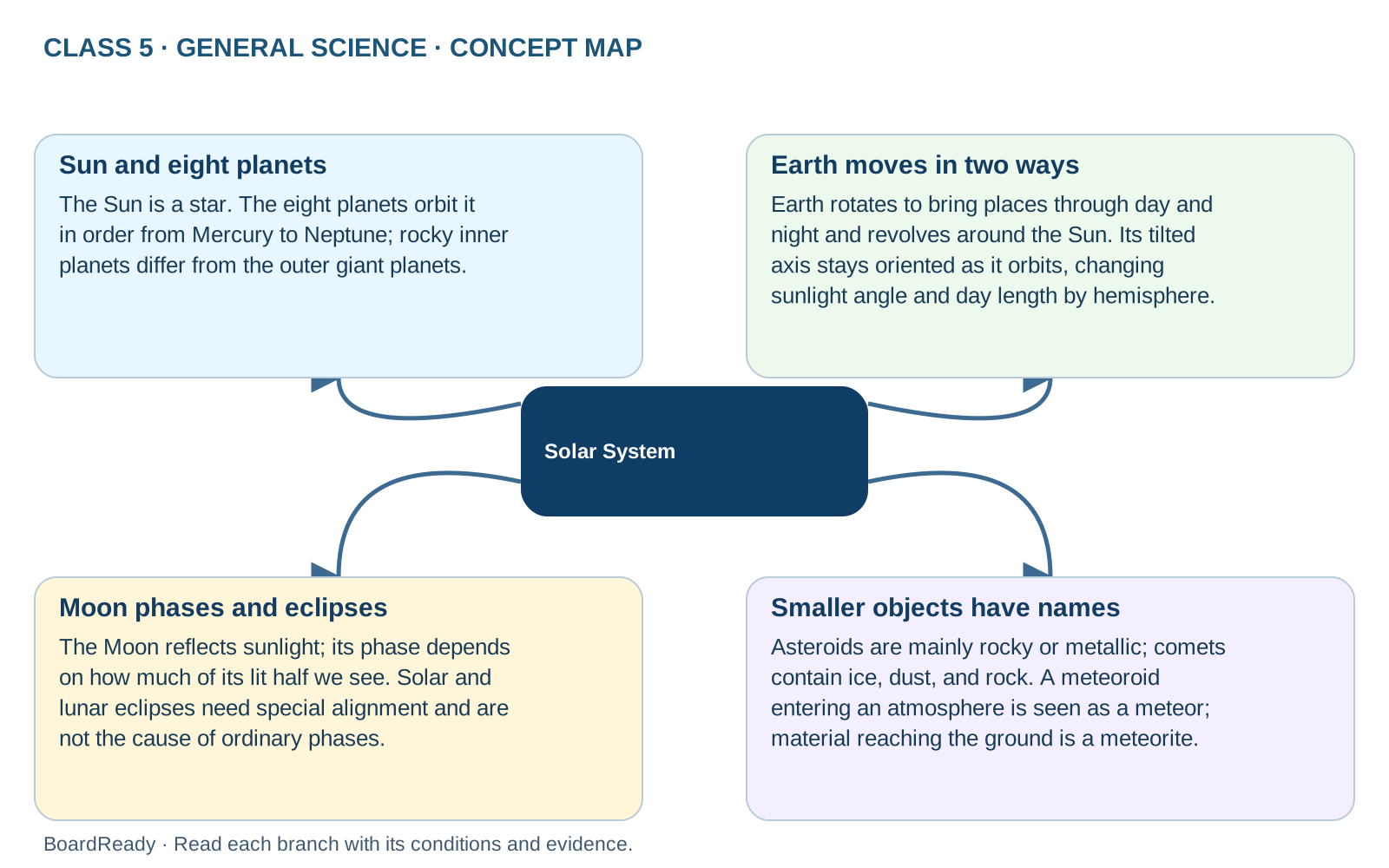
Connect the Sun and planets with Earth's rotation, orbit, and tilt; explain Moon appearances and eclipses; distinguish smaller space objects. Sun and eight planets: The Sun is a star. The eight planets orbit it in order from Mercury to Neptune; rocky inner planets differ from the outer giant planets. Earth moves in two ways: Earth rotates to bring places through day and night and revolves around the Sun. Its tilted axis stays oriented as it orbits, changing sunlight angle and day length by hemisphere. Moon phases and eclipses: The Moon reflects sunlight; its phase depends on how much of its lit half we see. Solar and lunar eclipses need special alignment and are not the cause of ordinary phases. Smaller objects have names: Asteroids are mainly rocky or metallic; comets contain ice, dust, and rock. A meteoroid entering an atmosphere is seen as a meteor; material reaching the ground is a meteorite.Exam cue: Name the bodies and their relative positions. Keep rotation, revolution, phases, eclipses, and meteors distinct; never look directly at the Sun.
- 1Solar System -> Sun and eight planets: The Sun is a star. The eight planets orbit it in order from Mercury to Neptune; rocky inner planets differ from the outer giant planets.
- 2Solar System -> Earth moves in two ways: Earth rotates to bring places through day and night and revolves around the Sun. Its tilted axis stays oriented as it orbits, changing sunlight angle and day length by hemisphere.
- 3Solar System -> Moon phases and eclipses: The Moon reflects sunlight; its phase depends on how much of its lit half we see. Solar and lunar eclipses need special alignment and are not the cause of ordinary phases.
- 4Solar System -> Smaller objects have names: Asteroids are mainly rocky or metallic; comets contain ice, dust, and rock. A meteoroid entering an atmosphere is seen as a meteor; material reaching the ground is a meteorite.