Comparison map
Soil, Rocks, and Natural Resources: relationships and examples
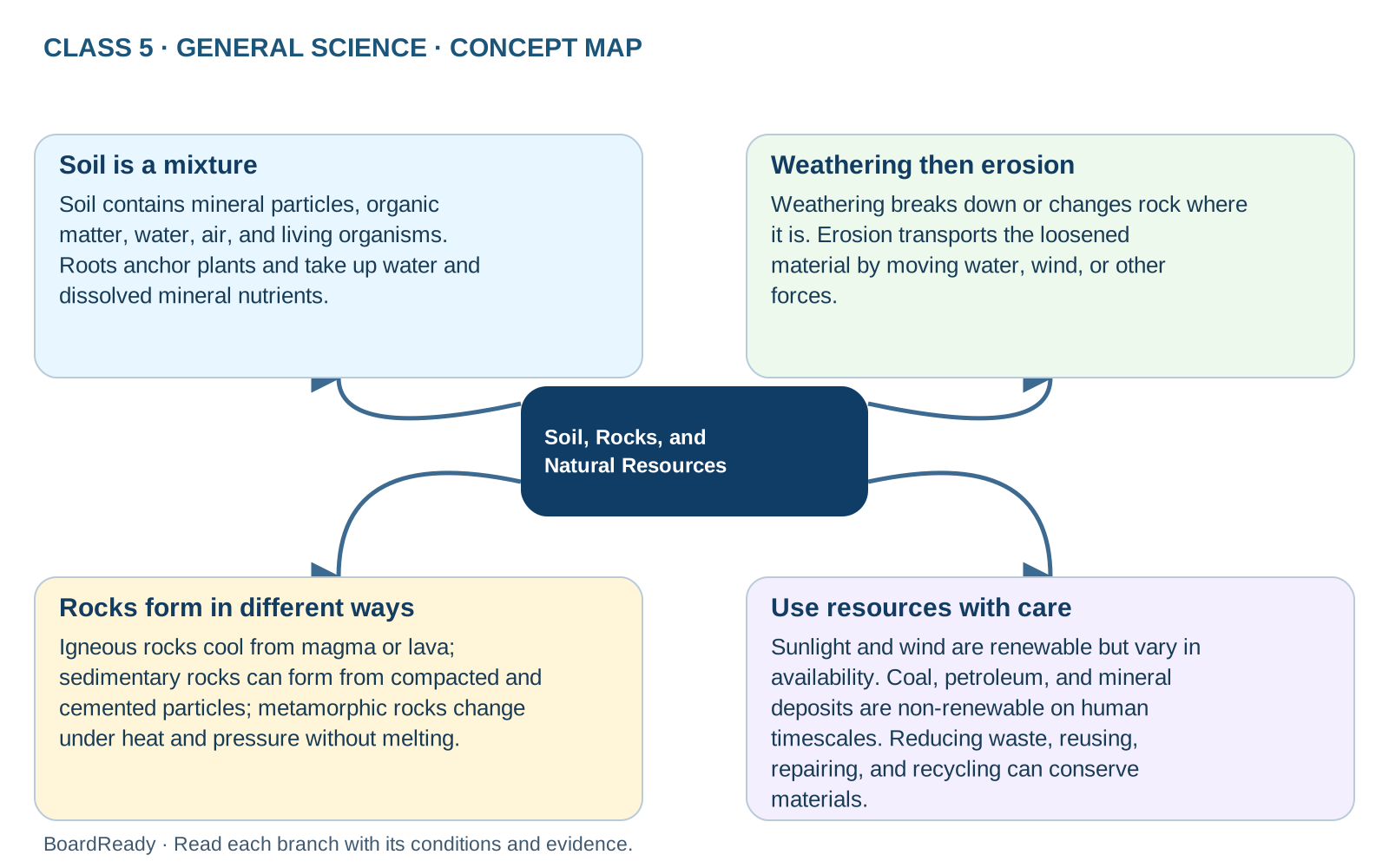
Connect soil's ingredients to plant growth, distinguish weathering from erosion, classify rocks by formation, and choose ways to conserve natural resources. Soil is a mixture: Soil contains mineral particles, organic matter, water, air, and living organisms. Roots anchor plants and take up water and dissolved mineral nutrients. Weathering then erosion: Weathering breaks down or changes rock where it is. Erosion transports the loosened material by moving water, wind, or other forces. Rocks form in different ways: Igneous rocks cool from magma or lava; sedimentary rocks can form from compacted and cemented particles; metamorphic rocks change under heat and pressure without melting. Use resources with care: Sunlight and wind are renewable but vary in availability. Coal, petroleum, and mineral deposits are non-renewable on human timescales. Reducing waste, reusing, repairing, and recycling can conserve materials.Exam cue: Describe what happens and where: weathering breaks material down in place; erosion carries it. For rocks, match formation process to group; for resources, name the resource and a specific conservation action.
- 1Soil, Rocks, and Natural Resources -> Soil is a mixture: Soil contains mineral particles, organic matter, water, air, and living organisms. Roots anchor plants and take up water and dissolved mineral nutrients.
- 2Soil, Rocks, and Natural Resources -> Weathering then erosion: Weathering breaks down or changes rock where it is. Erosion transports the loosened material by moving water, wind, or other forces.
- 3Soil, Rocks, and Natural Resources -> Rocks form in different ways: Igneous rocks cool from magma or lava; sedimentary rocks can form from compacted and cemented particles; metamorphic rocks change under heat and pressure without melting.
- 4Soil, Rocks, and Natural Resources -> Use resources with care: Sunlight and wind are renewable but vary in availability. Coal, petroleum, and mineral deposits are non-renewable on human timescales. Reducing waste, reusing, repairing, and recycling can conserve materials.