Comparison map
Electromagnetic Induction and AC: relationships and examples
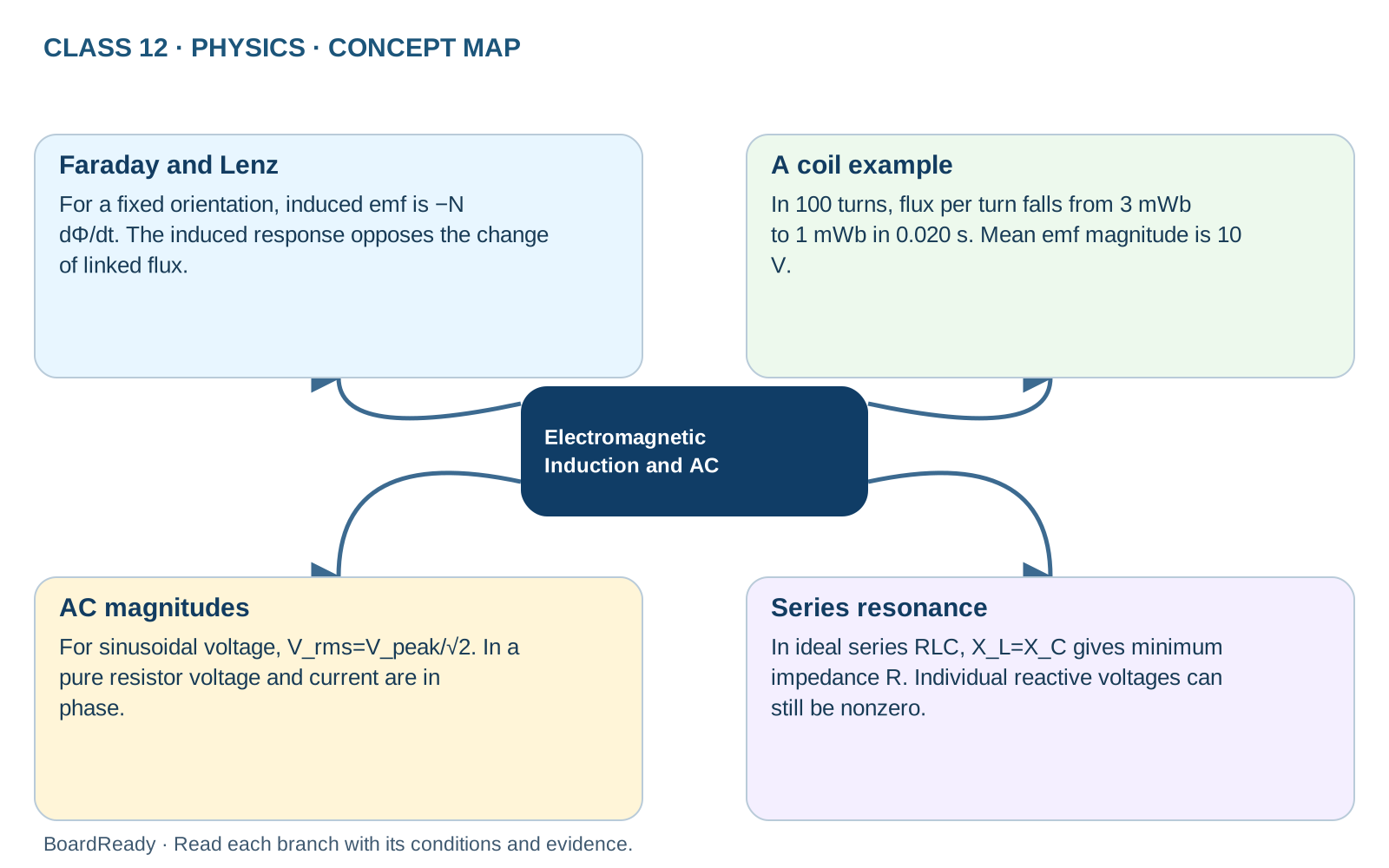
Changing flux produces emf; AC response also depends on phase. Faraday and Lenz: For a fixed orientation, induced emf is −N dΦ/dt. The induced response opposes the change of linked flux. A coil example: In 100 turns, flux per turn falls from 3 mWb to 1 mWb in 0.020 s. Mean emf magnitude is 10 V. AC magnitudes: For sinusoidal voltage, V_rms=V_peak/√2. In a pure resistor voltage and current are in phase. Series resonance: In ideal series RLC, X_L=X_C gives minimum impedance R. Individual reactive voltages can still be nonzero.Exam cue: Distinguish flux per turn from flux linkage and peak values from rms values.
- 1Electromagnetic Induction and AC -> Faraday and Lenz: For a fixed orientation, induced emf is −N dΦ/dt. The induced response opposes the change of linked flux.
- 2Electromagnetic Induction and AC -> A coil example: In 100 turns, flux per turn falls from 3 mWb to 1 mWb in 0.020 s. Mean emf magnitude is 10 V.
- 3Electromagnetic Induction and AC -> AC magnitudes: For sinusoidal voltage, V_rms=V_peak/√2. In a pure resistor voltage and current are in phase.
- 4Electromagnetic Induction and AC -> Series resonance: In ideal series RLC, X_L=X_C gives minimum impedance R. Individual reactive voltages can still be nonzero.