Comparison map
Magnetism and Electromagnetic Induction: relationships and examples
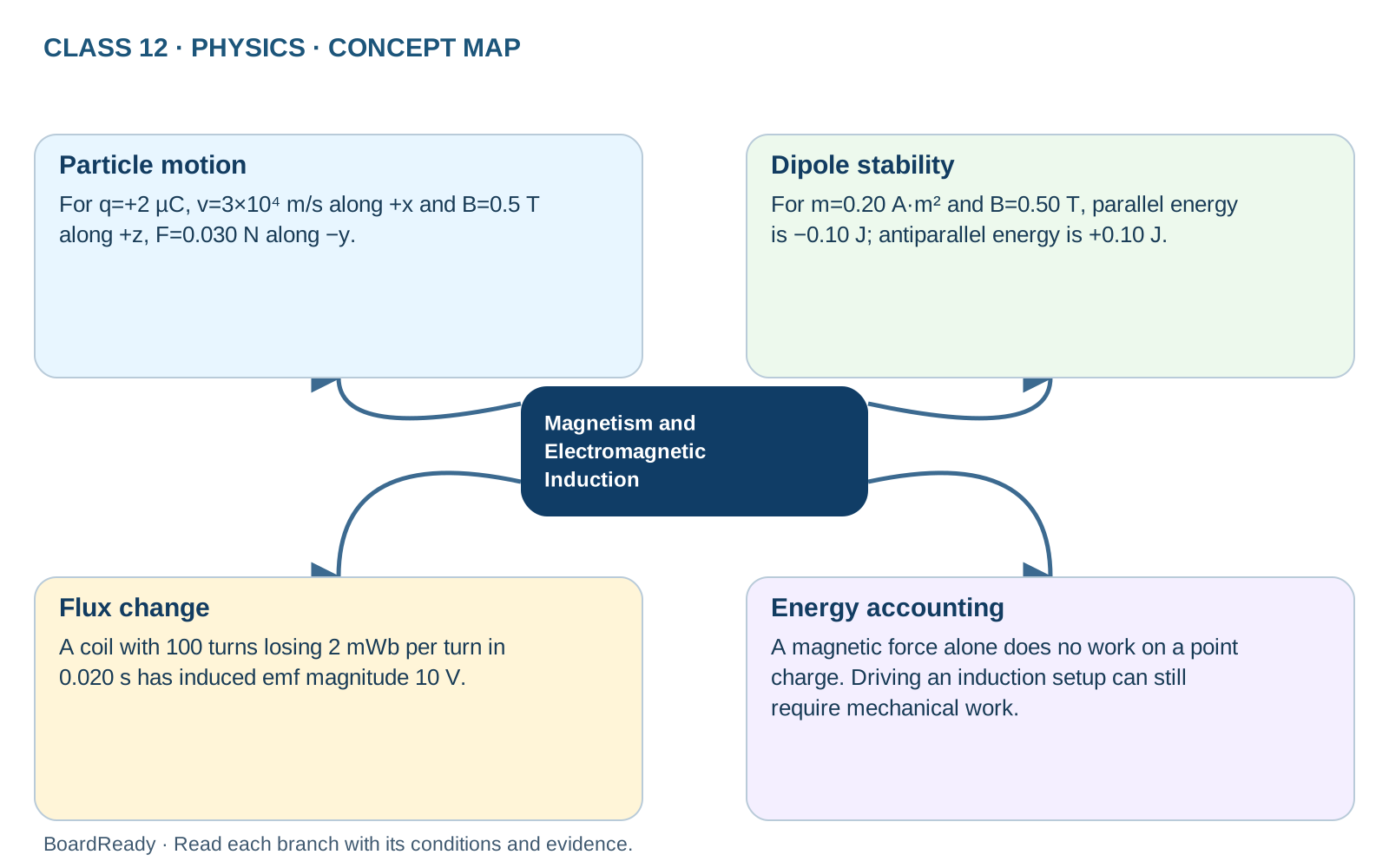
Connect magnetic force, dipole energy and induced electrical energy. Particle motion: For q=+2 µC, v=3×10⁴ m/s along +x and B=0.5 T along +z, F=0.030 N along −y. Dipole stability: For m=0.20 A·m² and B=0.50 T, parallel energy is −0.10 J; antiparallel energy is +0.10 J. Flux change: A coil with 100 turns losing 2 mWb per turn in 0.020 s has induced emf magnitude 10 V. Energy accounting: A magnetic force alone does no work on a point charge. Driving an induction setup can still require mechanical work.Exam cue: Use a cross product for force, a dot product for dipole energy and a time derivative for induced emf.
- 1Magnetism and Electromagnetic Induction -> Particle motion: For q=+2 µC, v=3×10⁴ m/s along +x and B=0.5 T along +z, F=0.030 N along −y.
- 2Magnetism and Electromagnetic Induction -> Dipole stability: For m=0.20 A·m² and B=0.50 T, parallel energy is −0.10 J; antiparallel energy is +0.10 J.
- 3Magnetism and Electromagnetic Induction -> Flux change: A coil with 100 turns losing 2 mWb per turn in 0.020 s has induced emf magnitude 10 V.
- 4Magnetism and Electromagnetic Induction -> Energy accounting: A magnetic force alone does no work on a point charge. Driving an induction setup can still require mechanical work.