Comparison map
Electric Potential and Capacitance: relationships and examples
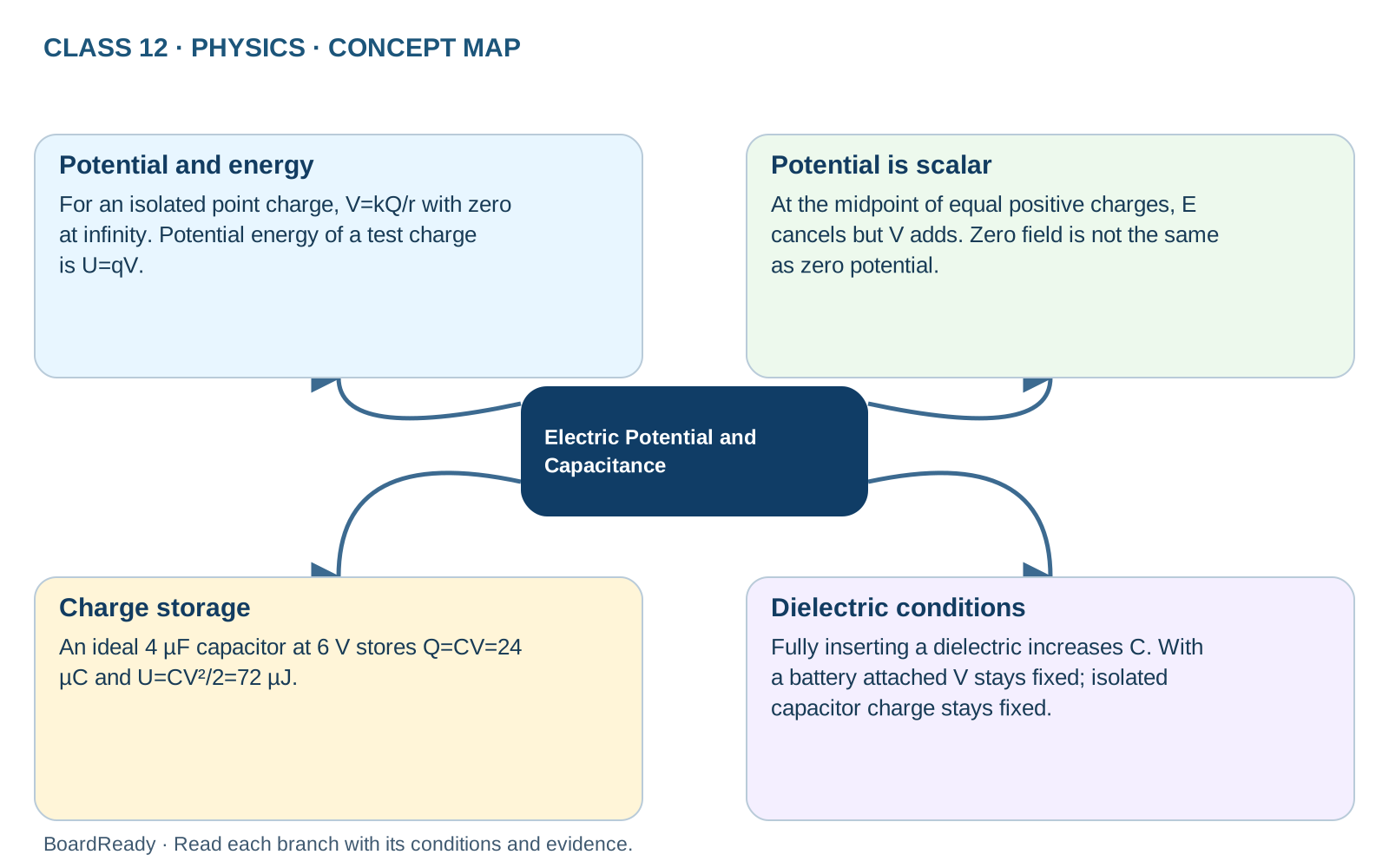
Relate scalar potential, work, charge storage and energy with stated conditions. Potential and energy: For an isolated point charge, V=kQ/r with zero at infinity. Potential energy of a test charge is U=qV. Potential is scalar: At the midpoint of equal positive charges, E cancels but V adds. Zero field is not the same as zero potential. Charge storage: An ideal 4 µF capacitor at 6 V stores Q=CV=24 µC and U=CV²/2=72 µJ. Dielectric conditions: Fully inserting a dielectric increases C. With a battery attached V stays fixed; isolated capacitor charge stays fixed.Exam cue: Decide whether charge or voltage is held fixed before comparing capacitor energies.
- 1Electric Potential and Capacitance -> Potential and energy: For an isolated point charge, V=kQ/r with zero at infinity. Potential energy of a test charge is U=qV.
- 2Electric Potential and Capacitance -> Potential is scalar: At the midpoint of equal positive charges, E cancels but V adds. Zero field is not the same as zero potential.
- 3Electric Potential and Capacitance -> Charge storage: An ideal 4 µF capacitor at 6 V stores Q=CV=24 µC and U=CV²/2=72 µJ.
- 4Electric Potential and Capacitance -> Dielectric conditions: Fully inserting a dielectric increases C. With a battery attached V stays fixed; isolated capacitor charge stays fixed.