Comparison map
Current, Resistance, and Ohm's Law: relationships and examples
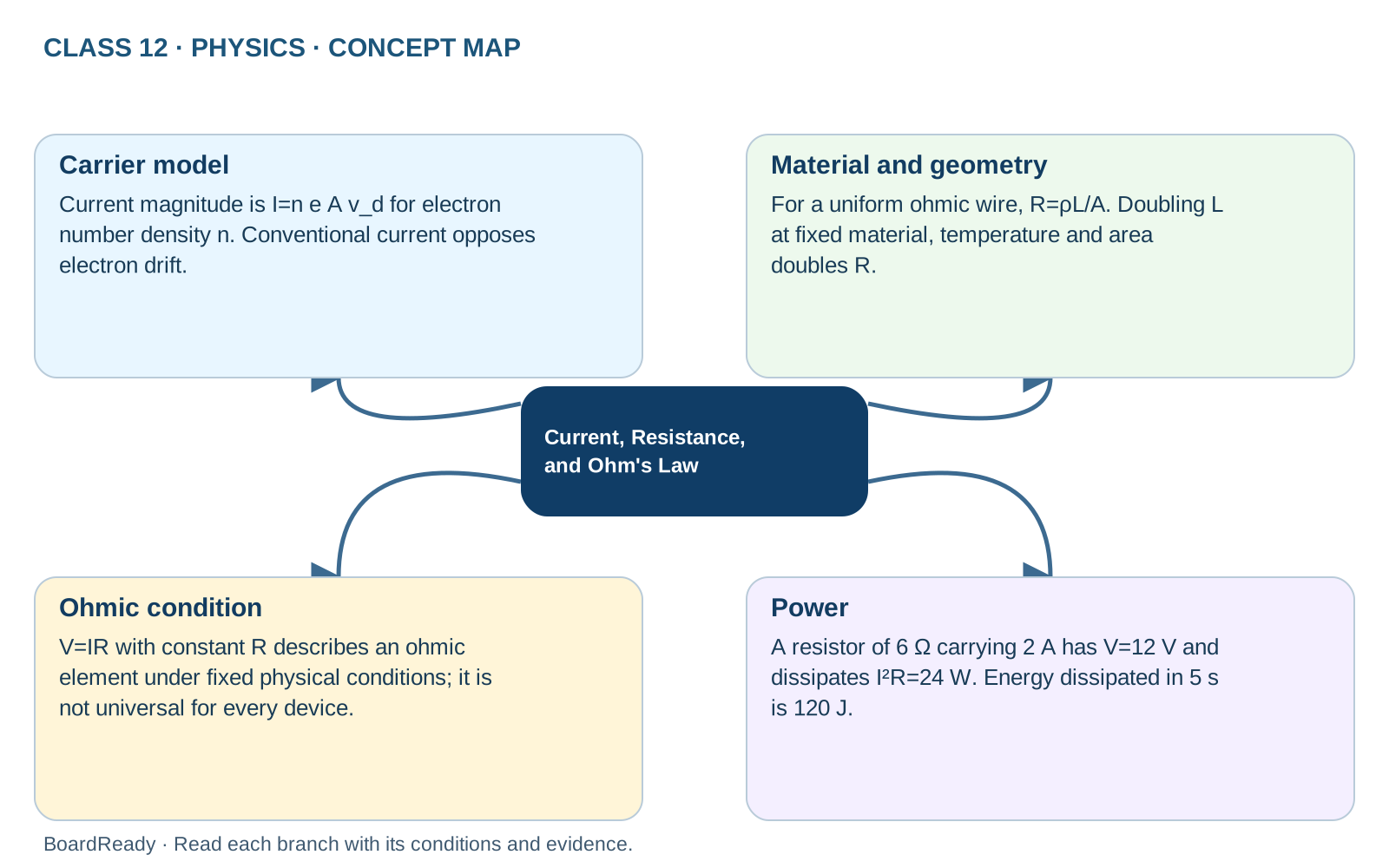
Connect microscopic charge motion to measurable circuit quantities. Carrier model: Current magnitude is I=n e A v_d for electron number density n. Conventional current opposes electron drift. Material and geometry: For a uniform ohmic wire, R=ρL/A. Doubling L at fixed material, temperature and area doubles R. Ohmic condition: V=IR with constant R describes an ohmic element under fixed physical conditions; it is not universal for every device. Power: A resistor of 6 Ω carrying 2 A has V=12 V and dissipates I²R=24 W. Energy dissipated in 5 s is 120 J.Exam cue: Convert areas to m², state temperature conditions, and distinguish resistivity from resistance.
- 1Current, Resistance, and Ohm's Law -> Carrier model: Current magnitude is I=n e A v_d for electron number density n. Conventional current opposes electron drift.
- 2Current, Resistance, and Ohm's Law -> Material and geometry: For a uniform ohmic wire, R=ρL/A. Doubling L at fixed material, temperature and area doubles R.
- 3Current, Resistance, and Ohm's Law -> Ohmic condition: V=IR with constant R describes an ohmic element under fixed physical conditions; it is not universal for every device.
- 4Current, Resistance, and Ohm's Law -> Power: A resistor of 6 Ω carrying 2 A has V=12 V and dissipates I²R=24 W. Energy dissipated in 5 s is 120 J.