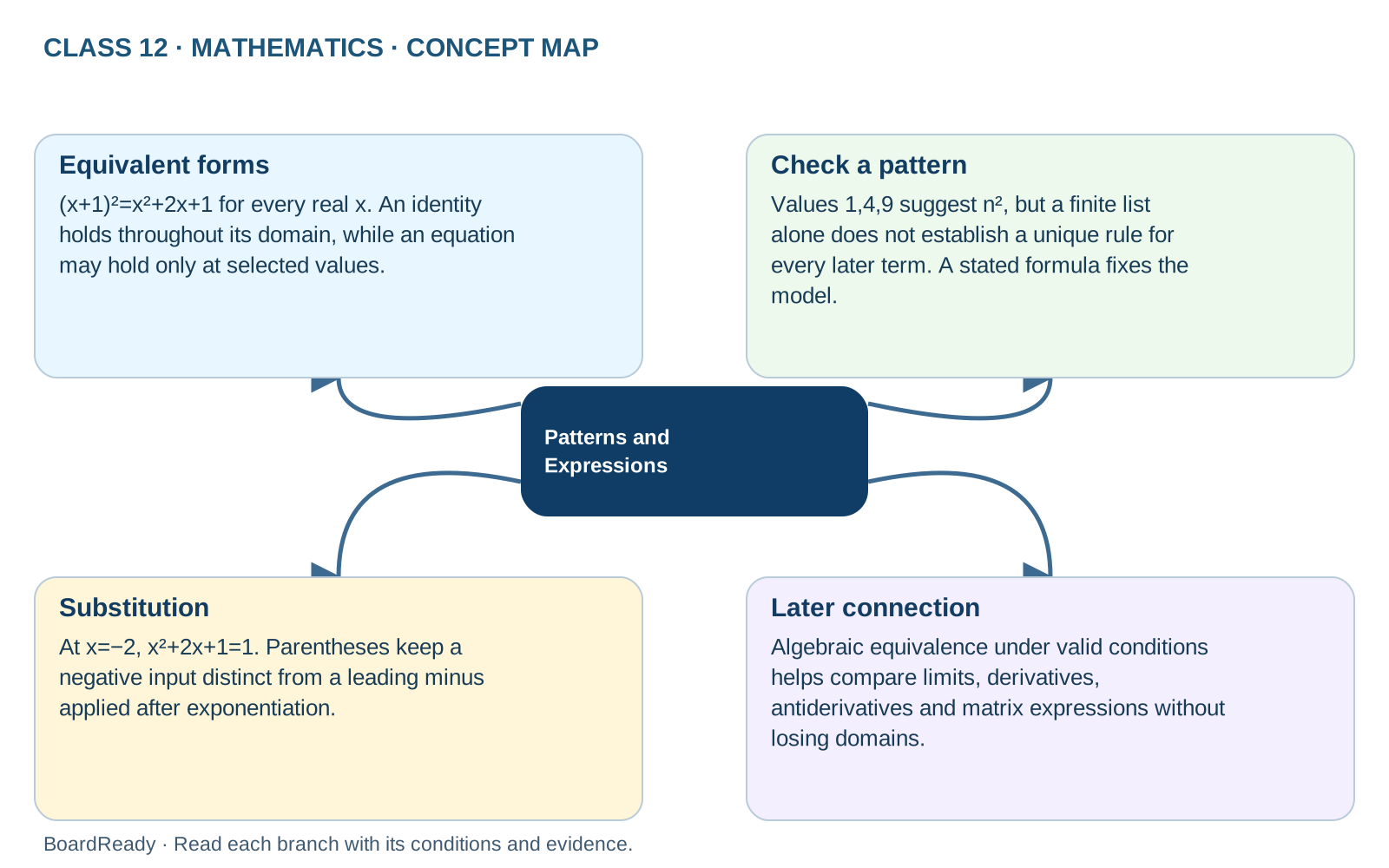
Comparison map
Patterns and Expressions: relationships and examples
Prerequisite recap: distinguish an expression, an equation and an identity. Equivalent forms: (x+1)²=x²+2x+1 for every real x. An identity holds throughout its domain, while an equation may hold only at selected values. Check a pattern: Values 1,4,9 suggest n², but a finite list alone does not establish a unique rule for every later term. A stated formula fixes the model. Substitution: At x=−2, x²+2x+1=1. Parentheses keep a negative input distinct from a leading minus applied after exponentiation. Later connection: Algebraic equivalence under valid conditions helps compare limits, derivatives, antiderivatives and matrix expressions without losing domains.Exam cue: Use a stated rule and valid operations; a few matching values do not prove a universal identity.
- 1Patterns and Expressions -> Equivalent forms: (x+1)²=x²+2x+1 for every real x. An identity holds throughout its domain, while an equation may hold only at selected values.
- 2Patterns and Expressions -> Check a pattern: Values 1,4,9 suggest n², but a finite list alone does not establish a unique rule for every later term. A stated formula fixes the model.
- 3Patterns and Expressions -> Substitution: At x=−2, x²+2x+1=1. Parentheses keep a negative input distinct from a leading minus applied after exponentiation.
- 4Patterns and Expressions -> Later connection: Algebraic equivalence under valid conditions helps compare limits, derivatives, antiderivatives and matrix expressions without losing domains.