Comparison map
Linear Equations: relationships and examples
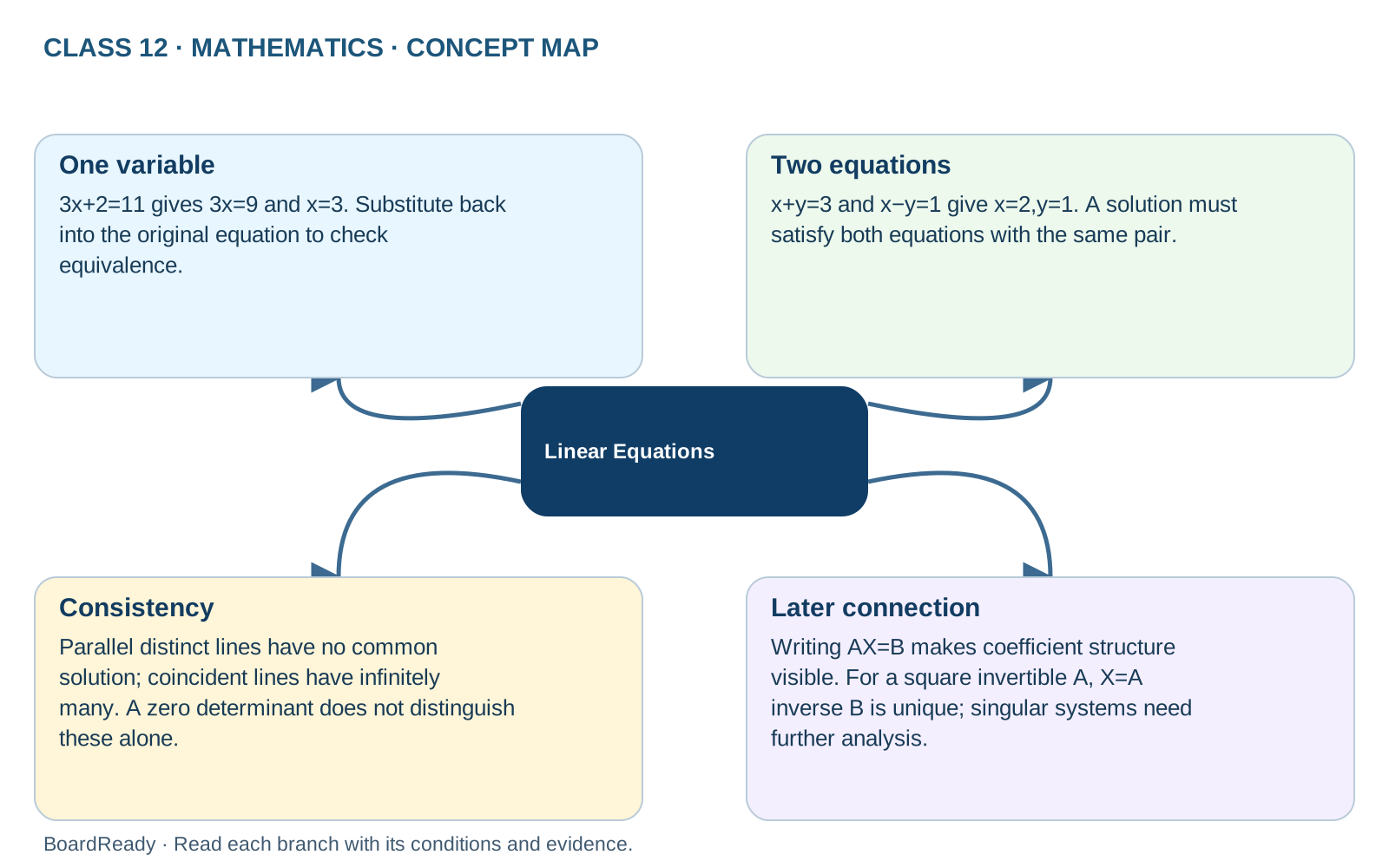
Prerequisite recap: inverse operations and consistency extend to matrix systems. One variable: 3x+2=11 gives 3x=9 and x=3. Substitute back into the original equation to check equivalence. Two equations: x+y=3 and x−y=1 give x=2,y=1. A solution must satisfy both equations with the same pair. Consistency: Parallel distinct lines have no common solution; coincident lines have infinitely many. A zero determinant does not distinguish these alone. Later connection: Writing AX=B makes coefficient structure visible. For a square invertible A, X=A inverse B is unique; singular systems need further analysis.Exam cue: Distinguish a single equation from a simultaneous system and verify in every original relation.
- 1Linear Equations -> One variable: 3x+2=11 gives 3x=9 and x=3. Substitute back into the original equation to check equivalence.
- 2Linear Equations -> Two equations: x+y=3 and x−y=1 give x=2,y=1. A solution must satisfy both equations with the same pair.
- 3Linear Equations -> Consistency: Parallel distinct lines have no common solution; coincident lines have infinitely many. A zero determinant does not distinguish these alone.
- 4Linear Equations -> Later connection: Writing AX=B makes coefficient structure visible. For a square invertible A, X=A inverse B is unique; singular systems need further analysis.