Comparison map
Physical Chemistry: relationships and examples
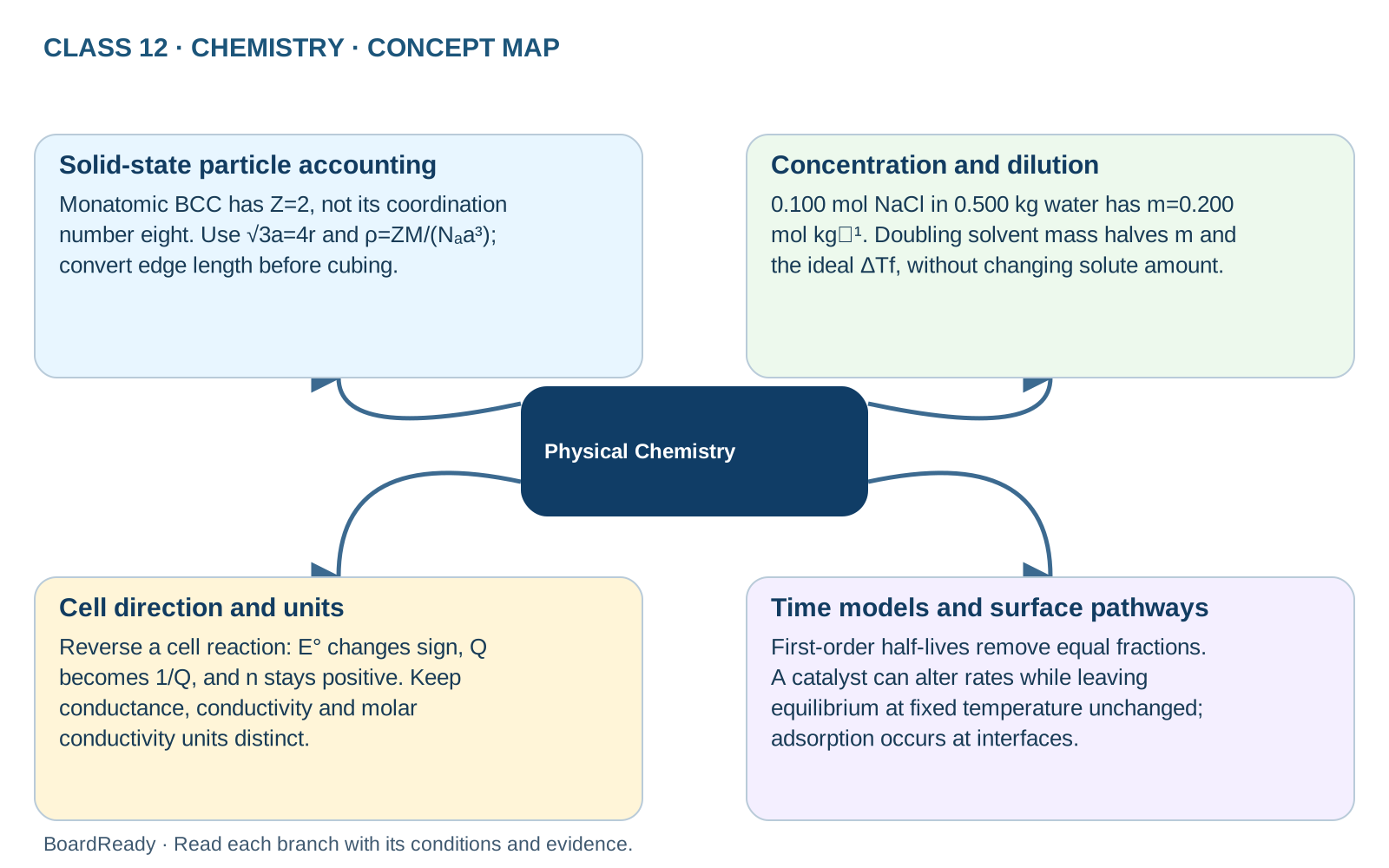
Choose the correct count, denominator, reaction direction and time model across the four lessons. Solid-state particle accounting: Monatomic BCC has Z=2, not its coordination number eight. Use √3a=4r and ρ=ZM/(Nₐa³); convert edge length before cubing. Concentration and dilution: 0.100 mol NaCl in 0.500 kg water has m=0.200 mol kg⁻¹. Doubling solvent mass halves m and the ideal ΔTf, without changing solute amount. Cell direction and units: Reverse a cell reaction: E° changes sign, Q becomes 1/Q, and n stays positive. Keep conductance, conductivity and molar conductivity units distinct. Time models and surface pathways: First-order half-lives remove equal fractions. A catalyst can alter rates while leaving equilibrium at fixed temperature unchanged; adsorption occurs at interfaces.Exam cue: Name the required quantity and conditions before substituting. Keep occupancy separate from neighbours, solvent mass from solution volume, and thermodynamic favourability from rate.
- 1Physical Chemistry -> Solid-state particle accounting: Monatomic BCC has Z=2, not its coordination number eight. Use √3a=4r and ρ=ZM/(Nₐa³); convert edge length before cubing.
- 2Physical Chemistry -> Concentration and dilution: 0.100 mol NaCl in 0.500 kg water has m=0.200 mol kg⁻¹. Doubling solvent mass halves m and the ideal ΔTf, without changing solute amount.
- 3Physical Chemistry -> Cell direction and units: Reverse a cell reaction: E° changes sign, Q becomes 1/Q, and n stays positive. Keep conductance, conductivity and molar conductivity units distinct.
- 4Physical Chemistry -> Time models and surface pathways: First-order half-lives remove equal fractions. A catalyst can alter rates while leaving equilibrium at fixed temperature unchanged; adsorption occurs at interfaces.